We can’t overstate the importance of inspecting rigging equipment. Neglecting this vital process can lead to catastrophic consequences for industrial workers and the overall work environment. The following sections delve deeper into what happens if you don’t inspect rigging equipment and why regular checks are essential.
Deterioration of Equipment Quality
One reason to conduct routine inspections is to monitor deterioration. With continued use, wire rope slings may fray, develop rust, or otherwise weaken. When workers allow equipment to degrade unchecked, it opens doors to problems, such as malfunctions or breaks during lifting or other applications, posing serious safety risks.
Compromised Safety and Increased Accidents
Ensuring workers are safe on the job is paramount. Disregarding the need for assessing rigging gear can jeopardize the overall safety of the work environment. Damaged and deteriorated equipment may suddenly fail, often resulting in accidents such as falling loads, equipment collisions, or snapped cables. These accidents can lead to severe and costly consequences for businesses.
Regulatory Compliance Issues
Depending on the local authority, laws and regulations governing the inspection and maintenance of rigging equipment may vary. However, neglecting the necessary inspections can result in noncompliance with government regulations, leading to fines or legal action against the business.
Decreased Productivity
You could contribute to decreased productivity if you don’t inspect and maintain your rigging equipment. Failing equipment can lead to delays or costly repairs and replacements, affecting productivity and project timelines. In attempting to save time by not inspecting equipment, organizations may ironically lose time—and money.
Tips To Keep Rigging Equipment in Optimal Condition
The importance of inspecting rigging equipment is evident from the potential consequences we discussed above. Establishing and adhering to inspection schedules will help ensure everything remains in optimal condition. Additionally, make sure you train your staff in these processes, such as by teaching how to inspect wire rope slings. Training employees instills better care and awareness about inspecting rigging equipment.
Now that you know what happens if you don’t inspect rigging equipment, you won’t overlook this important process. Doing so places worker safety at risk, increases the likelihood of accidents, and compromises productivity. By implementing regular inspections and maintenance procedures, businesses can ensure enhanced safety and efficient work processes, benefiting their bottom lines.
Today I want to share a review of a Hydration backpack I just got with Amazon. This is a backpack with an removable 2 liter hydration bladder.
I have owned a lot of hydration backpacks overt the years, fat guys that work outside need a lot of water so I have used (and worn out) my share.
This isn’t just a hydration pack, its a full backpack, so its not something I would wear will working the sawmill or working in the garden, this is something I would wear as I took William out “hunting” which means letting him walk in the woods with an empty bb gun.
Personally, I plan on using mine as a “get home bag” in the truck. Something I can pack with some non-perishable food, flashlight, socks and underwear – basic gear I would need for an unplanned overnight stay or if I had to walk home in an emergency.
This pack is well made – especially for a pack that sells for less than $30.00 (with prime shipping included). I like how the blasser tube is insulated and covered in neoprene. I always tend to kink mine up. It has a nice tube routing system to keep it out of the way.
As I said in the video, the stitching is better than I expected for such an inexpensive pack, and the material is pretty heavy duty.
I am pleased with the purchase, and will probably order two more for the other vehicles in the household.
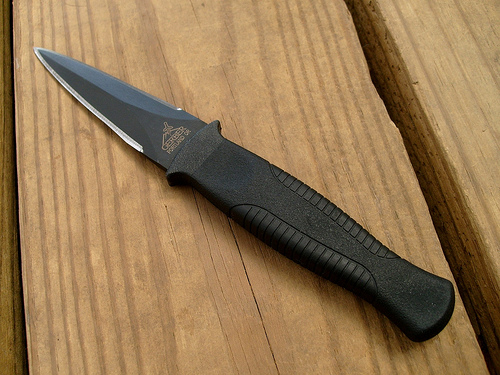
Whether worn for protection or survival in the wilderness, boot knives or shoe knives prove themselves very useful in times of need. If you are thinking of carrying a knife in your boot, here is a simple tutorial on how to wear a boot knife.
What is a Boot Knife?
It is a blade that is made specifically to fit most calf-high boots. It is essentially a small fixed blade knife dagger with a sheath to protect the wearer from accidental cuts. Often this type of knife has a double edge.
Generally, These knives serve the purpose of protection so that you can have a concealed and easy-to-reach weapon to defend yourself with in times of need.
Moreover, boot knives can be used as an additional weapon or tool to bring during camping or hunting. Since they are easy to carry around, these knives can be useful when cutting rope or splitting bark without having to rummage in your hunting backpack.
If you are reading this article, then you probably have interest in carrying a boot knife yourself. Don’t worry, wearing a knife on your bootis very easy. But to be sure that you do it right, here’s how to wear one.
How to Wear a Boot Knife
Boot knives are convenient tools or weapons just like tactical pens. They can be concealed and are easy to carry. If you want to wear a boot knife for yourself, follow these general tips that we have put together for you:
Step One: Select a particular pair of boots
Some hunting boots are equipped with a special straps or built-in compartments for boot knives. If you already have a pair of boots that do have this special compartment, then you are ready to go.
You can try purchasing a new pair of hunting boots with this function. If you do not have boots that have built-in straps for your knives, you can still use regular boots.
However, the ease of use of boot knives will depend on your boots. Generally, boot knives fit well in boots that come up to the low to mid-calf. These types of boots are said to be more comfortable to use with boot knives.
Knives come in all shapes and sizes. However, not all knives can be used as boot knives.
Most boot knives are generally made to fit into a shoe and provide easy access. They also often come with a sheath to keep your feet safe. So, if you don’t already have one, you can try finding the best boot knife available on the market.
The best knives are easy to conceal, generally easy to carry, and provide you with good protection against hostile people or animals.
When you carry a boot knife with you whether you are only out in public our going hunting in the woods, they can provide you with more peace of mind and definitely more security than going without it.
What to Do if You Don’t Have Special Boots
If you don’t have boots that have built-in straps or compartments for boot knives, you can still easily wear a boot knife. How to wear a boot knife with regular boots just requires a string added to the equation.
Generally, a shoelace or thin rope will do. Simply insert your boot knife into the ring of your boots and use the string to secure the handle against your calf. This will prevent it from falling out of your shoe or getting moved around a lot.
On the other hand, if you are feeling a bit more creative, you can try sewing in a sheath for yourself into the boots. To do this, simply take a sheath and sew it into the interior of your boots, obviously where you want your boot knife to be.
Before you go on and wear a boot knife out in public, read up on your locality’s laws about wearing concealed weapons like boot knives.
Wear your boot knife on your dominant side
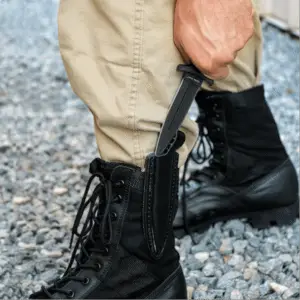
In times when you need to use your boot knife, you can easily access and use it if you place it on your dominant side. For example, if you are right-handed, place your boot knife in your right boot, facing outwards. This will make it much easier for you to access your boot knife.
Make sure the sheath is always secure
The sheath in your boot or the sheath that comes with the boot knife functions to keep your calf safe from any accidental cuts or stabs. Make sure that you always keep the sheath secure. That way you won’t end up with an unnecessary trip to the emergency room.
Choose high-quality equipment
The best tactical pens are considered the best for a reason; and that is because they perform their function well based on pre-set standards. Just like with boot knives and the boots you will be wearing, you need to pick out quality products that would meet your needs. Otherwise, the boots or boot knife may be worn down quicker than you want them to.
A boot knife doesn’t always have to be in your shoe
Boot knives are versatile weapons. Since they are small, they can fit into your glove box, purse, waist, backpack, and basically almost anywhere.
Conclusion
Boot knives are great for serving as self-defense weapons as well as tools in hunting/camping or in emergency situations. Needless to say, they can help you perform tasks easier and defend yourself better due to their ease of access and concealed nature. We hope this article on how to wear a boot knife enlightened you on the necessary steps you need to take before buying your own boot knife.
Got any friends interested in concealed weapons? Share this article with them and let us know what you think in the comments below. Thanks for reading!
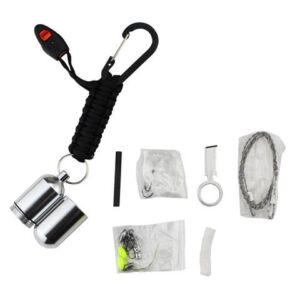
This is a pretty cool little EDC Keychain from Survival Hax. I have reviewed some of there stuff before, and it is perfect for the budget prepper.
The keychain is a simple paracord weave that you can unravel to get a lenght of cord, it has a whistle and an easy to use carabiner to attach it to your gear (my plan is to clip it to the rifle sling of my M6 Scout Survival Rifle.
I really like the contents of the survival kit – the knife is pretty cool and its always nice to have a means to start a fire.
The kit has:
Fishing line
Hooks
Weights
Floaters
Sinkers
Swivels
Eye knife
Cotton tinder
Fire starter rod
Safety pins
Wire saw
With this kit and a nice rifle I could make myself comfortable for an extended stay in the woods. It is a pretty decent set up that is light and small enough to go on all of your outdoor adventures and at under $15.00 its a steal.
I have to say while I did get this keychain for free in order to do a review, I am planning on buying another to go on my the sling of my son’s cricket rifle. (not that he will be outdoors alone, but so he and Daddy can match.
Most cheese was historically made with animal rennet, nowadays, a lot of cheese is made with a mold based rennet.
It is possible to make a vegetarian rennet for those that are either vegetarian, vegan, or who do not have the resources to make animal based rennet.
Today we will make a DIY Vegetable Rennet out of Thistles.
The biggest problem with vegetable rennet is that it becomes bitter in aged cheeses.
This means it should not be used with raw milk, or cheeses like cheddar that need aging to build their sharp taste.
List of plants used to make a vegetable rennet:
Thistle
Fig
Yarrow
Ground ivy
Lady’s Bedstraw,
Nettle
Pineapple
Artichoke
Since Artichokes and Thistles are in the same family, we will show how to make rennet using them, but as a rule of thumb if you crush and extract the sap from the greenery any of the plants above you can use it to thicken milk.
Material:
Thistle flower head when it has turned brown, but harvest it before the plant produces the thistle down, in which case it is too late.
Or
The Purple head of the artichoke before it makes the head
Equipment:
Dehydrator
Pot
Procedure:
Dry the flower heads and pick off the purple stamens.
Boil water and drop thistles into the water and let steep into a thick dark tea.
Strain off the liquid. This is now thistle flower rennet.
The rennet can now be added to warmed milk to curdle it and begin the cheese making process.
Note:
Most cheese recipes using commercial rennet are in the teaspoon/tablespoon amounts, I started using a traditional recipe amount, but ended up using ½ cup of my homemade rennet to get a good result.





 Most cheese was historically made with animal rennet, nowadays, a lot of cheese is made with a mold based rennet.