Tag: knives

  • Cutting Techniques: Four Knife Cuts That You As A Cook Should Know

    Cutting Techniques: Four Knife Cuts That You As A Cook Should Know


    Knife Cutting
    Buy at Amazon

    Working in a kitchen is not a child’s play, and those who work are completely aware of this.

    Cooking in the kitchen could be boring or fun.

    Those who find it boring are not experimenting at all, which is not right because kitchens are like laboratories.

    People should experiment with different food items in order to create something magical.

    One of the important kitchen related tasks is ‘cutting’. If you know how to cut properly, then working in the kitchen will be a lot more interesting for you.

    It is important for you to know how a knife cuts and in how many ways a knife can be used.

    But first, you need to have the best kitchen knife set for cutting vegetables.

    Four Main Cutting Strokes You Should Know:

    1. Slicing
    2. Chopping
    3. Back-slice.
    4. Back-chop.

    You can’t use all these strokes with a single knife, so you need to have a set of different knives that you can use for performing different tasks. For chopping and back-slicing, you can use santoku-style knives, whereas, for slicing and rock-chopping, you can use western-style curved blades.

    If you have no idea regarding using a knife for a particular stroke, then you will get a decent idea by the end of this post.

    The Slice:

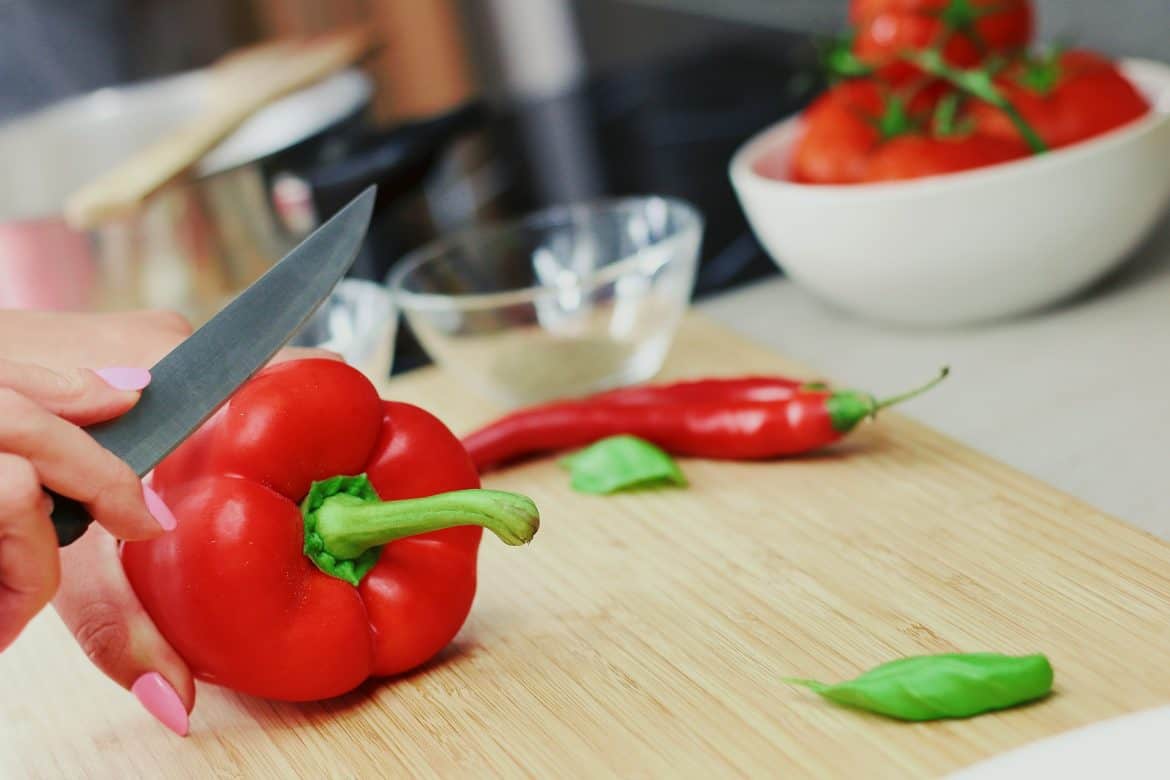
    Slicing is a stroke with which you cut meat and vegetables. You can also cut herbs with a knife that is used for slicing. In order to slice vegetables or meat, you must place them on a solid and stable surface. Then, slice the food item in half followed by holding the food item with your free hand and curling your fingers to a claw. Tuck your knuckles underneath.

    The tip of the knife should be in constant contact with the cutting board with the angle of the knife in an upward direction. Press the knife in the downward and forward direction and use the entire length of the knife to slice food. Repeat the process using a circular motion, but make sure that the tip of the knife remains against the board all the time.

    The Chop:

    If you are looking for a precision while cutting your vegetables or herbs, then the concept of chopping is used. Chopping is same as slicing, but it’s just that chopping is done to style up the vegetables. For chopping, you need a very sharp knife in order to get precise cuts. The surface on which the vegetables are placed needs to be firm and stable. If chopping a long vegetable, then cut it in half. Hold the vegetable with your free hand and curl your fingers to make a claw followed by tucking your knuckles underneath.

    Use your knuckles to hold the flat side of the knife blade and life the knife above cutting board. Press the knife in the downward direction making smooth and even stroke. Move the knife in the forward direction to chop further. Lift the knife after one stroke and repeat.

    The Back-Slice

    This stroke allows you to cut vegetables or herbs into fine, small slices. While slicing herbs, you need to stack leaves and roll them up so as to create a bundle. Hold the bundle tightly with your free hand and curl your fingers into a claw followed by tucking your knuckles underneath.

    After that, place the knife’s tip against the cutting board with the rest of the knife resting against your knuckles. You should hold the knife at a very low angle and pull the knife in the backward direction after each stroke, as this will result in the slicing of the food properly. Don’t move the knife in the downward direction.

    The Rock-Chop

    This stroke is used to finely mince fresh herbs or zest. You don’t have to be that much precise while chopping as you were at the time of back-slicing. Just roughly chop the ingredients using the chop or the slice, then accumulate those into a small pile. Start rocking the knife up and down from one side and regather the ingredients in between. Keep repeating the process until you get finely minced ingredients.

    When accumulating the ingredients, make sure to drag the knife blade at a low angle to the cutting board as dragging the blade perpendicular to the cutting board is going to make the blade dull at a much faster pace.


  • How to Wear a Boot Knife

    How to Wear a Boot Knife


    How to Wear a Boot Knife
    Buy at Amazon

    A boot knife is great for survival and defense.

    Whether worn for protection or survival in the wilderness, boot knives or shoe knives prove themselves very useful in times of need. If you are thinking of carrying a knife in your boot, here is a simple tutorial on how to wear a boot knife.

    What is a Boot Knife?

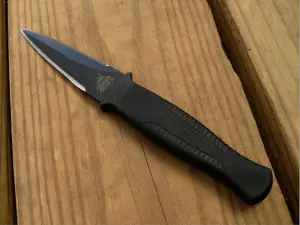
    It is a blade that is made specifically to fit most calf-high boots. It is essentially a small fixed blade knife dagger with a sheath to protect the wearer from accidental cuts.  Often this type of knife has a double edge.

    Generally, These knives serve the purpose of protection so that you can have a concealed and easy-to-reach weapon to defend yourself with in times of need.

    Moreover, boot knives can be used as an additional weapon or tool to bring during camping or hunting. Since they are easy to carry around, these knives can be useful when cutting rope or splitting bark without having to rummage in your hunting backpack.

    If you are reading this article, then you probably have interest in carrying a boot knife yourself. Don’t worry, wearing a knife on your bootis very easy. But to be sure that you do it right, here’s how to wear one.

    How to Wear a Boot Knife

    Boot knives are convenient tools or weapons just like tactical pens. They can be concealed and are easy to carry. If you want to wear a boot knife for yourself, follow these general tips that we have put together for you:

    Step One: Select a particular pair of boots

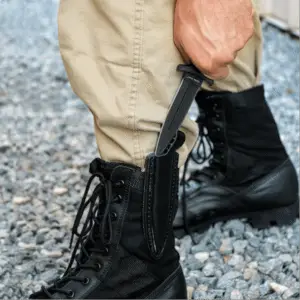
    Some hunting boots are equipped with a special straps or built-in compartments for boot knives.  If you already have a pair of boots that do have this special compartment, then you are ready to go.

    You can try purchasing a new pair of hunting boots with this function.  If you do not have boots that have built-in straps for your knives, you can still use regular boots.

    However, the ease of use of boot knives will depend on your boots.  Generally, boot knives fit well in boots that come up to the low to mid-calf.  These types of boots are said to be more comfortable to use with boot knives.

    Step Two: Pick out your boot knife

    Choose the boot knife that most appeals to you.

    Knives come in all shapes and sizes. However, not all knives can be used as boot knives.

    Most boot knives are generally made to fit into a shoe and provide easy access.  They also often come with a sheath to keep your feet safe. So, if you don’t already have one, you can try finding the best boot knife available on the market.

    The best knives are easy to conceal, generally easy to carry, and provide you with good protection against hostile people or animals.

    When you carry a boot knife with you whether you are only out in public our going hunting in the woods, they can provide you with more peace of mind and definitely more security than going without it.

    What to Do if You Don’t Have Special Boots

    If you don’t have boots that have built-in straps or compartments for boot knives, you can still easily wear a boot knife. How to wear a boot knife with regular boots just requires a string added to the equation.

    Generally, a shoelace or thin rope will do. Simply insert your boot knife into the ring of your boots and use the string to secure the handle against your calf. This will prevent it from falling out of your shoe or getting moved around a lot.

    On the other hand, if you are feeling a bit more creative, you can try sewing in a sheath for yourself into the boots. To do this, simply take a sheath and sew it into the interior of your boots, obviously where you want your boot knife to be.

    Tips on How to Wear a Boot Knife

    Tips on how to wear a boot knife

    1. Check local laws and regulations

    Before you go on and wear a boot knife out in public, read up on your locality’s laws about wearing concealed weapons like boot knives.

    1. Wear your boot knife on your dominant side

    In times when you need to use your boot knife, you can easily access and use it if you place it on your dominant side. For example, if you are right-handed, place your boot knife in your right boot, facing outwards. This will make it much easier for you to access your boot knife.

    1. Make sure the sheath is always secure

    The sheath in your boot or the sheath that comes with the boot knife functions to keep your calf safe from any accidental cuts or stabs. Make sure that you always keep the sheath secure.  That way you won’t end up with an unnecessary trip to the emergency room.

    1. Choose high-quality equipment

    The best tactical pens are considered the best for a reason; and that is because they perform their function well based on pre-set standards. Just like with boot knives and the boots you will be wearing, you need to pick out quality products that would meet your needs. Otherwise, the boots or boot knife may be worn down quicker than you want them to.

    1. A boot knife doesn’t always have to be in your shoe

    Boot knives are versatile weapons. Since they are small, they can fit into your glove box, purse, waist, backpack, and basically almost anywhere.

    Conclusion

    Boot knives are great for serving as self-defense weapons as well as tools in hunting/camping or in emergency situations. Needless to say, they can help you perform tasks easier and defend yourself better due to their ease of access and concealed nature. We hope this article on how to wear a boot knife enlightened you on the necessary steps you need to take before buying your own boot knife.

    Got any friends interested in concealed weapons? Share this article with them and let us know what you think in the comments below. Thanks for reading!


  • Comparing Serrated Vs Straight Edge Knives

    Comparing Serrated Vs Straight Edge Knives

    Serrated Vs Straight Edge I have heard many arguments in regard to the serrated vs straight edge knife dilemma. The truth is that there are pros and cons of both types of knife edges, and the choice of which type is better largely depends on the function you expect it to serve and the situation you will be using it for. For slicing, I would recommend a serrated edge, but for push cutting you should choose a knife with a straight edge.

    Straight Edge Knife Benefits

    The benefits of straight edged knives are many. They are extremely sharp and pointed, which allows for better control and precision when using them. This type of knife is great for push cuts, such as cutting potatoes, chopping wood, shaving and other cutting tasks. Plain edged knives are also much easier to sharpen as compared to serrated ones. The main problem with this type of knife is that it can slip and fly off the object you are attempting to cut or slice. Also, if the edge is too short, you can’t use it for deep cutting. Even though they are easier to sharpen than the serrated blades, very sharp straight knives tend to get duller faster than knives with serrated edges.

    Serrated Edge Knife Benefits

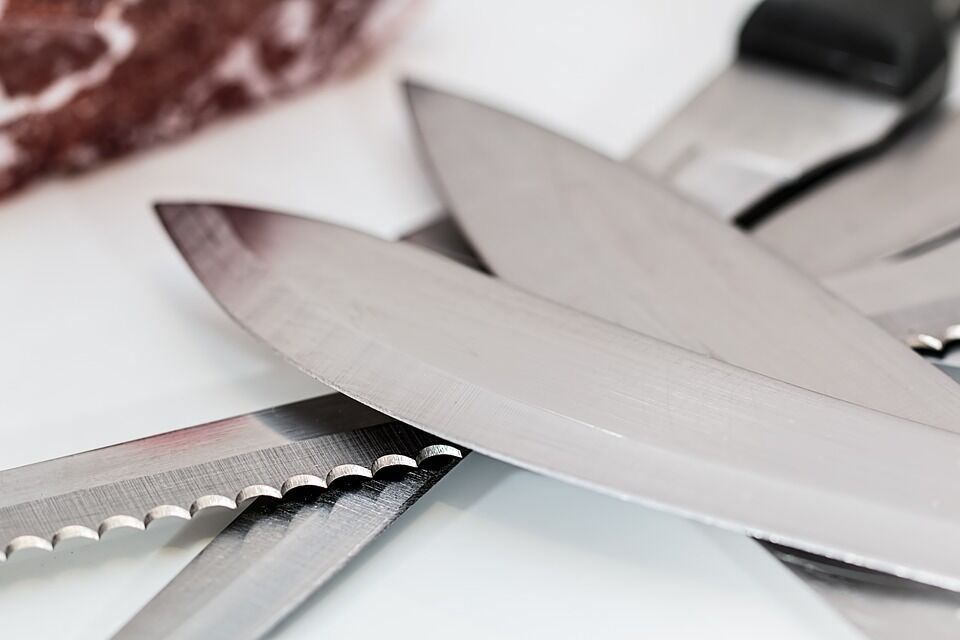
    As for the knives with serrated edges, they are great for slicing things, such as: ropes, bread, tomatoes and others. Its contact area is smaller than that of the straight edge knife which is another benefit, so there is minimum resistance from the material which you cutting. This makes this type of blades perfect for cutting hard and tough items and materials, such as plastic and wood. Also, it is a great choice for cutting in situations when you can’t achieve a stable grip of the object you are cutting. The geometric design of serrated blades allows you to use lateral movements instead of just friction when cutting.

    Partially Serrated Knives:

    There is actually an option to choose a hybrid knife which incorporates the best of straight edged and serrated edged knives. This type of hybrid knife with a straight edge on the top and serrations at the bottom is a multi-functional knife, which is a perfect choice for survival purposes. Choose a hybrid knife with small serrations located in the right place, and you will get a knife with excellent functionality and great speed when inflicting cuts.

     Choose the edge depending upon the intended use:

    If you are looking for a knife for survival and/or self-defense, then you should get a straight edge type. Serrated edges can get caught to the fibers you are cutting and this can limit the depth of the penetration of your cut.

    • Utility

    If you are looking for a good utility knife, then one with a serrated edge is probably the better choice because they are better for slicing soft fruits, vegetables and other foodstuffs.

    Final thoughts:

    The problem with serrated knives is that they are tricky to sharpen and it is difficult to make very smooth and controlled cuts with a blade like that. Make sure that the serrations are not too large, because they will likely tend to get caught up in the material you are cutting. If you choose to use a straight edged knife for utility purposes, you need to make sure that it is sharp enough at all times, for a better performance as well as for safety purposes.

  • How to Baton Wood With a Knife

    How to Baton Wood With a Knife

    How to Baton Wood With a Knife
    Buy at Amazon

    Batoning wood is a common bushcraft/survival technique in which a strong knife.

    The technique can be used to split wood.

    I am showing it here because it is a good technique and useful and is necessary to know to get to my next post – which is basic spoon carving.

    How to Baton Wood

    Equipment:

    • A knife with a strong spine.  My USMC issued Ka-Bar is perfect
    • A baton (I used a stout piece of limb – which is also perfect)
    • Something to split

    Procedure:

    • All you need to do is to set the log to be split up on its cut end so it stands vertically.
    • Next, the knife blade onto the log so that the blade is orientated where you want the split to occur.
    • Hold the knife handle and tap the spine of the blade smartly and evenly with the baton.
    • Finally, the blade will be driven into the log and a split will develop.

    Similarly as using a froe to make shakes (split roofing shingles), you can turn the knife handle to cause the knife to exert pressure into or away from the split to make the split thicker or thinner (this takes some experience).

    Do You Really Need to Baton Wood?

    Bladeforums has an interesting discussion on the situations in which you would actually need to baton wood.


  • Tueller Drill Test

    Tueller Drill Test

    Tueller Drill Test
    Buy at Amazon

    You can’t be a serious practitioner of armed self defense if you don’t understand the legal and moral implications of lethal force.  One tool used to discuss such things is a concept called the Tueller Test.
    Today we are going to talk a little about lethal force and handgun deployment. Over the course of this blog, I have been very clear that in Tennessee before a person is legally justified in using deadly force they have to Believe their life is in immediate danger, and the person against whom they are employing deadly force has the ability to kill or seriously injure them at the present time. Meaning, even though the peta guys that threaten to kill me over the butchering videos may have the ability to kill me, as long as they are expressing the threat over the internet, deadly force is not applicable because they can not kill me right now.

    This is a pretty clear standard, but sometimes we may need a little clarification.

    Back in the early 80’s Salt Lake city had some police officers hurt by knife wielding scumbags, and their Sergeant wanted to know how a cop with a gun was being hurt by a drunk with a knife. Basically the officers were hesitant to draw their firearms because they felt that they were safe as long as the guy with the knife was standing across a room.

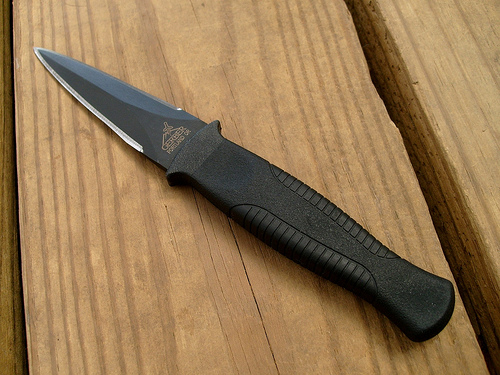
    Sgt. Tueller, than began experimenting to see exactly when a knife fighter was a threat. Obviously to use a knife effectively you have to be in contact range of your target (we are specifically ignoring thrown knives as they are generally tactically ineffective and not the reason for the experiment). However, an officer’s reaction time to an attack, coupled with the attackers speed combine together to allow a criminal to close the distance and strike an officer before the cop can draw his firearm and neutralize the threat.

    Sgt, Tueller had volunteers test to see how fast they could draw their weapons, and other volunteers were timed how far they could run and stab a target. Based upon the good sergeants work, we now know that the typical individual can cover 21 feet and inflict a lethal wound in under 1.5 seconds. We also know that the typical officer takes 1.5 seconds to realize they are being attacked, draw, and fire their pistol.

    Sometimes this is misunderstood – and I would recommend that you read the original article “How Close is too Close” in the 1983 edition of SWAT magazine. You cannot shoot someone with a knife just because they are 21 feet from you and threatening you, but if you do not act, they most likely can hurt you before you can react.

    Basically, if someone has a knife, and they are threatening you with it, you would most likely be justified (unless of course you started the fight) in drawing your firearm and telling the person to “back off”. That way, if they do decide to initiate the attack and charge you, your reactionary gap is lessened, and you can defend yourself.

    In my firearm classes, I normally demonstrate this by getting a volunteer, arm them with a holster and an air-soft pistol. I then explain the two rules of deadly force, and then stand about 21 feet away. I then ask the student for some money, they generally laugh and tell me no. I then pull out a large rubber knife and ask again. Sometime during the resulting conversation I begin moving my 350 pound body toward them as rapidly as possible.

    The results are generally as follows;

    • They stand on one leg, and raise the other towards their chest and try to assume a standing fetal position.
    • They draw their gun, paddle holster still attached and then look at the holstered gun in their hand.
    • They run away.
    • They shoot two rounds into the floor in front of me, or off to my side.

    In ALL the years I have taught this I have been shot twice – once was by a correctional officer that shot me the second I pulled my knife (I didn’t even get a chance to threaten – pulled knife – received welt from plastic bb) he sheepishly said “better judged by 12…” The other was a recently discharged Recon Marine taking an Armed Security Upgrade so he could work security at a nuclear plant. He simply drew and double tapped me right below my sternum with a speed that the majority of us will never practice enough to achieve.

    I am a big believer in this demonstration as it allows an in depth discussion about what actually constitutes a lethal threat, and the proper methods of response.

    However, for the video, I chose a test instead of a demonstration, the way we performed the demonstration in the video below gives an individual a INDICATOR as to whether they are below or above the 1.5 second reaction time average.

    I had one student with a holstered, and loaded firearm stand and face a target. A second student stood shoulder to shoulder with the armed student, but he faced up range. This student held a 1 pound lead weight wrapped in a bandanna. He is will represent the knife armed aggressor.

    At a time of the aggressors choosing, and without warning he will begin to race up range (away from the shooter and his target). When he begins to run, the shooter is told to draw and fire two shots at center mass of the target. He is told that shoot as rapidly as he can, but that he needs to hit the target.

    As soon as the aggressor hears gunfire, he drops the weight – this signifies how far he could stand AWAY from the shooter and still inflict a lethal blow.

    Remember, even if you hit the attacker, he still would have hit you at that distance. This gives the shooter an average of where he is justified to be worried if he is threatened by an attacker holding an impact weapon.

    https://www.youtube.com/watch?v=FL1zX-SrBH0