I bought this $12 adapter from amazon because I needed to figure out how to mount a camera to a scope. The scope I wanted to use immediately was my son’s microscope, but additionally I wanted to be able to put it on a bb gun as well as his .22lr cricket.
I doubt this cheap adapter will work on anything larger than .22lr, However, I have not tried it.
The adapter was too large to fit on my son’s microscope without adaptation. Instead of doing anything permanent, I simply took painter’s tape and wrapped it around the objective tube. This was to increase its diameter.
I went slow so I could keep the tape in the same area. This ensured a smooth wrap and no wrinkles.
It was not hard, and did not take long. However, it was tedious.
The do make commercial adapters and lenses specially for microscopes. Unfortunately, they cost several hundred dollars and are for specific cameras and microscopes.
I wanted something universal and cheap so I had to be okay with a less elegant solution.
Once I had done his scope, I went back to try it on his rifle.
There are three different adjustments, and none are very fine. It takes a minute to get everything lined up and the screws tightened.
Actually, the installation part is a true PITA. Getting the reticle level and lined up on the scope to reduce parallax and allow the bolt to be thrown takes patience.
It also disallows the use of the actual scope when completed, but this setup allows me to watch over his shoulder and see what he sees. With the phone set to video, it also can be used to go back and look at trigger control and follow through.
For the price I am pretty satisfied with the setup, and if he gets into using it I may buy a better setup – something specific to his rifle scope.
When you’re in a sudden SHTF situation, a lot of things will probably go through your mind.
Have you prepared enough? Do you have enough food? Does your family have enough protection? Do you have a plan? Will you survive?
One of the most important things to consider if ever caught in a survival situation is to make sure that you have a dependable firearm.
The right equipment to help aid the firearm, like the best rifle scope is also necessary.
Preferably, you will want a rifle that can take on several different tasks, from hunting for food to self defense for protection.
Though there is no “perfect” survival gun, popular survival rifles out there to have for an SHTF situation is a rimfire rifle or some form of a .22 LR.
Factors to Consider When Choosing The Best Rifle Scope For Survival
Regardless of the type of rifle you choose, there are a lot of factors to consider when choosing the best survival rifle, including:
Ammo costs (ammo costs are usually determined by the caliber size. The bigger the size the more expensive the round.)
Killing power (You want a caliber that kill varmint for food, and potentially bigger game like a deer)
Protection (not considered a ‘man stopper’ but it will get the job done if you need it to)
Long Range (A rifle with range at least up to 100 yards for defense or hunting. A handgun is really only effective within 25 yards)
Cost (depending on your prepper budget, you may want to find a rifle that is at a lower cost but still built well)
Weight and Mobility (You may need a lightweight rifle because you’ll be using it a lot for hunting and potentially for defense)
Equipment (the equipment needs to be top quality and durable to aid your rifle so you can be more efficient)
What’s the most important factor to consider?
The reasons above are ALL important factors when picking a firearm. One of the most important things that will help you in almost every area is by getting a high quality rifle scope
Even if a .22LR wasn’t your top choice, having a rifle scope equipped to your survival rifle may be the difference between food for the next few days or not.
Is a rifle optic really that important?
The answer is a big YES! A rifle scope does so many things for you and makes your survival situation that much easier to bear.
Basically, a scope improves accuracy and allows you to see your target with clarity, even at long distances. Improvements in rifle scope design have allowed even entry level scopes to be high quality.
Let’s explain more reasons why an optic is important for survival:
A rifle scope can allow you to in low light conditions.
Like hunting later in the evening, when it’s dark and way past the time that you would normally be able to see your target with just the iron sights. The same is true at dawn. Sure, you would be able to see with the iron sights, but not as quick nor as early as with a scope.
When you and your family are hungry, and there are no grocery stores open and you need some food, you need to go hunting for it. Using a rifle scope will help with higher precision and accuracy. Your success rate of getting food on the table greatly increases with the proper rifle scope.
Depending on what you are hunting for, you need to be able to have proper shot placement for a clean and fast kill. Having a rifle scope will increase your chances of hitting the proper spot of the animal. This will also increase your chances to actually kill the animal in less shots.
You’ll likely be shooting more varmint than big game, but in either case, the animal will likely run away if you miss after the first shot. This makes precision and accuracy an important factor. Even if you hit the target, but miss your spot, it may still run and even get away.
Long Range Shooting
When hunting for food in survival mode, you’ll likely be shooting animals up to 100 yards away. If you want an accurate and efficient kill, using a scope is essential. A scope can also help those of whose vision is not what it used to be.
Most scopes on the market have a magnification power setting that will allow you to see very clear up to 100 yards, no problem.
Depending on your budget, you can find a scope that can even reach up to 500 yards or more. Keep in mind that you will need to consider which rifle caliber you choose for survival if you are going to shoot targets at long distances of 200 yards or more.
For example, if you got a scope for a .22 LR, 100 yards is about as far as you should go for the highest efficiency, especially if you were going to shoot a deer.
Cost
Scope prices vary greatly. From as low as $30 in some cases all the way up in the thousands of dollars. For survival, you need a high quality scope that is durable, will hold its zero, and is clear with enough focus and power to get the job done when needed.
You just need a rifle scope that does the basics, without any fancy features and add-ons. The extra features on a scope are what drive the price of the optic up dramatically.
The old rule of thumb was that a scope should cost at least half of what your gun did in order to get a quality scope for your rifle. Nowadays, this isn’t the case. You can find a high quality scope for under $200 and even under $100 in some cases.
$100-$200 is a small price to pay for the value you will be getting by adding an optic on your rifle.
How to choose the best rifle scope
Choosing the best rifle scope for an SHTF situation can be difficult, as there are a lot of different factors that determine the best rifle scope.
Assuming that you are limited and need an all around great scope for survival narrows the choices down.
The best way to prepare yourself for an important purchase like this is to learn how a scope works so you can fully understand the mechanics behind it. Below is a quick diagram for your reference.
Now that you have an idea of where things are located and the important terms on an optic, there are a few things to consider when choosing the best optic:
Objective Lens
An objective lens is the front lens of the scope. It gathers the light and its size gives the field of view. The bigger the objective lens, the more light is able to come into the scope allowing for greater clarity and a brighter sight picture. This is especially important if you are hunting at dusk or dawn or in other low-light conditions.
A bigger objective lens also affects the field of view (FOV). The bigger the lens the more ground you will be able to see through the optic. For example, a FOV of 100 yards means that you can see 100 yards from left to right through your scope.
The best objective lens size for a scope in survival mode is probably between 30mm and 40mm. Anything bigger and the scope starts to get too bulky making it hard for mobility and ease of use.
Also, if the objective lens gets too big you will need higher mounts and scope rings in order for the objective lens to avoid touching the gun barrel, making it seem even bulkier when on your rifle. Cost usually goes up as well if you go higher than 40mm.
Optic Style and Tube Size
The best type of scope style you can get for survival is a tube body style. These are more high quality and best all around scopes. The other style to get for your optic is a heads up style or holographic style, but with these scopes there is no variable magnification setting. Instead, you are stuck focusing at a specific magnification (fixed magnification).
30mm tube style size is pretty standard and a great size for a survival situations. Anything bigger will start getting too heavy and bulky and less mobile. Remember that the scope rings you buy must match the diameter of the scope body.
Variable or Fixed Magnification
Magnification power allows the user to adjust the power given. A typical scope you will see is 3-9x40mm. What this means is that at 3x, you will see 3 times larger than the naked eye and at 9x, 9 times larger than the naked eye. 40 refers to a 40mm wide objective lens.
This magnification set is a variable magnification as you can adjust the power between 3x and 9x allowing you to shoot at short and long distances with great focus and clarity.
Some scopes are single or fixed power (1×25 or 4×30 for example) which means no adjustments.
Make sure you choose a variable magnification scope. The best variable magnification scope that you can get is probably the 3-9x40mm. This allows you to shoot at very long distances (up to 500+ yards if needed at the 9x) but still be able to have great clarity and focus at shorter distances (50 to 100 yards with the 3x)
Adjustments
You don’t need anything fancy when it comes to adjustments. All it does is raise the price of the scope by adding unnecessary features. You just need the basics. All you need on your optic for survival is elevation and windage adjustments, parallax adjustments if you choose a higher magnification, and eyepiece focus adjustments capabilities. For windage and elevation, the standard is one click changes impact ¼” at 100 yards.
Reticle
Choosing the right type of reticle is extremely important as well. There are all types of reticles like simple cross hair, mil dots, duplex reticles, BDCs, and many other variations. Some reticles are even illuminated or light up using a battery or ambient light.
Having the correct reticle is extremely important, especially for survival. When choosing the right reticle, you don’t want so much going on that you lose focus on what is really important, which is simply hitting your target.
The best reticle for survival is a Duplex reticle. Manufacturers making variations of the duplex reticle but the concept is the same. It’s a modified crosshair style that features thick bold lines on the outer part of the crosshair for fast target acquisition, but at the center where the two lines cross are much finer lines so you can still see the target you are shooting at. Some duplex reticles have dots that help measure the distance for bullet drop (BDC) at longer distances.
Durability
You need a scope with some necessary features for long term use and durability. Pick a scope with lens coatings. This block different wavelengths and repels water.
Also make sure the scope is seals for air tight use or it will get foggy with moisture and you won’t be able to see through the glass.
Getting high quality mounts and scope rings are also important. Don’t buy cheap scope rings. Cheaper scope rings are more likely to cause the scope to lose its zero from getting loose after long term use.
The downside to scopes
The downside to scopes is that they are more fragile than iron sights. You must keep your iron sights for backup. Redundancy is the name of the game in survival preparations and could save your life in a survival situation.
Though a good quality scope can last a long time, things happen. You could drop your rifle and damage the scope. The scope could for some reason lose its zero after a few hundred rounds. The glass could fog up on a cold day if the seal breaks. These are all things to consider.
Due to some of these unplanned scenarios, having back up scopes is something that a lot of shooters live by. Some hunters have 2 to 3 scopes just for one rifle depending on the situation and perfect as backups in case something happens.
Having easy off mounts can be a solution to increase the life of your rifle scope. You can make sure to take the scope off of the rifle and carry it in your pack when you are traveling. Wrap it with something soft, like blankets or extra clothes for some cushion. Taking it off and on may be a hassle without easy off mounts. What’s important is that the scope should not change zero when it is reattached.
Take good care of your rifle as well. If you drop your rifle with the scope attached, the scope is much more fragile and will break easier and faster than your rifle will.
Choosing the best rifle scope for survival
Find the best rifle scope for survival is tough. With so many factors to consider and so many different scopes to choose from it can be a daunting task. To makes things easier, just be sure to understand the situation you are in when SHTF. You will need a good all around scope that will get the job done. Get a great scope for the money that is still high quality and durable and will help you put food on the table and for protection when trying to survive.
In the end, I recommend a scope that is a 3-9x40mm. This is a great scope for a variety of calibers and environments.
Which size of scope would you recommend for survival? Do you have any specific scopes models that you would recommend for an SHTF situation?
Guest post by Gary Fretwell, rifle optics guru and big game tracker at GoShootGuns.com. He is a 33-year-old die hard hunter from Wyoming. He served in Iraq, loves his Ar-15, and is an Asset Protection Officer and a big game tracker who helps hunters like himself find big game.
Hunting in low or no-light is possible – and it’s easier to catch more – with the right night vision scope. This buyer’s guide will share everything you need.
Are you tired of missing your shots in the dark?
You need the right night vision scope. With proper night vision equipment, you have No Need to Be Afraid of the Dark with the Right Night Vision Scope. You can see a person standing over 200 yards away on a moonless, cloudy night.
Having been around since World War II, night vision technology has really improved and has become much for affordable and accessible for citizens. In the past, night vision devices were only available to military personnel.
Night vision technology allows you to see in those low light conditions when you’re out hunting in the dark. With these devices, you can also magnify things and make them appear closer.
This, of course, is great for hunting.
But with all the devices out there, it can be overwhelming and difficult to know what is best for hunters. Read on to learn everything you need to know about the night vision devices on the market today.
How Night Vision Works
Night vision gives you a clearer picture in low light situations as it works to amplify the existing light. If there is no light in a dark room, night vision cannot work. It needs any kind of light (such as moonlight) to be effective.
In technical terms, the objective lens of a night vision devices takes ambient light through an image intensifier tube. The image intensifier tube applies power to the image tube components and converts the light to electrons. These electrons create thousands of new electrons as they pass through microchannels.
When the electrons exit the microchannels, they collide with a screen coated with phosphors and make the image green. The electrons and phosphors then combine to create photons. At the end, the same image originally seen is created in a way that makes the image appear green as the light is amplified.
Why Choose a Night Vision Scope
Night vision scopes have always been prioritized by developers over other night vision devices because of their applications. Because of that, night vision scopes have advanced better and faster over the decades.
Night vision scope applications are pretty realistic for hunting and shooting range. With a scope, you don’t have to try and spot the game with your binoculars and put them down before getting back to your rifle and shooting. Night vision scopes allow for less errors in hitting your target.
With its relevance to the military, night vision scopes will continue to get better and be the best among night vision devices.
Night Vision Generations
Night vision devices are split into four generations, and it is important when buying to understand the technical aspects of these generations.
1st Generation
The first generation of night vision started in the 1960s. This type is still used today and is inexpensive in comparison to the other three. Since these were made with lower technology, the need the light of a full moon to do any good.
2nd Generation
The second generation night vision scopes go back to the 1970s. Less light is required for a bright image, and there is also an amplification plate that makes the image clearer and bright. These are a bit more expensive that the first generation devices, but you’re paying for better technology and imaging.
3rd Generation
The third generation night scopes have much more advanced technology than the first two. Made with gallium arsenide in the light amplification tube, these devices ensure a brighter, sharper and clearer image. Of course, they’re also much more expensive in comparison to the first two generations.
4th Generation
This generation is still hard for civilians to find. By removing the protective coating on the microchannel plate, the fourth generation optics improved clarity and performance by 20 percent. Yet, these are not capable of lasting as long as the others.
Performance Features to Consider
As a hunter, it’s important to understand that night vision scopes are different than night vision binoculars. Scopes allow you to aim to hit a target rather than merely observe it. Many different factors come into play with determining the quality of scopes.
Clarity
You need to have a good resolution to see and operate in the dark. Good clarity ensures that you can identify your target before shooting.
When checking resolution in night vision scopes, the higher the lines per millimeter (LP/MM) the greater the clarity. 64-72 lp/mm is an excellent resolution feature to shoot for.
Range
You need to know your recognition range when buying a night vision scope. Don’t place as much importance on the total range, because the recognition range is more important.
You’ll often see recognition ranges for full moons, quarter moons, starlight only and overcast ranges because manufacturers often measure range by the amount of ambient natural light. Longer optics tend to be better at producing more light.
Ergonomics
Night vision scopes are similar to regular scopes in that they’ll still weigh the same. A night vision scope with a higher magnification is going to be bigger and heavier. It may be harder to aim and more uncomfortable with a heavy optic.
Keep that in mind if you are into brush hunting or off-hand shooting. For those, you might want to go with a lighter optic.
Durability
Night vision scopes are pricey, so you want to make sure yours is going to stay strong for you for a long time to come. Consider investing in a waterproof optic so the electronics have a lesser chance of being shut down by water. Also, check the amount of recoil the scope is rated for.
Infrared illuminators
Some optics will have an infrared illuminator or at least have the ability to attach one. This is another important factor to consider. With an infrared illuminator, you can shine an infrared light and make the night vision slightly brighter.
When you’re out hunting and it is pitch black outside, an illuminator can certainly come in handy.
There is a lot to consider when buying the right night vision scope, but knowing what to look for will be helpful in the process.
There is another night vision device that is also help hunter to own the night but work pretty difference from night vision scope, it’s thermal scope. If you want to find more, you can check out IOutdoorPursuit for everything you need to know about thermal scopes. Once you find the right product, you’ll be unstoppable in the dark.


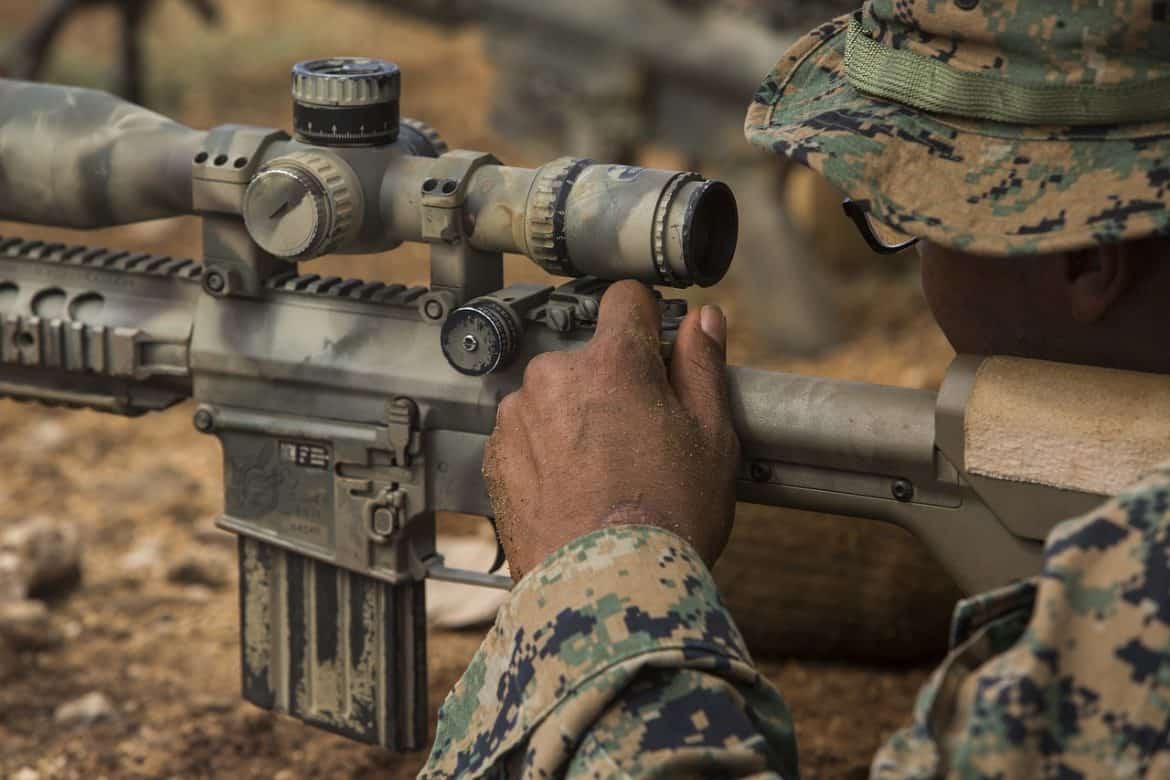

 When you’re in a sudden SHTF situation, a lot of things will probably go through your mind.


 Hunting in low or no-light is possible – and it’s easier to catch more – with the right night vision scope. This buyer’s guide will share everything you need.