Tag: music

  • How to Extract Nitrocellulose from Ping Pong Balls

    How to Extract Nitrocellulose from Ping Pong Balls


    How to Extract Nitrocellulose from Ping Pong Balls
    Buy at Amazon

    Ping pong balls are made of nitrocellulose, I am sure that many would like to create non-nitro based balls, but industry has never been able to create ping ping balls with the same bounce as the nitrocellulose based balls.

    Now, while extracting nitrocellulose from ping pong balls is easy, the nitrocellulose is adulterated with camphor.  This turns the explosive potential of the balls down while making them more plastic.

    Now, while I like to extract the nitrocellulose to make nitrocellulose lacquer for making e-matches (electric initiators) for my rockets, woodworkers have long used nitrocellulose lacquer for fine furniture and musical instruments.

    How to Make Nitrocellulose Lacquer:

    • Ping pong balls, acetone, scissors, a wooden stir stick, and a glass jar with a tight fitting lid.
    • Simply cut up 4 or 5 balls, and cover them with twice as much acetone as you need to cover the balls.
    • Let sit overnight.

    Additionally, I like to add in some double based (smokeless) gunpowder that I save from my mistakes while reloading.  It gives me a hotter flame for igniting my model rockets.  Additionally, it allows me to waste less powder when reloading.

    So now you know how to extract nitrocellulose from Ping Pong Balls.  Its easier than editing actually, I just realized that for some time this said nitroglycerine.  I guess that was a Freudian slip, because it would be really neat to have a easy way to get nitroglycerin, but it would probably be illegal, and I would not want to break the law.

  • Kitchen DIY: Cooking Pizza in a Pie Iron

    Kitchen DIY: Cooking Pizza in a Pie Iron

    Kitchen DIY: Cooking Pizza in a Pie Iron
    Buy at Amazon

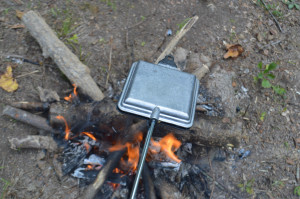
    Pie IronThis is a fun “camping” recipe that kids of vast range of ages can make themselves with little adult supervision.
    While being a easy favorite for kids, cooking with a pie iron is infinitely adaptable you can use it with eggs and sausage to make a breakfast meal, eat it for lunch or dinner, use pizza dough, biscuit dough, or sliced bread – or even use apples and sugar to make it a dessert.

    As with many of my projects, once you learn the technique you can take it and make it your own special recipe.

    Material:

    • 2 pieces of bread per pizza
    • Butter
    • Pizza Sauce
    • Shredded Cheese
    • Dried Italian Seasoning (Oregano)
    • Garlic Salt
    • Topping
      • pepperoni, pre-cooked sausage, hamburger, whatever you want – or just make a cheese pizza

    Tools:

    • Pie iron
      • Unless it’s just for one or two people, one pie iron is never enough.
    • Campfire gloves
    • Knife
    • Spatula

    Procedure:

    1. Heavily butter one side of each piece of bread
      • For biscuit dough and pizza crust dough – heavily butter the pie iron instead.
      • Pull biscuit dough until it is flattened out to fit the inside of the pie iron – use 1 biscuit for each side
      • For pizza crust: butter the pie iron, lay the dough inside one half of the pie iron, with an equal portion hanging over, then fold the back over the toppings before closing pie iron
    1. Generously spread pizza sauce on one side of bread/biscuit/dough – to suit your taste.
    2. Add shredded cheese, and toppings if used.
    3. Spread pizza sauce on the other piece of bread/biscuit, or flap of pizza crust.
    4. Season with oregano and garlic salt, then close pie iron.
    5. For pizza crust – fold flap in, over cheese and toppings first.
    6. Trim off any excess ingredients sticking out of the closed iron.
    1. Cook over medium coals, or low campfire flame.
      • For bread pizza: after three minutes, rotate pie iron and cook for four more minutes.
      • For biscuit and pizza dough: rotate after four minutes, and cook for five more minutes
      • These are only approximate times. Use your own judgment and keep in mind that pie irons can be closed and re-cooked if you want more them more well-done, but you cannot “un burn” pizza.
    2. Open pie irons and use a spatula to remove pizza.

    CAUTION! Pie irons will be very hot. AND, the insides of the just-cooked pizza will be very hot! Do not let young kids try to handle them until they have time to cool – which should only be a few minutes.

  • How to Retread a Lawnmower Tire

    How to Retread a Lawnmower Tire


    DIY: Retreading Lawnmower a Tire
    Buy at Amazon

    I saw this on a youtube video a few years ago and kept it in mind for the day I needed it.

    Basically both the originator of this idea and I both used an old bike tire to cheaply retread a lawnmower tire.

    This takes a little work, but it is much cheaper than buying new tires.

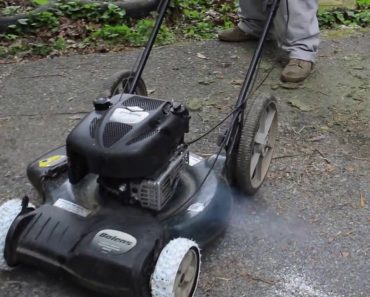
    I simply measured around the circumference of my lawnmower drive wheels and cut the tire into a strip long enough to wrap around the tire.

    Next, I cleaned the tire really well and glued the bike tire to the plastic lawnmower tire.

    I additionally used self driving sheet metal screws to both hold the bicycle tire to the lawnmower wheel, but also to create “spikes”

    Once the glue tried I tried it out, and my retreaded tires really made a difference in how my third hand lawnmower worked.

    This Saved Me Money on a “Garbage” Mower

    A co-worker thought he was taking advantage of me by selling me this lawnmower for $20.

    However, a simple carb cleaning, blade sharpening, and tire retreading made this lawnmower work like a champ.  The so called “garbage” mower worked well for me for 2 years.

    Once again, a little ingenuity  and the willingness to try new things has made my life a little easier.  Especially when my yard is very hilly and slick.

    This may not be a go to trick for retreading a lawnmower tire, but it was cheap and worked well.

    I am sure I will do this again.  This is the kind of money saving DIY project that I love to share on my site.

    However, I kinda also want to get a reel mower.  I like how they are quiet, even if they may take a little more work.

  • How to Modify a TDI Knife with Tek Lok

    How to Modify a TDI Knife with Tek Lok


    Modifying A TDI Knife with Tek Lok
    Buy at Amazon

    I love my Ka-Bar TDI, it is very ergonomic and designed to be used weak-handed to help defend against gun grab situations.  I modified it to make it easy to carry.  Additionally, if you need a smaller EDC knife, I have a post on how to conceal the Ka Bar LDK.

    The problem with the TDI is not the knife.  It is an extremely well designed knife, with a nice Kydex sheath.  In order to keep it inexpensive something had to give.

    What “gave” was the belt clip.

    I am not the only person to hate the mounting system on this knife.  Ka-Bar even sells replacement mounting hardware to replace the belt clip when it invariably bends.

    This post shows how I went about modifying a TDI knife with Tek Lok

    The belt clip is just a thin piece of tempered steel.  If the knife ever catches on something the loop will open up.  Unfortunately, it will never bend back to hold the knife tightly again.

    This problem with an otherwise fantastic knife has created a small cottage industry of custom sheathes for this knife.

    However, I like the sheath that came with it so I decided to see if I could engineer a solution.

    Introducing Tek Lok

    Modifying A TDI Knife with Tek Lok
    Buy at Amazon

    I happened to have some Tek-Lok belt clips in the shop from an earlier project. It seemed like a perfect fit.  A good knife mounted to a well thought out belt clip.

    Its such a good idea that I was not the only person to think of if, however, most people used the large Tek-Loks, and drilled holes through their sheaths to mount the two together.

    Looking at the sheath, the mount, and the two sizes of Tek-Loks, I saw that a small one fits flush against the old belt clip.

    I cut off the belt clip from the mounting bracket and used my grinder to smooth everything out.

    I then used a punch to mark out the 4 mounting holes.

    After drilling out the 4 holes, I mounted the tek-lok to the mounting bracket made from the old belt clip, and then mounted the bracket to the sheath.

    It does stick out a little more (about 1/8 inch) than the old system, but it is MUCH more secure.

    One thing I need to mention is that the small tek-lok was not designed for use on wide belts like my 5.11 rigger belt so it does not “slide on”, I have to force the belt into the tek-lok, and then clamp it shut.

    While this is not that difficult, it is an extra step when getting dressed. On the other hand, this makes the knife fixed and it does not move on your belt.

    I am very pleased with this project, and it is one that I use quite a bit.

  • PRN Episode #27 Interview Survival Punk

    PRN Episode #27 Interview Survival Punk

    Survival Punk is a blog created by James Burnette. James takes a rational, creative approach to self-reliance, applying a punk DIY ethic to survivalism without any of the fear mongering or “tinfoil hattery” found in some other areas of the survivalist movement.

    The Survival Punk blog covers a huge range of his projects, both success and failures along with a healthy bit of myth busting. He also provides a ton of dirt cheap creative solutions to common prepping needs and does a great job of integrating the paleo lifestyle with the prepping lifestyle.

    I respect Survival Punk, and we partnered together on Dual Homestead where he lived on my land and worked to homestead it.  Unfortunately his anarchist tendencies and my need for plans clashed to the point where it just did not work.  However, I still think he knows a lot and he has a great website.

    The show is scheduled for Monday at 10pm central time at this link.

    If you cannot listen on Monday, you can always download the podcast for listening at your own leisure.

    Listen to internet radio with Preparedness Radio Network on BlogTalkRadio