
Potting Meat

Food Storage: How to Start Potting Meat

Food Storage: Potting Meat
Buy at Amazon

Potting Meat is a “if everything else fails” method.

Potting meat is an ancient food storage technique that worked for thousands of years.

Unfortunately, the USDA recommends against this process because of the potential for botulism.

Personally, I would rather pressure can meat – it is a much safer, however crocking meat is still used as a culinary practice still used in France.

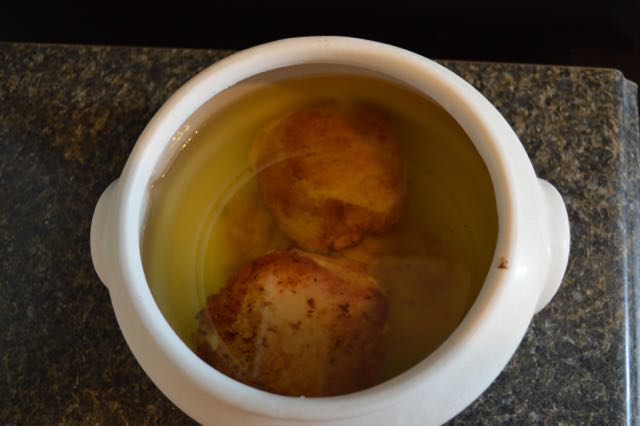
Potting (also known as crocking) meat is a process where meat is fully cooked and then placed in a sterile ceramic container and then covered with melted fat.

When the fat solidifies, the crock is covered and stored in a cool and dry location.
Potting Meat
Potting Meat

The idea is that the cooking destroys any bacteria in the meat and the fat covering seals the meat so that no new contamination can occur.

This is similar in mechanism to canning, except that the fat can insulate and botulism spores that were not destroyed – thereby locking them in the perfect conditions to grow.

Ingredients

  • Meat (I used pork chops – which are perfect for crocking, but sausage, or bacon also work well)
  • Fat (amount depends on the size of the crock and the amount of the meat, but I used a medium sized container of Manteca (pork fat).

Equipment:

  • Skillet
  • Pot
  • Ceramic Crock
  • Tongs

Procedure:

  • Thoroughly clean a ceramic crock with very hot soapy water. Items cannot be sterile until they are clean.
  • Sterilize by pouring boiling water into the crock. Hold the hot water in the crock until just before filling with meat.
  • While water is boiling, melt some fat in a clean pot so you have enough grease to cover all the meat completely
  • Completely cook meat until the internal temperature to be above 250ºF.
  • Empty the water from the crock and wipe the crock dry with a clean towel.
  • Place hot grease in the bottom of the crock so that the bottom of the crock is covered.
  • Place a layer of cooked meat into the crock.
  • Cover with hot grease.
  • Add another layer of meat and repeat adding hot grease.
  • When the crock is full or you run out of meat, cover the meat with at least 2 to 3 inches of hot grease.
  • Cover the crock with a plate or a cloth. Store the crock in a cool, dry place.
  • When you want to eat your pork chops, remove the meat carefully. Place in a frying pan and re-fry and heat thoroughly. You want the internal temperature of the meat to reach at least 250ºF again.

Yield:

Variable

Notes:

I believe that crocked meat is superior in flavor and taste to canned sausage patties or links, but with all things stored – you must trust your nose and other senses when cooking stored food. If anything seems off, discard the food.

Stories and Recipes of the Great Depression of the 1930’s, Volume IV

Book Review: Stories and Recipes of the Great Depression of the 1930's, Volume IV
Buy at Amazon

Reading about how others survived hardship is a great way to prepare to survive. The book Stories And Recipes of the Great Depression os a great resource to do just that.

This book is a continuing historical documentation of the impact the Depression Era had in the homes of those who struggled to keep their families together, body and soul. It contains previously untold candid personal stories in the unique dialect of that time.

As a prepper I think it is a must read.  Knowing other people survived hard times is a great way to realize you also can survive.  Knowing HOW they did it makes it easier.

Like the video above from the popular YouTube channel “Cooking with Clara” this book also includes more of the original comfort-food recipes that sustained them.

This book is part of a larger series, and it is worth collecting and reading them all.  I especially enjoyed the recipes of the Great Depression, but the stories were pretty cool also.  From a historical perspective it documents our American history.  More to the point it may help us survive the next Greater Depression.

That is important because in the 1930’s preparedness skills were commonplace.  That is not the case now.

Gear Review: Quick Barrel Gun Magnet

Quick Barrel Gun Magnet
Buy at Amazon

I got a chance to try out this $19.99 covert gun storage option and had to get a couple of my own.

This is a really great product for keeping a firearm at the ready but not out in the open.

I like the Quick Barrel Gun Magnet because it is a strong Neodymium magnet that allows flexible options.

It holds 25 pounds, so my Glock 19 is held up very securely, but it will also work with my Remington 870 or an AR.

I was worried that it would scratch the finish on my gun, but it has a protective coating and I have not noticed any scratches so far.  Now, a 100% money back guarantee doesn’t help a marred up safe queen, so I am not going to use it on any of my mall ninja guns, but for a working gun like a Glock, this works like a charm.

I did receive the model shown on the video in exchange for an honest review.  However, this gun magnet works so well I use them quite a bit.  I really like the idea.

How to Build a Paracord Carabineer Spool

How to Build a Paracord Carabineer Spool


Paracord Carabineer Spool
Buy at Amazon

This Paracord Carabineer Spool project that is very useful for outdoors-men of all types. It is just an way of carrying cordage in a way that is easily accessible.
If you can get a section of PVC pipe around a carabiner (more on this latter) and zigzag spool 550 or tethering cord around it, you can use the carabiner to attach to the outside of your pack when not needed, and either spool from your pack, or detach it and use from the spool. Heck, you could even hold the free end, and use the carabiner spool as a weight to throw over a tree for things like hanging bear bags.

The oval and D shaped carabiners will have the most room for carrying more Paracord. The diameter of the carabiner tubing should be slightly smaller than the interior spool diameter to reduce wobble and to give you more room for spooled cord.

Cut a 3” section of ½” PVC pipe to use as a spool. Since this won’t fit directly on the carabiner, you need to cut a slit down the center of the pipe. (you can either separate the two halves, or only cut through one side and pry it open and force it around )

If you cut the PVC into two parts you will need to use duct tape to secure them back together.

No matter which way you use, ensure the pipe then spins freely around the carabiner.

Next wrapped as much paracord on the spool as you can, (probably about 40 feet worth), and still be able to open the carabiner gate just enough to slip it over nylon webbing/PALS/MOLLE attachment point on your bag, backpack, strap, or vest.

New 750 Cord

FYI, the paracord listed above is a new paracord product.  I plan on doing a full review, but it is not regular 550 cord, this is 750 cord – meaning it it’s breaking strength is 750 pounds, and like the original cord it has the smaller inner strands that you can scavenge to make things like fishing cord – its mil-spec 550 cord – but better….

I hope this is useful to you, and I look forward to hear how you use this project.

Book Review: Meditations on Violence

Meditations on Violence

Book Review: Meditations on Violence
Buy at Amazon

Experienced martial artist and veteran correction officer Sgt. Rory Miller distills what he has learned from jailhouse brawls, tactical operations and ambushes to explore the differences between martial arts and the subject martial arts were designed to deal with: Violence.

In Meditations on Violence Sgt. Miller introduces the myths, metaphors and expectations that most martial artists have about what they will ultimately learn in their dojo. This is then compared with the complexity of the reality of violence. Complexity is one of the recurring themes throughout this work.

Section Two examines how to think critically about violence, how to evaluate sources of knowledge and clearly explains the concepts of strategy and tactics.

Sections Three and Four focus on the dynamics of violence itself and the predators who perpetuate it. Drawing on hundreds of encounters and thousands of hours spent with criminals Sgt. Miller explains the types of violence; how, where, when and why it develops; the effects of adrenaline; how criminals think, and even the effects of drugs and altered states of consciousness in a fight.

Section Five centers on training for violence, and adapting your present training methods to that reality. It discusses the pros and cons of modern and ancient martial arts training and gives a unique insight into early Japanese kata as a military training method.

Section Six is all about how to make self-defense work. Miller examines how to look at defense in a broader context, and how to overcome some of your own subconscious resistance to meeting violence with violence.

The last section deals with the aftermath?the cost of surviving sudden violence or violent environments, how it can change you for good or bad. It gives advice for supervisors and even for instructors on how to help a student/survivor. You’ll even learn a bit about enlightenment.

Finalist – 2008 Book of the Year Award by Foreword Magazine

Finalist – 2008 USA Best Book Award

A Comparison of Martial Arts Training & Real-World Violence