
Firearm Suppressor Basics

Firearm Suppressor Basics
Buy at Amazon

There are many misconceptions about firearm suppressors or “silencers”.  That is a shame since suppressor information is very easy to find if you just look.  This post is about firearm suppressor basics.

Suppressors were one of the items that became regulated under the National Firearms Act (NFA) of 1934. This means that suppressors are classified as a restricted “firearm” and each has its own serial number.  As with all gungs the Bureau of Alcohol, Tobacco, Firearms and Explosives (BATFE) is tasked with enforcing suppressor regulations in accordance with federal law.

While the federal government regulates suppressors, they do not outlaw them.  That is a state action.  Therefore, depending on what state you live in, you may or may not be able to own a suppressor.  Since a basic tenet of common law is that everything is legal until it is made illegal, I will give a list of what states currently outlaw suppressor ownership (if the state allows ownership, but narrowly defines who can own one to special classes of people I consider that to be outlawing them).

Suppressors are outlawed in:

  • California
  • Delaware
  • Hawaii
  • Iowa
  • Illinois
  • Massachusetts
  • Minnesota
  • New Jersey
  • New York
  • Rhode Island
  • Vermont
  • Washington (You may own, but you cannot use it on a gun).

If you live in any other state, and are willing to navigate the NFA regulations then you can own a suppressor.

As the video below shows, a suppressor does not “silence” a firearm.  It just makes it quieter, which makes shooting safer and reduces friction with the neighbors.  I think it makes shooting more fun.  They are the most effective plash suppressor you can buy, and if shooting from the prone, they reduce dust being raised by the muzzle blast.

Suppressors reduce audible sound to differing degrees.  They do this by diffusing the gas released at the muzzle so that it is diffused.  It is kind of like opening a champagne bottle or popping a balloon.  High pressure and a single opening make a loud noise, but slower release of the pressure, or multiple openings make a much quieter sound.  A suppressor has openings that are 20-30 times the size of the muzzle which allows the gas to be released in a more controlled manner.

Of course, the reduction in sound only occurs at the muzzle.  If you are shooting a semi-automatic some sound will escape at ejection port, the mechanics of the gun (such as bolt cycling) are not dampened, and projectiles still make noise on their way to the target.   If you are shooting supersonic ammunition, no matter how well you suppress the gun, the bullet will create a loud “crack” when it breaks the sound barrier.

Some suppressors are designed to be used “wet”.  This means the shooter has the can fill the baffle cavities inside the suppressor with water or possibly manufacturer specified oil.  While not very practical in the field, firing a wet suppressor will provide more sound suppression than when dry.  If you have a “wet” suppressor, follow the manufacturer’s instructions carefully.  Water does not compress, and improper suppressor filling can break your expensive gun into large non-repairable pieces.

Suppressor sound reduction is usually expressed as sound pressure level (SPL). SPL is measured in decibels.  Most manufacturers publish SPL either as a reduction from the unsuppressed sound or as a total decibel measurement.   Differences in the type of sound meter used, microphone placement, calibration, weighting scales, ground surface and many other factors can change the actual reading, so take the numbers with a grain of salt and use it more as a comparison rather than as a firm number.

There are several different popular suppressor designs, and a quick patent search will show you hundreds more.  But for the recreational shooter, I feel the material a suppressor is made of is more important.  Due to the high heat of the muzzle gas, and how it circulates inside the suppressor body suppressors are exposed to a lot of wear.

Suppressors are rated for with semi-auto or full auto fire based upon the alloys used to create them. All things being equal, a fully auto rated suppressor is made of materials that better handle heat.  If you use a full auto rated suppressor on a semi-auto you will enjoy a much longer suppressor life.  However, if you reverse this and put a semi-auto suppressor on a full auto firearm you could melt the darn thing.

As with gun in general, suppressors are tools, and all tools have specific purposes and problems.

When you attach a suppressor to a gun, you will increase the pressure inside the barrel.  This is especially true in centerfire, semi-auto rifles.   A semi-automatic that relies on gas to drive the operating system only needs a specific amount of that gas to function properly.   The excess gas normally expands out of the barrel’s muzzle after the bullet leaves the gun.   When using a suppressor, some of that gas remains in the bore, expanding back into the gas system, which can result in malfunctions.

Any semi-auto rifle intended for regular sound suppressor attachment will benefit from an adjustable gas block or regulator. Many of the piston-driven semi-automatics have adjustable gas systems that allow for some modulation of pressure.  By contrast, AR type rifles are typically nonadjustable.  Just you need to find out what type of ammo your particular gun likes to eat the best; it is a good idea to several ammunition types to see what your gun works with best when it is wearing a suppressor.

The world of suppressors is much like the world of guns, how deep you want to delve into the specifics depends on your personality and end goals.  But they are useful and useful tools.  It’s a shame that, in the United States, suppressors have such a negative stigma and are seen as tools of the hit man.  In many European countries, suppressors are seen as polite hunting accessories.  It was really interesting, as the guys helping me in the suppressor video came down for a class, and brought several suppressed guns.  While running the class at the indoor range we got lots of looks from the other shooters.  I could just feel the side conversations wondering who we were and what we were doing.  But, when offered the chance to shoot the guns, there were a lot of very excited guys enjoying shooting such neat tools.

The guy in the video is Terry Hassler from http://www.rockinguns.com/.  He is a very knowledgeable guy, as well a registered firearm manufacturer.  I want to thank him for helping me put this information out to you, and if you are in the Cookeville or Crossville TN area and are looking for a gun, you ought to check them out.
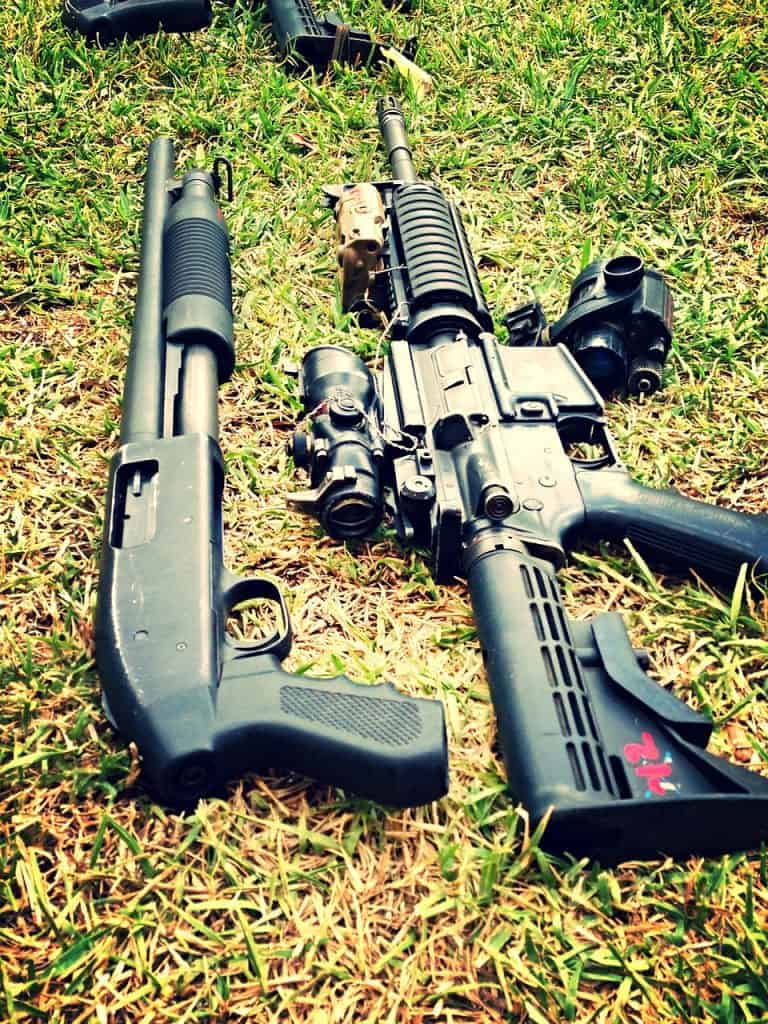
Functional And Affordable Upgrades For Your Shotgun

Functional And Affordable Upgrades For Your Shotgun
Buy at Amazon

The following guest post shows some affordable upgrades for your shotgun.

Everyone likes to have accessories and modify their shotgun in one way or another. Some people will never modify or upgrade the gun, but those same people will buy a precisely fit sling or unique protective case. Those that do upgrade will add any number of add-ons available depending on how they plan to use it. When thinking or accessories or upgrades the best thing to do is to look at all of the products made available for the most popular shotgun in the world, the Remington 870, and then see if that same item is made for the shotgun you own.

The reason you look to the 870 is because the 870 has more accessories and upgrades available than any other shotgun. This way you are not limited to imagining items available for your specific shotgun, you are seeing the entire breadth of available products and then if it is not made for your shotgun, you can have it made.

Some of the accessories available for any gun include shell holders, slings, cases, and cleaning kits. They also include special storage and safety locks. Upgrades include everything from magazine extensions through adding a full length tactical rail. For example, if you are making your 870 into a tactical shotgun, there are hundreds of Remington 870 tactical accessories and upgrades available. Muzzle brakes, pistol grips, other stock configurations, attached shell holders, and even red or green dot sights. You can even upgrade an 870 to do everything you would expect from a Saiga 12 drum combat shotgun, save for the semi automatic action, if that is your goal and at the same time enjoy the widespread availability and affordability of parts. This is the same for any shotgun, not just the 870.

If combat or tactical use is not your goal then while looking at the options for the 870, you can see that any upgrade or option imaginable has already been thought of and put to use. Different barrel lengths, replacement fore-ends, heat shields, unique stocks, and mounted flashlights are common upgrades that make any shotgun unique.

The important thing to remember is that you can get accessories or upgrades all shotguns. Some will have to be custom made or ordered if you do not own an 870, but looking at what is available for the 870 opens your mind to the possibilities

How to Build a Survival Squirrel Snare

How to Build a Survival Squirrel Snare


Survival Squirrel Snare
Buy at Amazon

Trapping gives much more meat per unit of energy expended than hunting does. Using snares is a passive activity; you can set several traps in multiple locations and check them once a day leaving you free to do other useful work while still gathering food. Hunting requires active attention; you cannot stalk a deer while tending a signal fire.

Snares are also relatively lightweight, cheap, and easy to pack.

Today’s video shows how to make and use a Survival Squirrel Snare using bailing wire or 20 gauge galvanized steel wire.

A roll of this wire is about $5.00, makes several dozen snares, is relatively lightweight, compact, and can be used for other survival uses.

How to Build a Survival Squirrel Snare

  • Cut a length of wire approximately 18 inches long (length depends on how you are going to attach it).
  • Make a small loop at one end of the wire
  • Run the wire back over itself and through the small twisted loop you made. This makes a larger loop “lasso”. The wire should run freely through the small twisted loop you made at the end of the wire. The loop this forms should be approximately the diameter of a coke can.
  • With the small twisted loop at approximately the “10 o’clock” position, run the free end of your wire snare down and attach it to your squirrel run.
  • The squirrel run is a straight stick relatively free of limbs and 6-10 feet long. It should be about the same thickness as a man’s wrist. This branch has one end resting on the ground, and the other resting on the trunk of a tree. It should intersect the ground at an approximate 45 degree angle.

Is possible you want to pick a tree that has a squirrel nest in it, or is an oak tree – that way squirrels will be naturally drawn to it.

The idea is that a squirrel will choose to run up the stick to get to the tree trunk, as that is easier for them to get on the tree than jumping the 90 degree angle to move from ground to trunk.

If a squirrel runs up the pole they will have to move through the snare. They won’t mind as it looks flexible and they can see through it. As they enter the snare, their head goes in, but their body cannot. The snare tightens around them as they run; they hit the end of the wire and fall off the branch in their struggle.

Be Careful How You Place the Snare

If the wire is placed appropriately, they will hang themselves and will not be able to climb back up.

You can place multiple snares on a single run, just make sure they are all high enough that a snared squirrel will hang free and not touch the ground, and that there is enough space that they cannot touch each other.

I do not know where you live, but obviously you need to look at the game laws in your area. In my state of Tennessee this is illegal, and not something I would do as long as I can go to the grocery for food. But in the event nothing else was available and I would starve otherwise, there are many squirrels in my subdivision (or nearby parks) and they could mean the difference between going hungry or not.

The Trapper’s Bible: Traps, Snares & Pathguards

Dakota Line’s Versatile Snares 1 Dozen

How to Replace the Recoil Spring in a Walther P22


Walther P22 Recoil Spring Replacement
Buy at Amazon

This post is about why I had to do some work on my Walther P22 Recoil Spring.  It also shows how to replace the recoil spring in a Walther P22

I am a huge believer in repetition for any physical skill. If you want to be good at something you have to put in the time practicing perfectly. I have heard that to be a master of something you need to spend at least 10,000 hours practicing the skill. Dry firing can be a big part of that time block, but you will HAVE to get out to the range.

I haven’t won the lottery, or invented the next widget so spending 10,000 hours of range time is cost prohibitive shooting centerfire ammunition, but I since still have to practice I decided to try a .22 rimfire.

After hearing a lot of good things about the Walther I bought myself a P22. I was told that it needed a long break in period using premium ammunition and repeated cleanings in order for it to function properly. However, even after firing 500 premium rounds through the gun, I was still having malfunctions with the gun.

A weak grip is notorious for causing malfunctions, so I spent time looking into that.

Not the problem.

Early model P22s had a magazine problem.  The newer (marked with a “b”) magazines have a 1inch slit cut into them for the rimmed cases to stack.  This is also not the problem

Several internet forums state that bulk green box federal rounds are not powerful enough to cycle the gun…

BINGO

In my search for cheap shooting those 550 round Wal-Mart boxes of ammo is pretty much all I shoot in my .22lr caliber firearms.

Now, that doesn’t help me much – higher velocity .22 ammo is getting expensive – I want to shoot as cheaply as possible so I kept searching for a solution. A gunsmith friend of mine told me that they changed out the recoil spring in later designs of the Walther P22. The new recoil spring is lighter.

I had also read on the interwebz that “cutting a couple turns off the spring” helped – Now I am not willing to butcher my gun by cutting springs – but I am willing to try a new factory spring. I called Walther customer service, explained my problem, and asked if I could purchase a spring. They were very helpful and sent me a new spring at no charge.

The one I received was a bit longer than the original, but it had a lot more “give”.
I replaced the Walther P22 Recoil Spring and as the video shows I was able to rapidly fire the firearm without any malfunctions. I don’t have enough rounds through the gun with the new spring to say the problem is fixed, but I am quite pleased with Walther working with me fix the problem.

As a value added tip for following along this far I am going to tell you an easier way to reassembly the slide back on the frame without using the little tool they send you:

How to Replace the Recoil Spring in a Walther P22

  • Put the recoil guide rod in your palm(non-dominant hand), and insert the spring over it.
  • Compress the spring, once compressed use your thumb and forefinger to grasp the recoil spring and rod. Several inches of rod should extend past your fingertips.
  • With your dominant hand pick up the slide and push the guide rod through the hole in the slide.
  • Grasp the end of the rod with your dominant hand. Once you have a firm grasp (otherwise you will shoot the rod across the room), let go with your non-dominant hand.
  • The Compressed spring should be inside the slide, with your hand holding on to the majority of the guide rod sticking outside the muzzle end of the slide.
  • Guide the slide onto the frame, with the barrel inserted into the slide and slightly extended outside of the slide.
  • Slowly, and carefully release tension on the guide rod so that it retreats back into the slide. Once the guide rod is touching the frame wiggle it until it slides into the detent inside the frame.
  • Let go of the guide rod
  • Rack the slide
  • Press the slide down over the ears in the frame
  • Ride the slide forward
  • Push the locking bar back up
  • Function check the pistol

It takes some practice to do it this way, but it is a much simpler way of doing things.

Understanding the USE of Handguns for Self-Defense

The Gun Digest Book of .22 Rimfire: Rifles ·Pistols ·Ammunition

Who gave you the right to take my Guns from me


Who gave you the right?
Buy at Amazon

I love Steve Lee and the Lees, my son grew up (and still grows up) dancing to “I like guns”, but while the Lees have some whimsical songs that are fun to listen to, they also have some very powerful ideals behind their music.

Steve Lee gives a monologue before the music video to “Who gave you the right to take my Guns from me”

His words give valuable insight into the core reason behind the assault on our Gun rights.

If we allow ourselves to have this crucial civil liberty stolen from us then we will have no ability to protect our other rights.

There is already a concerted effort to erode our other fundamental rights in t he name of state security.

It should be so self evident that we have a right to defend ourselves, our families, our country, and our way of life that gun control should never even be thought off – but as the video shows this is not the case because most people choose to love by feelings.

For me I ask – Who gave you the right to try to take my rights?  I know I did not agree to this.