
Setting a Power Pole


Setting a Power Pole
Buy at Amazon

Once the meter box was removed I went to the electric company to see about getting a power pole.

Originally I was simply going to take the entire meter box and weather head off the trailer and bolt it to a shed.   However, after talking to the utility and the shed builder we were convinced that getting a stand alone pole and getting it set up with an RV hookup was the cheapest and simplest method.

Basically I was told that if we installed the meter box on the shed the inspector would require the shed meet residential code.  While that is no problem the $3000 fee was completely out of the budget.

This means we had to set a power pole.

As you can see in the video I had nothing to do with actually setting the pole.  I watched the power company come in with their power pole setting equipment.

They came, drilled the hole, set the pole, and left in about 30 minutes.

Since a 30 foot utility pole needs to be set in the ground 5 feet.  If I had to hand dig to the proper power pole setting depth in the rocky limestone soil I would have been at it for much longer than that.

The utility used a truck with a hydraulic auger.  After asking which of us would be climbing the pole (he kept looking at me) the equipment operator dug in a couple extra feet setting the pole at 8 feet deep.  He said it would give extra stability when we had to climb the pole.

They also used a hydraulic tamper.  It acted like a pogo stick. The tamper compacted the dirt as they filled the hole. It stabilized the power pole and made me feel really good realizing how much work the power company saved us.

Since now the pole was only 22 ft high we could get away with not setting a guy wire – which greatly improves the land use around the pole.

Beware of Code

Code says the power line has to be at least 12 feet above ground and 18 ft over a road – so setting our weather head 20+ feet in the air gives us a good measure of safety.

In later articles, we will discuss the RV box in more detail, but the idea is to have an outlet we can use to power things like a cement mixer without using a generator, and not having the issues with setting up a temporary pole.

Plus, once the trailer is demolished we can plug a tiny house or an RV right into the pole.

In case you are keeping score it cost us $280 for the 30 ft pole and install.  Which I feel is a bargain.  Plus another $300 in various inspection fees, deposit and hook up fees to the electric company.

As of this point beside the land purchase of $7500.  The almost $600 we paid to the electric company is our only large expense.

If you have never seen a utility pole being installed, you can watch the video. I found it very exciting.  It is one large step toward my future Independence.

How to Remove a Meter Box from a Burnt Trailer


How to Remove a Meter Box
Buy at Amazon

The electric service to the property was attached to the trailer.  Unfortunately, the mobile home is in that awkward stage of too burnt to fix, but not burnt enough to be easy to demolished.  So we need electricity to run power tools so that we are not trying to tear the building down for the next decade.

Since our budget was demolished by buying the land I have to be frugal and reuse as many building materials from the trailer as possible.

That means we have to begin our electric install by removing a meter box from the side of the trailer.  We will rewire it and replace a meter box on a future power pole.

Removing the Box

We start by using the flimsy aluminum ladder I got from the Doomsday Prepper film crew.  It did not hold my weight very well.  But we were able to remove the shingles and flashing from around the weather head.

Since the trailer is slated to be demolished, there was no worry about the home.  This meant the rood was chopped and slashed until the electric conduit was free.

Next, the clamps holding the conduit to the trailer wads removed.  Then ground wires and other connections to the home were disconnected.

The previous owners scrapped a lot of copper (which is what lead to the trailer being unfit for repair).  This meant there was not a lot to disconnect.

The meter box itself was held on by 3 strong lag bolts.

Those wires were connected inside the meter box by some highly torqued Allen head bolts.  Since I lacked the equipment to remove those bolts the guts of the meter box were removed.  Then I could take out the connectors easier.

Take Pictures

Since I had to reuse the meter box and not just remove it, care was taken to replace the screws back in the holes they were removed from.  I also took a lot of video and pictures so we could go back and see what the original set up looked like.  That meant we could recreate it when we replaced the meter box on the new pole.

Once everything was disconnected, the screws holding the meter box to the trailer were removed.  Then the the box and pole were lowered to the ground.

The conduit was heavy galvanized steel, and it was 12 feet tall.  Therefore, it was not the easiest job for the day.

Make sure you are ready for the weight before you remove that last screw.

Watch the Video

The video below shows most of the process – but since the process of removing a meter box, rewiring it, and eventually replacing a meter box is pretty dynamic sometimes we forgot to set the camera up so we may have missed a couple steps – but we have shown enough that anyone with enough common sense to be able to safely remove a meter box should easily get the idea.

As you can see from the above video, removing a meter box is not hard, but the next part of setting the new power pole was a little harder and took some tools.

How to Build with Tires

Homesteading - Building with Tires Part
Click the Picture to Purchase

I have been interested in sustainable building for decades.  I remember sitting in the birthing area of the USS Saipan in the mid 1990’s reading about Earthships and missile silo homes.

For some reason I am very taken by the concept of rammed earth tires as a building material.  However, the idea of pounding 3 or 4 four wheelbarrows of dirt into a tire over the course of 45 minutes multiplied by the 1000-15000 tires per house keeps the idea in the back of mind instead in front of me under a swinging sledgehammer.

Tire Building Does Not Have to Be Earthships

However, the technology has evolved and I recently found two sites that gave me some ideas that bring the concept back into focus.  The first is a place called Blue Rock Station.  They sell a self-published little booklet about how to use tires as a foundation for other building designs.  This allows you to build with tires without solely building with tires.  Their concept allows the use of less cement, and is perfect for incorporating into cob, cordwood, or straw bale construction.

The second is a place called Touch The Earth Ranch who have found and published a college paper on the use of tire construction where one sidewall was removed.  This allows a tire to be filled in 10 minutes instead of 40-45.  While the tests show it is less strong, it is still plenty strong enough for most purposes.

My plan at the land is to incorporate both ideas to all building with tires that is faster and more flexible than typical earthships.  Basically I want to build several small sheds with waist high tire walls.  With framing made of earthbag, cordwood, strawbale, and any other methods I want to try.

I figure there public place someone can go to experience the multiple types of alternative construction.  So I should be the first.

The plan is to turn each building into a specific workshop; electrical, metalworking, woodworking, storage, and firearms related.  Then connect them all with one roof so we have several dog-trots to allow for open air classrooms and working space.

I have no experience building with tires, but that’s not going to stop me as I experiment and learn.


How to Prevent Your Macbook Cord From Breaking

How to Prevent Your Macbook Cord From Breaking


How to Prevent Your Macbook Cord From Breaking
Buy at Amazon

Apple products have an almost cult-like following – and in most cases the quality control is deserving of admiration.
However there is one area that apple gets wrong.  The power cords fail on a regular basis, cost nearly $100 each, and apple holds a patent on them and zealously guards it so when the cord breaks you have to spend $100 to keep the $2000 macbook from turning into a brick.

The best way to keep from having to buy new cords is by preventing your macbook cord from breaking.

I prevent cord breakage by supporting wear points on the ends

I have tried tape, but it does not last long, so this time I started using sugru to build up the area around the magnetic connector.  This prevents macbook cord breakage by keeping the cord from flexing at its most vulnerable spot.

Watch the video above to see exactly how the sugru was used.  In this post I used a homemade sugru style silicone to make these modifications, but real sugru would work just as good (if not better).  I used the homemade kind because it was cheaper and I did not have to order it.

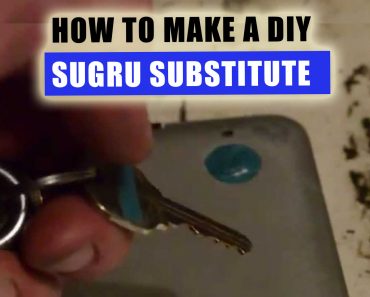
How to Make a DIY Sugru Substitute

How to Make a DIY Sugru Substitute


Sugru Substitute for DIYer's
Buy at Amazon


Sugru is a DIYer’s dream – it is a simple and relatively inexpensive material that can be molded into almost any shape.  If you have never played with it you can buy 8 packs for $22.00

It is no wonder that something so useful and simple has lots of people hacking it, so I wanted to show an easy DIY Sugru substitute

What is Sugru

Basically Sugru is silicone caulk.  As silicone reacts with the moisture in the air it cures (and gives off acetic acid which explains the vinegar smell).

If you mix the silicone with something that holds moisture (like cornstarch) you can make your own Sugru substitute.

This mixture allows the silicone to set up faster, is stiffer, and since the cornstarch moderates the silicone its less sticky so its easier to mold.

You can mix the silicone/corn starch in ratios from 5/1 to 1/2 the more starch the faster the setup.

I later used this sugru substitute to fix a problem with my Macbook’s power cord.  It kept fraying and causing me to spend $100 bucks on the proprietary cords.