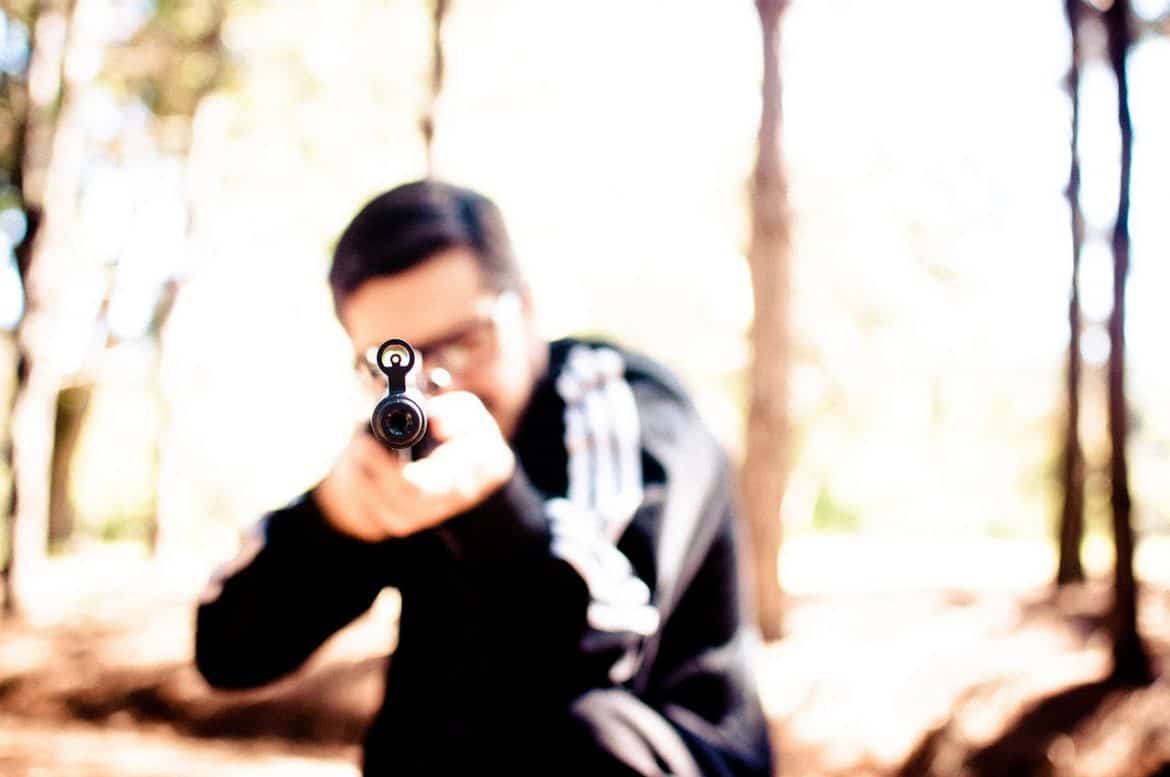
Its exceptional accuracy, controllability, and wide array of accessories make the carbine an essential tool for modern warriors.
In this exclusive video from Paladin Press, WARTAC founder Rich Nance and WARTAC instructor Aaron Peachman teach combat techniques and tactics designed to help you deploy the carbine under real-world conditions.
In Advanced Carbine Tactics they first they reveal the mindset needed to master the fundamentals of marksmanship, proper weapon handling and shooting positions, malfunction clearing and reloads, and shooting in low-light situations.
Then step-by-step instruction in one- and two-man room entry and the use of cover provide you with the advanced tools needed to maximize the carbine’s advantages in a firefight.
Ultimately, the will to win and expert training in sound combat tactics are what help you prevail in any violent encounter. This video delivers both.
Rich Nance is a black belt martial artist, with over 25 years of experience. Nance has been a police officer for 13 years and a SWAT team member for six years. He is a firearms instructor, patrol rifle instructor, less-lethal munitions instructor and his department’s lead defensive tactics instructor. In 2004 Nance and David Hallford founded WARTAC CQC , a company specializing in tactical training for law enforcement and military personnel. Aaron Peachman has 20 years of experience in the martial arts. He has been a police officer for four years and is a member of his department’s SWAT team. Aaron is an instructor for WARTAC CQC.
While I am not a perfect shooter, I do consistently score in the mid/high 90% range on my targets in just about any situation. I was not always able to do this. As a matter of fact, when I was in the service I shot much worse. Each time I went to the pistol range the range staff would ask “Hey corporal, are you looking at the front sight post.” To which I would always answer in the affirmative and then crunch the trigger and send a bullet hurtling in the general direction of the target.
I could not understand why I qualified sharpshooter (that’s the mid-range qualification in the USMC). I had a good stance, controlled my breathing, and did not jerk the trigger. I felt like my sights were aligned when I pulled the trigger, and I felt I understood the fundamentals of accurate shooting.
It was not until I had my End of Active Service and joined the TN Department of Correction that I found out my problem. I was not focusing on the front sight post.
It interesting to me that the way I found out the solution to my problem was by following a principle of education that I feel is overlooked. It is a well-known secret that people learn by doing, and they retain more information from performing an act than they do by hearing a description of the act. Well if someone TEACHES this act they retain (and understand) more about whatever they are trying to learn.
I guess its mentally organizing the information to pass it on to another that enhances retention and understanding, or it may be thinking deeper to prepare for a student’s questions. I don’t know. But I do know that after I attended my very first firearm instructor course something clicked. I went to the range and thought about all the same things I normally think about. This time though, when I got to the sight alignment piece, I played back the “script” on how the eye focuses and decided I would concentrate and fully focus on the front sight post of my handgun.
It was interesting, now that I decided to ACTUALLY perform the actions I half-stepped through all those years; the front sight came into a sharp focus. I could make out the striations on the ramp, the colored strip on the revolver front sight; the slight imperfection where it was dropped once (followed it)…
Amazingly, with this one change my group went from chest sized to saucer sized. I became a convert and began to throw out all my old understanding and try to explore why the fundamentals are what they are as well as to concentrate on performing them consistently perfect each time.
We have a tendency as shooters to want to look at the target; I understand it – that’s where we see the results of our shooting. However, the target is a reflection of the past – the round we just fired. It does not help us with the round we are preparing to fire. Focusing on the target has the effect of causing us to aim over our sights and shoot low.
Because our eyes can only focus on one distance at a time, if we focus on the target we will not be able to even see our rear sight. If we focus on the rear sight we won’t be aware of our target.
A compromise is to clearly focus on the front sight. Because it is between the rear sight and the target, if we focus on the midpoint we will have the ability to see them both (albeit a little blurry). This will allow you to place the clear front sight centered on the blurred target and centered inside the blurred rear sight.
If you try it, and truly focus on the sight until you can make out all the fine detail on your front sight post I promise that you will see a difference in your shooting. I do not promise that it will be comfortable or easy the first time. You will have to practice.
If you want a clearer explanation, or you want to hear me ramble on about Massad Ayoob’s front sight study from his book “The Ayoob Files” by all means watch the video above.
I also have a great video from a former Navy SEAL that I use with a lot of my students below.
It seems like drawing your handgun from a holster is a pretty intuitive action that does not need a lot of comment, and in reality it pretty much is, however, there is a difference between doing something and doing something smoothly, effectively, and quickly. Today we are going to talk about the fundamentals of the Three Step Handgun Draw of your firearm as well as the reasons behind the methodology.
Anytime you are learning a new skill it is best to break it into the component parts and master each step individually. Don’t try to add speed until you master the entire sequence. A common saying in the firearm training/Law Enforcement field is “slow is smooth, smooth is fast”. If you try to run before you can walk all you are going to do is bust your head.
The first step is simple – Establish the grip on the gun. Before you attempt to draw the firearm from the holster you need to have a firm grip on it. I have seen an officer try to reload his firearm in a simunitions training exercise get in a hurry drawing his magazine and end up flipping it out and across the room because he did not have a strong grip. The other piece of the first step is to get your non shooting hand out of the way of your draw stroke. The best place for your hand is on your stomach – that keeps it from being muzzled by your handgun as it is being drawn. Obviously if you are in a contact distance fight, then the best place for your non shooting hand is your opponent’s throat, but all things being equal the stomach is a good default area.
Practice step one over and over, bring your dominant hand to the gun and the non-dominant hand to stomach (both actions simultaneously). Once you can do this without thinking, learn step two.
Step two is to rock the gun up and out of the holster, your upper arm should be close to your body, your elbow bent, and your dominant forearm and pistol perpendicular to your body. This is pretty close to the idea of the “speed rock” as you can fire from this position if needed, (and your non-shooting hand is safely away so as not to get shot). I have seen several teach the “speed rock” draw for contact distance shooting by having the shooter (defender) lean back at the waist as they draw. Personally I dislike the backwards lean as it brings you off balance, and with a charging or aggressive attacker could end up with you being knocked down.
Step three involves bringing the gun forward and upwards to establish your shooting stance. At the same time you are bringing the gun forward, you are also bringing your support hand to the gun also. It is very important to move the support hand TO the gun by moving it faster and coming in from behind rather than moving the gun to the support hand. You do not want to muzzle your non-nominant hand (especially in the stress of a lethal force incident).
Once you master each step separately, combine them and practice them in sequence. In the beginning it helps to call out each step and perform them separately, but consequtively. Step 1, Step 2 Step 3…. Gradually speeding up and dropping the act of calling out each step. A tip I used was that each morning as I donned my holster was to perform three perfect 3 step draws slowly with an emphasis on perfect technique. Each night as I doffed the holster, I repeated the action with here more perfect draws.
Over time you will notice an ease of action that only comes through practice.
One last tip is that while there are several incidents that may cause for a “quick draw”, there are no reasons to perform a “quick reholster”. ALWAYS HOLSTER RELUCTANTLY, after scanning for threats and ensuring there is no longer a need for your handgun to be out.
When teaching firearms I spend the majority of the time teaching fundamentals, it’s not the coolest thing to talk about to work on but it’s the most effective at getting tight groups on target, and that is the coolest thing when it comes to range time. Fundamentals are the basics because they work. Once you master them you can adapt them to the situation. Today we are going to illustrate this by talking about shooting stance and one of the reasons progressive trainers’ teach shooters to utilize an aggressive shooting stance.
When watching shooters on the range I see a lot of them try to shoot while leaning backward. I make it a point to ask them why. Invariably there is a pause as they try to find a reason why they are leaning backward. It’s unstable, uncomfortable, and it puts a strain on your breathing. No shooters ever say this, but I suspect it’s a psychological thing. I think the new shooter leans back while firing to distance themselves from recoil, and lacking training to resolve this, it becomes ingrained in the shooter’s style.
Since the majority of firearm students are adult learners, and one of the main principles of adult education is that adults have to contrast what they know with what they are being taught simply telling the shooter to stand up straight may work in the short time, but it will not be internalized as a true change.
What you need to do is show the adult shooter why we want them to lean toward the target. We do this by SHOWING them the benefits. A good way of doing this is to have two lines of shooters (or just two if your training with a range buddy) face each other. Have the two groups face toward each other, and have one group act as shooters and have them lean backward and put their hands together to form the deadly finger gun. The other group is the aggressors; I normally have them raise an invisible knife over their head. Explain to the group that when the aggressors step forward to stab the shooters, the shooters should take a step back and fire their finger.
As an instructor the looks on the students faces is priceless. The shooters pause a second as they realize they have to shift their weight to step backwards because their center of gravity is over their heels. Next the shooters lean forward and the exercise is repeated. This time the students are able to easily move and shoot.
So now the student actually sees that there is a reason they stand in a certain position. By leaning aggressively toward the target the shooter is much more stable, and having a balanced stance allows them to move easily if needed. It also gives a psychological boost that is much more positive than leaning backward as if afraid of the gun.
Stay tuned for more fundamentals, and we will eventually get around to talking about the reasons for all the other shooting fundamentals…