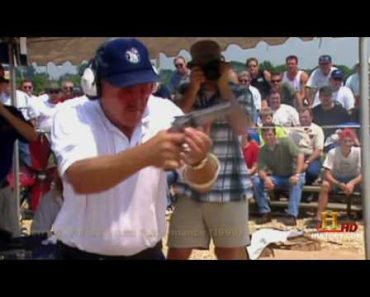
Jerry Miculek is the living embodiment of revolver shooting. He is the fastest revolver shot alive, and besides being fast, he is accurate.
The video shared is older, but it shows Jerry Miculek setting a world record for fast revolver shooting.
I have recently heard he set another speed record at the 2017 Shot Show, but I have not found any video of it yet.
I really enjoy Jerry Miculek’s videos, he is humble, talented, and enjoys both shooting and sharing shooting with others.
There is no doubt that he has information to share when it comes to shooting. Not just revolvers, even though that is his specialty, but all manner of guns.
What he does with a shoulder fired Barrett .50 is nothing short of amazing.
While I am not a perfect shooter, I do consistently score in the mid/high 90% range on my targets in just about any situation. I was not always able to do this. As a matter of fact, when I was in the service I shot much worse. Each time I went to the pistol range the range staff would ask “Hey corporal, are you looking at the front sight post.” To which I would always answer in the affirmative and then crunch the trigger and send a bullet hurtling in the general direction of the target.
I could not understand why I qualified sharpshooter (that’s the mid-range qualification in the USMC). I had a good stance, controlled my breathing, and did not jerk the trigger. I felt like my sights were aligned when I pulled the trigger, and I felt I understood the fundamentals of accurate shooting.
It was not until I had my End of Active Service and joined the TN Department of Correction that I found out my problem. I was not focusing on the front sight post.
It interesting to me that the way I found out the solution to my problem was by following a principle of education that I feel is overlooked. It is a well-known secret that people learn by doing, and they retain more information from performing an act than they do by hearing a description of the act. Well if someone TEACHES this act they retain (and understand) more about whatever they are trying to learn.
I guess its mentally organizing the information to pass it on to another that enhances retention and understanding, or it may be thinking deeper to prepare for a student’s questions. I don’t know. But I do know that after I attended my very first firearm instructor course something clicked. I went to the range and thought about all the same things I normally think about. This time though, when I got to the sight alignment piece, I played back the “script” on how the eye focuses and decided I would concentrate and fully focus on the front sight post of my handgun.
It was interesting, now that I decided to ACTUALLY perform the actions I half-stepped through all those years; the front sight came into a sharp focus. I could make out the striations on the ramp, the colored strip on the revolver front sight; the slight imperfection where it was dropped once (followed it)…
Amazingly, with this one change my group went from chest sized to saucer sized. I became a convert and began to throw out all my old understanding and try to explore why the fundamentals are what they are as well as to concentrate on performing them consistently perfect each time.
We have a tendency as shooters to want to look at the target; I understand it – that’s where we see the results of our shooting. However, the target is a reflection of the past – the round we just fired. It does not help us with the round we are preparing to fire. Focusing on the target has the effect of causing us to aim over our sights and shoot low.
Because our eyes can only focus on one distance at a time, if we focus on the target we will not be able to even see our rear sight. If we focus on the rear sight we won’t be aware of our target.
A compromise is to clearly focus on the front sight. Because it is between the rear sight and the target, if we focus on the midpoint we will have the ability to see them both (albeit a little blurry). This will allow you to place the clear front sight centered on the blurred target and centered inside the blurred rear sight.
If you try it, and truly focus on the sight until you can make out all the fine detail on your front sight post I promise that you will see a difference in your shooting. I do not promise that it will be comfortable or easy the first time. You will have to practice.
If you want a clearer explanation, or you want to hear me ramble on about Massad Ayoob’s front sight study from his book “The Ayoob Files” by all means watch the video above.
I also have a great video from a former Navy SEAL that I use with a lot of my students below.
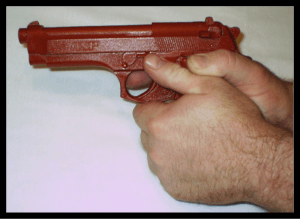
Today’s article on handgun grip demonstration starts with a demonstration that I do in my firearm classes to show the students WHY we grip the handgun as high as we can. Normally I do this with a plastic red gun, but since we were on the range with a double checked handgun I decided just to throw the concept out to you.
Simple physics is comes into play. As the slide recoils to the rear of the gun the closer you can get your hand to the line of force the less “bucking” you are going to feel. The lower your hand is on the grip panels of the gun, the more leverage the recoil will be able to exert.
If you think of your hand as a fulcrum (pivot point), the grip as the lever, and the slide recoiling as the force it is readily apparent that the longer the lever is from the fulcrum to the force, the less energy is needed to do work. In this case the work is the gun bucking in your hand.
The bigger the kid on the seesaw, the closer they need to be to the fulcrum to keep from tossing their little cousin into low earth orbit. The larger the recoil impulse of a firearm the more important it is for you to choke up on the grip the right way.
When teaching firearms I spend the majority of the time teaching fundamentals, it’s not the coolest thing to talk about to work on but it’s the most effective at getting tight groups on target, and that is the coolest thing when it comes to range time. Fundamentals are the basics because they work. Once you master them you can adapt them to the situation. Today we are going to illustrate this by talking about shooting stance and one of the reasons progressive trainers’ teach shooters to utilize an aggressive shooting stance.
When watching shooters on the range I see a lot of them try to shoot while leaning backward. I make it a point to ask them why. Invariably there is a pause as they try to find a reason why they are leaning backward. It’s unstable, uncomfortable, and it puts a strain on your breathing. No shooters ever say this, but I suspect it’s a psychological thing. I think the new shooter leans back while firing to distance themselves from recoil, and lacking training to resolve this, it becomes ingrained in the shooter’s style.
Since the majority of firearm students are adult learners, and one of the main principles of adult education is that adults have to contrast what they know with what they are being taught simply telling the shooter to stand up straight may work in the short time, but it will not be internalized as a true change.
What you need to do is show the adult shooter why we want them to lean toward the target. We do this by SHOWING them the benefits. A good way of doing this is to have two lines of shooters (or just two if your training with a range buddy) face each other. Have the two groups face toward each other, and have one group act as shooters and have them lean backward and put their hands together to form the deadly finger gun. The other group is the aggressors; I normally have them raise an invisible knife over their head. Explain to the group that when the aggressors step forward to stab the shooters, the shooters should take a step back and fire their finger.
As an instructor the looks on the students faces is priceless. The shooters pause a second as they realize they have to shift their weight to step backwards because their center of gravity is over their heels. Next the shooters lean forward and the exercise is repeated. This time the students are able to easily move and shoot.
So now the student actually sees that there is a reason they stand in a certain position. By leaning aggressively toward the target the shooter is much more stable, and having a balanced stance allows them to move easily if needed. It also gives a psychological boost that is much more positive than leaning backward as if afraid of the gun.
Stay tuned for more fundamentals, and we will eventually get around to talking about the reasons for all the other shooting fundamentals…