


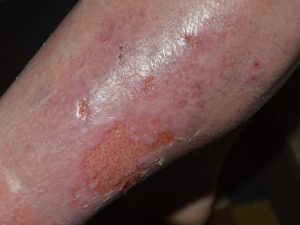
 A little over three weeks ago I burned both my legs. Now, as a semi-competent experimenter, I have burned myself a bunch of times. However, this was serious. I burned both legs, from just below the knee to the top of my foot almost 360 degrees. The burns were deep second degree burns with a few thrid degree spots thrown in.
I was messing around with gas, an I knew better. So when my wife said not to light the fire, I told her to be quiet. That was pride talking when I knew I should not do what I was about to do.
Pride comes before a fall, and when the gas vapor ignited, the temperature was low enough it did not “whoosh”, but the wind changed and basically, I was engulfed. Now it was only for a second, and did not do a lot of damage, but the fresh bug spray on my legs started to burn, which did me a lot of damage.
So now I have a reason to post about treating severe burns. I am not a doctor, but as I said before I am familiar with burn injuries.
This Article is not About Basic Burn Treatment
We all know to cool a burn and not to apply grease or butter. This post is about supplies and the daily aftercare.
When I first was burned, it did not immediately hurt, I played it off for a few minutes, so as not to “embarrass” myself around my wife. However, once the pain hit, it was horrible. For a old fat guy, I have a pretty high pain tolerance. I have been pepper sprayed and tased enough to have lost count. I have broken a leg, and have sliced crushed, and otherwise injured myself much more than the common man.
Not to put to fine a point on it, after standing in a cool shower for several hours to both cool the burn and control the pain, I had to lay in the bed and cry. The pain was as close to unbearable as anything I have ever felt. My wife wanted me to go to the Emergency Room, but I was afraid they would admit me, and I had the last class of my graduate certificate on Monday. I could not afford to miss a day of work. Additionally, if they did not admit me, I knew the only treatment was pain medication and a prescription for Silver sulfadiazine. I had some left over from when I burned my kitchen down and got to buy my wife a new kitchen and plastic backsplash.
I had lots of roller gauze and non stick pads, so I felt that I would just deal with the pain.
Daily Treatment
My regimen was to put the Silvadene on, cover it with a non0stick pad (it took a bunch to get total coverage), and then wrap it with roller gauze. For additional protection, I also used a ace compression bandage for light compression for the swelling.
I had a lot of swelling, and the reduced blood flow because of it caused me problems. It took me an hour to get out of bed Monday morning. When I put my foot down the blood flowing into the area caused me severe pain. Additionally, stretching the burned skin by walking also caused a lot of pain.
Luckily, the more I moved, the less pain the skin caused. Too bad I was in class all week and spent the time sitting at a table, and getting up at breaks.
The pain of getting up increased for a few weeks, and finally went away the start of the third week.
Blisters to Pop or Not?
After about 24 hours I started getting blisters, they were mostly around my ankles to start, but I kept getting more and more. Eventually, I had several blisters that were the size of my fist. I tried not to pop them, because infection is a huge concern with severe burns. The weight of the liquid inside the blister caused the blisters to travel down my legs stretching and peeling the remaining skin. Eventually, after about a week they popped on there own causing my wife much anguish when she saw the “blister juice”.
The smaller blisters never popped, and it is not recommended to pop them. Sometimes large blisters are popped by medical staff to control how it is done so the skin does not rip.
I finally went to the doctor after 5 days. I just could not take the constant pain and I was afraid of infection. She gave me some pain medication, a new prescription for silvadene, and some antibiotics. I was told I would scar, and that it would take about 6 weeks to heal.
Deal With Itching
The itching was terrible, still is after three weeks. At the time, I did not know that itching is a side effect of the cream. It is also a side effect of the healing skin. I had several large areas where the first couple layers of skin was burnt away, and the entire area was sensitive and peeling, so a good satisfying itch was not available. The only thing I could do was to lightly press on the injury and let the pain overcome the itch. After some reading, I learned that anti-histamines could help with the itch, so I started taking the allergy medicine I keep around for when I get bee stung. That actually helped a lot.
You Don’t Have Enough Supplies
As a long time prepper, I have more than just some bandages in the bathroom closet. I felt pretty prepared for first aid emergencies. Actually, as far as the initial treatment, I was about as prepared as anyone could be. However, it was the twice daily dressing changes, and the daily ointments that gutted my supplies. I now know just how ill prepared I am.
Going to the pharmacy, box store, or the local dollar store just doesn’t cut it when you are going through 4 sets of gauze, a tube of antibiotic cream, and 2 boxes of non-stick 2×3 pads daily. I was spending huge amounts on supplies, and my wife was tired of running to the store.
I went to amazon and bought in bulk.
This gave me great savings, and was convenient.
3 inch Conforming Stretch Gauze Bandage Rolls


To be fair, I am not as happy with this gauze, as I was with the 2 pack I got at the dollar general, but that was about $4.00 a box so it was really apples and oranges.
This gauze is not sterile, and it comes in a bulk paper container, so once you open it 12 rolls are exposed. However, going through 4 a day mitigated the problem.
From now on, I will have a unopened pack in my medical supplies. I still will have a smaller amount of higher quality roller gauze for smaller scale incidents.
75 non-adherent pads


I find that I can cover the worst areas of the original wounds on each leg by wrapping three of these bandages around each leg. After three weeks, my right leg is not completely healed, but the skin is not intact or scabbed over.
Most of my left leg is scabbed or has intact skin. Currently I am using only one pad per dressing change.
Since these are sterile, it works well with the non-sterile roller gauze. I plan on keeping a box in my medical supplies after this injury heals. Since the large size makes it not as flexible as smaller pads. It is my intent to also buy a large bulk box of similar pads in the more used 2×3 or 3×4 size.
Metal Style Clips Elastic Bandages Spares


I found that with a lot of use, the metal clips break or get lost. Also, some of my newer ace style bandages come with a wierd elastic clip that just doesn’t hold.
While ordering all the other supplies I found a bulk 50 piece set of metal style clips for ace bandages. the 50 peices only cost $3.79 and was free shipping so I bought a pack. Unfortunately, it comes from china and is very slow to ship. I haven’t gotten these yet, and I stopped needing the compression bandages because the swelling period has ended.
I recommend getting some spares, but buy them in advance.
In Conclusion
The best burn treatment is prevention. My mom says that this means I should listen to my wife more. So do my co-workers. I work with some great people, they have been very supportive, while making fun of the limp and my stupidity.
Be careful when working, if this injury occurred during a disaster, then it could have easily gotten infected and could have killed me. As it stands, it really impacted my abilities, and takes up a huge amount of time in my daily schedule.
.


 *Note from Dave:

 In recent years we have seen an increase in the increased risk and possibility of SHTF crisis type situations actually happening. Most emergencyies are relatively small. However, that is not always the case. To be honest, if you really want to keep your family safe, you definitely wouldn’t want to risk planning for anything other than the worst case scenario!

 The time has come for the big renovation! While you’re probably deep in planning the new look of your house, there are some other things you should keep in mind. Safety! Some people opt for moving out while the renovations take place. Ohers choose to stay at home and navigate the new circumstances in the best way possible. But a construction site is a place where a lot of dangers creep if you haven’t eliminated them on time. Here are 5 things to think about before remodeling to ensure the safety for yourself and your family.

 Are you one of the growing number of people thinking about downsizing your home? Though moving into a smaller house sounds like an exciting endeavor, it is also a logical choice for most, especially money-wise. Despite its potentials, moving into a smaller space can be overwhelming, so knowing a few things beforehand can save you a headache.