I had always wanted a lockpick gun, but figured they were a gimmick from TV cop shows. However, when I finally got around to getting one I was surprised just how useful a tool this is.
If you have the tension on the wrench just right, I have been able to open a padlock with one squeeze. More often it takes 3 or for quick pops of the handle, but this is pretty easy.
This gun is high quality and very sturdily built. I think it is well worth the cost.
I got mine from lockpickworld, it was $44.99 and you can follow the link.
It takes some practice, but in under 30 minutes of playing Julian and I were able to both consistently open practice padlocks. That was with sharing the same gun.
How Long Does it Take to Learn Lockpicking? Well, it depends. I learned with a very cheap set of picks. A small brochure called “easy pickings” came with them. I did not have any practice locks other than an old padlock.
It took me a few hours to get the lock open. It also took a few days to be able to do it consistently. I never bothered to really perfect my skill, so I can’t get higher quality locks open.
My friend Julian was taught by a person and not just a book, he practices more than I do, and had higher quality tools. He is able to open harder locks, and can open all locks faster and more consistently than I do.
If you take the time to watch a few youtube videos, get a good basic set of tools from a reputable supplier like lockpickworld and devote some time to practice, you should be able to get a basic master-lock open in under an hour.
You don’t need a huge kit. I normally only use the four basic picks Julian describes in my post on the basics of lock picks.
The main thing I learned from him that helped me was the amount of pressure to use on the tension wrench. I had been using too much pressure and binding my pins up.
Lockpicks are a good tool for a prepper to have. I enjoy the locksport hobby because I enjoy puzzles and seeing how things work.
While, I have no tolerance for crime, and I hate a thief more than anything. Lockpicking does have non-criminal uses.
Inside prison, specially trained key control officers understand how locks work so that they can repair and maintain the locks. Locksmiths on the outside have to have the lock picking skill as well.
For preppers, imagine a large scale collapse – like what Selco describes during the Yugoslav wars. During that time, people spent a large portion of their time scavenging for food. Being able to open locks without obvious signs of entry or damage would be highly useful in that situation.
Additionally, while a bolt cutter and a 12 gauge shotgun can get past almost any normal lock, you can’t relock it after you are done. People will know you were there.
How Lockpicking Works
Lock picking is the art of unlocking a lock by manipulating the components of the lock device using picks instead of the key.
The main components in the pin-and-tumbler design are a series of small pins of varying length.
The pins are paired up with two pins and a spring in each shaft.
There are multiple shafts lined up and running through a central cylinder plug and into the housing around the plug.
The springs at the top of the shafts keep the pin pairs in position in the plug.
The bottom pin in each pair is rests inside the plug, while the upper pin is halfway in the plug and halfway in the housing.
The top pin keeps the cylinder from turning because the pins bind the plug to the housing.
When you insert a key, the series of notches in the key push the pin pairs up to different levels. A correct key will line up the “shear line” between each pin pair at the gap between the cylinder and the housing. This allows the cylinder to turn.
An incorrect key will push the pins so that most of the top pins are still partly in the plug and partly in the housing.
This simple design is very effective.
Since the pins are hidden inside the lock, it is difficult to move the plug without the correct key. However, with a lot of practice, it is possible to open the lock by picking.
Two Main Tools Used to Pick Locks:
Picks – lockpicks are long, thin pieces of metal that curve up at the end. They are used to reach into the lock and push the pins up
Tension wrench – Tension wrenches put pressure on the pins by slightly turning the cylinder so that as a pin set reaches the shear line it is held in place.
The first step in picking a lock is to insert the tension wrench into the keyhole and turn it in the same direction that you would turn the key.
This turns the plug so that it is slightly offset from the housing around it.
While applying pressure on the plug, you insert a pick into the keyhole and begin lifting pin.
The object is to lift each pin pair so that the top pin moves into the housing while the lower pin remains in the cylinder. Just as it does when it is pushed by a key.
When you do this while applying pressure with the tension wrench, you feel or hear a slight click when the pin falls into position.
The process is to lift each pin pair into the correct position until all of the upper pins are pushed completely into the housing and all of the lower pins rest inside the plug. When you get that done, the plug rotates freely and you can open the lock.
Conceptually, the lock-picking process is quite simple, but it is a can be a difficult skill to master.
Lock Picking and the Law
Although lock picking is usually associated with crime, it is an essential skill for the legitimate profession of locksmithing. Additionally is a hobby called locksport.
In the United States, laws concerning possession of lock picks vary from state to state.
Generally, possession and use of lockpicks is considered equivalent to the possession of a crowbar or any tool that can be used for burglary.
Possession of lock picks with an intent for their unlawful use is generally prosecuted as a misdemeanor under the category of possession of burglary tools or similar statutes.
In many states, simple possession of lock picks is legal, as the statutes only prohibit the possession of lock picks or the activity of lock picking when there is a malicious intent. This is the case in Arizona,California, Utah, Maine, Massachusetts, New Hampshire, Washington D.C., Washington State, and New York.
Some states, such as California and New York, impose restrictions on businesses, such as prohibiting the operation of a locksmithing business without a license and imposing requirements to keep records about sales of lock picking devices.
Where To Buy Lockpicks
Amazon does not allow lockpicking tools to be sold. While some can skirt the rules for a while before getting caught, its not the best place to find tools.
I found a great online site called lockpickworld.com. They sell a variety of kits, tools, and books to get you started. There prices and quality are hard to beat. I fully recommend you visiting them.
Today I would like to introduce the 2 piece Deiss ART Silicone Collapsible Funnel Set.
This set of two collapsible silicone funnels costs $10.28 and has prime shipping on Amazon. I like how small these two funnels collapse down to.
Additionally, since I keep having problems with my plastic funnels cracking after being put in the dishwasher, I like how sturdy these are.
I originally wanted a collapsible funnel for camping with my son. My wife said she would be willing to go “car camping” so I have been collecting gear.
However, after using these funnels a few times and seeing how easy they are to both use and store, I decided to keep them in the house.
I like how the cone body’s fold-able ledges allow the funnel to be firmly seated on bottle and jar openings of all sizes. This helps the boy not spill when we work on his cooking skill.
The kit has two sizes of funnel endings, rounded and squared, for different containers and serving purposes.
The funnels are made of durable FDA-approved silicone and can be used at temperatures between -40 and 250 degrees Celsius. The odorless material doesn’t transfer any smells to your liquids. The funnels are oil- and stain-resistant, so it takes mere seconds to clean them up. Just throw them in your dishwasher or rinse them under water.
I have wanted a flex edge beater for my KitchenAid mixer for as long as I have had one. A few years ago I bought mine from amazon at a deep discount as it was a certified factory refurbished model.
I use mine for more than just baking. A favorite use for my stand mixer for meatloaf as well as for shredding chicken.
Unfortunately, when mixing batters, the edges of the bowl don’t get mixed as well as they should. A flex edge beater is designed to conform to and touch the side of the bowl.
It reminds me of a windshield wiper actually. This flexible edge wipes the sides of the bowl. This causes the ingredients are sent to the middle to be mixed thoroughly.
KITCHPOWER Flex Edge Beater Review
I got this replacement blade from a different company than KitchenAid so the blade was much less expensive. However, it still fit my power-head and matched up as tightly as the OEM blades that came with my machine.
It has a white enamel coating that seems to be very similar to the coating on my OEM blades.
Actually my only issue with the beater is that I bought one that was too small. This is for a smaller model of stand mixer. I could not really review the quality of the blade in use, so I focused on durability.
You are not supposed to put these types of blades in the dishwasher. Even KitchenAid says it will remove the enamel coating.
The amazon few negative reviews for this $15.99 blade says that in the dishwasher the paint flakes off. To test it I ran it though two consecutive heavy duty cycles in my dishwasher – one on the top rack, one on the bottom.
I did not have any flaking issues.
Of course that is a very light test.
I Don’t Need It, Do You Want It?
Since this is too small for my mixer, I will gladly share it with the first person to send me their mailing address. You can use the contact form to send me an email. As long as you have a 4.5-5 quart mixer bowl



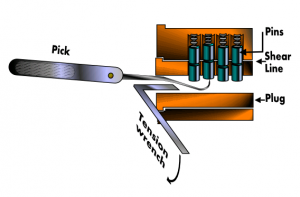 The first step in picking a lock is to insert the tension wrench into the keyhole and turn it in the same direction that you would turn the key.

 Today I would like to introduce the 2 piece Deiss ART Silicone Collapsible Funnel Set.
