The Sand Casting Manual, Volume 2, continues with solidification of metals and why it matters. Specifics of aluminum, copper alloys, brass and bronze are discussed along with solution heat treatment and precipitation hardening. Ductile and gray cast iron are covered.
Gating systems, filters, chills and risers are described along with the design of proper gating systems. Several “hands on” projects include pattern making, match-plates and rubber molds, casting a cylinder head and pistons all in your own back yard!
The plans for a sturdy flask latch are worth the price of the book alone. Historical topics include the details of casting the Ford Flathead V-8 and piston rings. This is a must have reference for the foundry enthusiast, auto restorer, or experienced metal caster!
I made my own foundry a few years ago, and like blacksmithing, my hope is that someday I will have a full time set up shop where I can spend whatever time I desire experimenting in and learning about metal work.
I have a little experience in sand casting, but I really wish I had more. This is a very valuable prepper skill. If you can cast metal then you can recreate society.
As a new mom, my wife is very particular what she feeds the boy, and as a new dad, I am always wondering how to afford all the new budget items babies bring.
When practical (especially during the summers when the wife is not teaching) we find making our own baby food makes the wife happy because she controls the ingredients, and makes me happy because it is much cheaper as well as being better quality.
So as the boy grows we are introducing new foods –so the first question is when can you start feeding peas to your baby?
As always I am not a doctor, so ask the pediatrician, but we started feeding WT peas at about 6 months. – peas are sometimes sold as a “first food”, but it can cause gas in some babies, and we wanted to wait a little while as gas problems runs in the family (even if we blame the dog)…
When making your own baby food you have a couple options, and cooking up fresh peas is obviously the healthiest choice, but not the easiest. Using canned peas is much easier (and normally cheaper), but since canned peas contain a lot of salt and sugar we think it negates the very reason we are cooking our own baby food.
We compromise and use frozen peas. They are economical, available, and less processed than canned peas.
Peas are not usually sold by variety, although many varieties DO exist.
Peas are a great source of nutrition for your child because they are rich in protein, fiber, vitamins, and minerals (including iron, vitamins A and C, vitamin B1, folate, and phosphorus)
To Turn Peas to Baby Food
Simply puree the cooked peas in a food processor, with a little of the cooking water or even a little homemade vegetable or chicken broth.
We like to use our OXO food mill to make baby food, and have done several videos on it, but, because the little bits of the skin tend to be hard to break down, Pea puree is somewhat difficult to get completely smooth we find the food mill does not do a good job.
The best way around the problem is to pass the puree through a very fine mesh strainer, which should filter out even the tiniest bits. Or use this tip from Andrea, one of our visitors…
I was able to get a smooth puree without straining by using a blender on the fastest setting and letting it run for two minutes or so. Add a little water so it really gets moving and the skins will puree.
Now that the boy is a little older and prefers to eat what we eat, Cooked peas can make a great finger food for older babies – a bowl of cooked peas can keep our WT busy, and the small size helps build hand eye coordination which he will need to help his daddy with “projects”. Just make sure to only use cooked peas, as uncooked peas are a choking hazard.
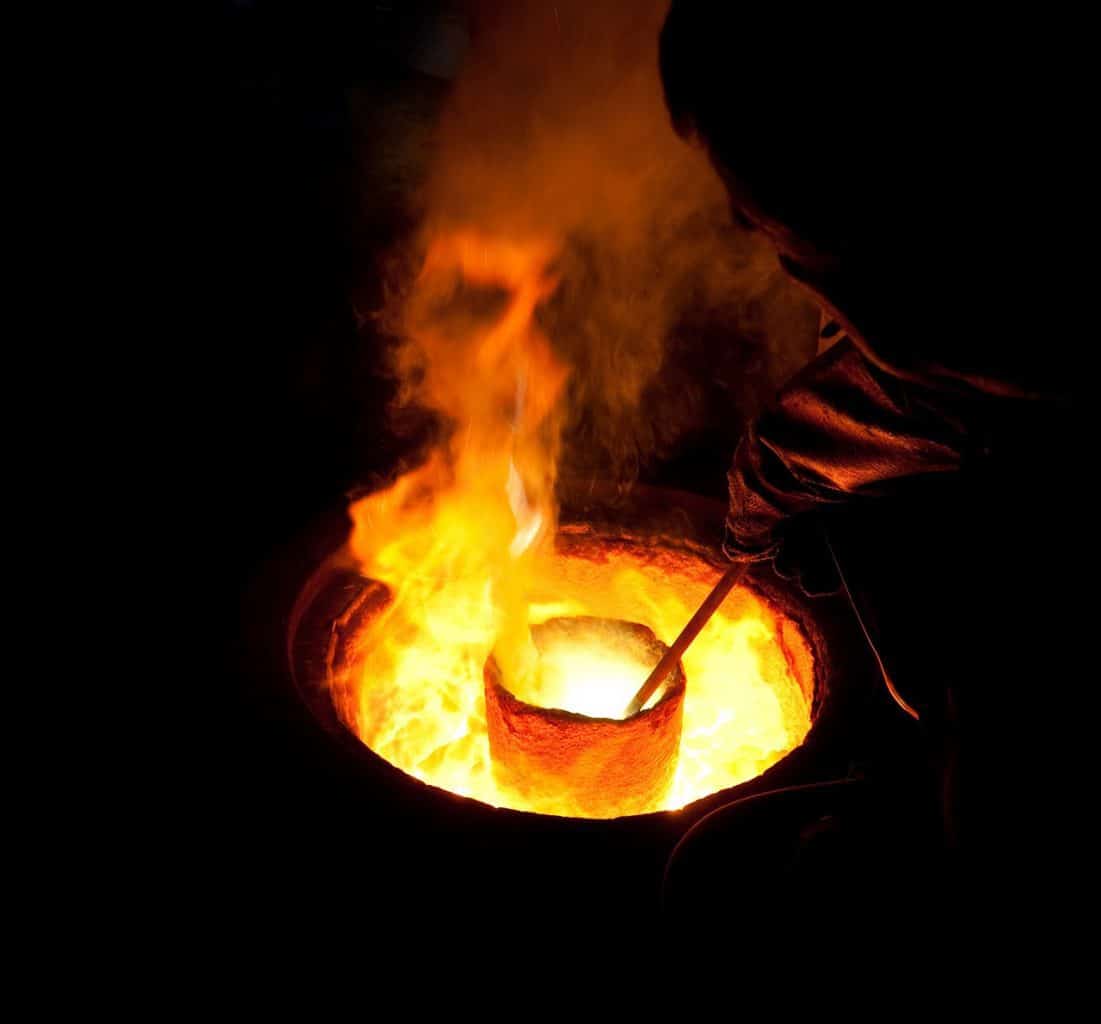
In A Sand Casting Manual for the Small Foundry, Vol. 1 you will learn how to cast metal in sand molds using simple techniques and readily available materials.
Steve Chastain, a Mechanical and Materials Engineer, shows the beginner how to make a sand mold and then how to hone your skill to produce high quality castings.
Written in non-technical terms, the sand casting manuals begin by melting cans over a charcoal fire and end by casting a cylinder head. All for little cost in your own back yard!
The Sand Casting Manuals are good for both the beginner and experienced metal caster.
I have long stated that Chastain and Gingery are the two authors a diy guy should know. Both of them are experts in teaching people how to cast metal into useful items.
The ability to cast metal is essential for industrial society. We need to be able to shape items to our uses. I believe that it is valuable prepper skill because of that, but it is also fun.
I have a lot of other material on this site about beginning sand casting. I think it is an invaluable skill for the DIY enthusiast. I made my own foundry based upon the gingery book and I have learned a lot from this one.
The Tactical Shotgun Suarez gives you his second book on tactical weapons.
Gabe Suarez sets the record straight on the true role of the shotgun in combat.
He shows you what you need to know to defend your home, family or business, including multiple hostiles, low-light situations, moving targets and more.
For those that don’t know Gabe Suarez is a veteran of Southern California law enforcement, where he has served for many years.
His extensive field experience includes single officer patrol, gang enforcement, special operations and tactical training.
He was one of the founding members of his department’s Special Weapons and Tactical Precision Rifle teams.
Gabe Suarez knows his shotguns, and the Tactical Shotgun is one of the best books on the subject. If you want to know how to use a shotgun for interpersonal conflict resolution, you need to read this book.
This book is a key work on my shelf of shotgun manuals. I don’t hunt or skeet shoot with my shotgun, it is only used for self-defense purposes, which makes this book even more valuable to me. I recommend this book highly. Between this book, a sling, and a lot of practice, you won’t need much else.
From my experience working in disaster response, I know the work and thought that goes into running a shelter during a disaster. Emergency management workers try very hard to make shelters safe and comfortable. However, the lack of privacy, resources, and independence makes me pretty hesitant to choose to go to a shelter as long as I have other options.
Personally, it would take a very severe reason for me to evacuate or “bug out” from my home in the first place. Leaving the house would entail me having to leave many of my in-place systems and make me more vulnerable to outlaws and well meaning (and otherwise) bureaucrats.
Want and Reality aren’t the Same
However, just because I don’t WANT to evacuate from my homestead doesn’t mean I won’t HAVE to evacuate. I don’t want any kind of disaster to befall my family, but measuring risk says I should be prepared “just in case”. This leads me to the subject of emergency kits.
Any prepper or interested party with access to the internet has probably noticed the love of acronyms as they relate to kits and gear. You have: BOB, INCH, GOOD, GHB, and EDC, IFAK, 72 hour kits, and 1st 2nd and 3rd line gear. The confusion just piles on.
Basically, it all related to the stuff you need to survive and the philosophy that caused you to pack it all together.
Basically it all starts with the 72 hour kit, which comes from the US military and is based around the fact that American soldiers are resupplied so often that they only need to be self-sufficient for three days at a time. This level is what the US government recommends for all citizens, because in the event of a federally declared disaster it will take FEMA approximately three days to get a supply system organized to provide relief. A 72 hour kit should have basic cooking, lighting, shelter, water, and food to survive for three days.
Prepper Terms
EDC
EDC or everyday carry are things you have on you everyday. A whole prepper subset has evolved around EDC. Generally for me my EDC is a couple knives, a cell phone, a cheap screwdriver set and P-38 on my key chain, and if I am carrying my “baur bag” to school some Altoids tins with containing a sewing kit and OTC medicine, and some car charger adaptors. I would love to have a pistol in my EDC, but I work on a National Guard Base so that is verboten.
Bob
BOB, bob, or B.o.B means Bug Out Bag. A BOB is a small bag that is basically a portable 72 hour kit. The idea is that if a fire or something broke out and you had to leave RIGHT NOW, you can throw on your shoes, grab your BOB and have whatever essential medicines, food, and clothes that you would need. A good idea is to have copies of vital records in your bob, so that you won’t loose them if you don’t have time to dig around in your filing cabinet.
GHB
A GHB or Get Home Bag is practically the same as a BOB, but philosophically the opposite. A GHB is a portable kit containing the essentials you would need if you have to find an alternate route home if disaster struck while you were away from home. I work inNashville, but I live about a 45 minute drive away. If something happened and I had to leave my car and walk home, I would want a light backpack type kit that allowed me to change out of my work clothes, and gave me some comfort and security on a long trek home.
I keep a GHB in both mine, and my wife’s vehicles, and due to the nature of cars, my GHB is actually a box that has a lot of stuff, both for light repairs, minimalist camping, and a walk home. Space and weight is not an issue in the car, so I have things in my box that I can pick through to make a bag that best fits my situation.
Many people keep firearms in their GHB’s and I totally understand that, however, if you have a AR or other long arm and change into a multi-cam uniform, your going to attract unwanted attention. Consider a more concealable approach to defensive weaponry. Personally, I want to look like Joe Sixpack with no more on me than anyone else. In a disaster I want to blend in until I have to stand out.
Good Bag
A GOOD bag or Get out of Dodge is a larger BOB, but still small enough to pack quickly. It’s pretty much interchangeable with a BOB. Some preppers have GOOD trailers or GOOD vehicles that are pre-packed. I use big plastic totes with a color code system. Each food tote contains approximately a month of food rather than a single commodity. In an emergency I can grab as many as I have room for and not have to worry about grabbing a 50 pound bucket of wheat but forgetting the salt or grinder.
Inch Bag
An INCH bag on the other hand means “I’m Never Coming Home”. Its more of a mad max/ the road/Postman type problem where you have to take what you can carry, but all you get it what you take. My inch bag would contain everything in my GOOD kit, plus extras like my hand reloading press, more tools, and reference materials.
Military Terms
IFAK
IFAK is not a general preparedness kit, but it took me a minute to connect the dots so I will throw it in as a “good to know” IFAK is an improved first aid kit. This improved kit that is part of a new military Soldier in a system initiative. It basically is a one pound kit that addresses major blood loss and airway distress.
Line gear is also a military concept and centers around the gear you would need to complete a mission. It’s not exactly applicable to citizen preppers, but it is related in many ways.
First Line Gear is your EDC
It focuses on what you would carry on your person. This would include your clothing, knife, weapon and maybe a small survival and first aid kit. Obviously, if you’re a office worker your EDC would be much different than a law enforcement officer, or a coal miner. Don’t go mall ninja on me though and carry a bunch of neato jiffy wow stuff to feel cool. Everything needs a use or you won’t carry it all the time.’
2nd line gear is your “fighting load,”
When I have my “baur bag” (my wife calls it a “murse” but jack pack, messenger bag are all appropriate terms.) I can carry more prepper stuff, flashlights, hand held radio, batteries, power bars. It also can go with me almost everywhere and gives me more capability without sacrificing a lot of maneuverability. IF it was a full on WROL (without rule of law – VERY unlikely) this would most likely take the form of a load bearing vest, or chest rig to hold ammunition for your rifle.
3rd line gear is your pack
Sustainment items you need for a longer term. Your not going to fight wearing your rucksack, you would drop it and depend on your 1st and 2nd line gear during the fight and then go back and get your pack to refill your empty magazines.
The thing is, who cares what you call your stuff, organize it to suit your needs and as long as you understand what your doing and why you are light years ahead of guys that follow the conventional prepper wisdom and build kits based upon what some internet guru wrote in a list. Your also Galaxies ahead of people that don’t even have a thought about prepping.
You don’t need to be scared, but it is important that you take some time to develop a plan that you can work with.





 As a new mom, my wife is very particular what she feeds the boy, and as a new dad, I am always wondering how to afford all the new budget items babies bring.

 In A Sand Casting Manual for the Small Foundry, Vol. 1 you will learn how to cast metal in sand molds using simple techniques and readily available materials.

 The Tactical Shotgun Suarez gives you his second book on tactical weapons.

 From my experience working in disaster response, I know the work and thought that goes into running a shelter during a disaster. Emergency management workers try very hard to make shelters safe and comfortable. However, the lack of privacy, resources, and independence makes me pretty hesitant to choose to go to a shelter as long as I have other options.