Today I have two hunting rifle bipods from Twod, they are almost identical in design. The difference is size. The one pictured on the left of the screen is adjustable from 9-13 inches. The bipod on the right of the screen adjusts from 6-9 inches.
The smaller version is cheaper. It is $15.99 on Amazon, with its big brother costing $19.99.
Both bipods attach to a sling swivel stud, something I have a hard time saying fast. If your rifle does not have an attatched stud, but it has a rail the rifle bipods each come with a rail mount adapter.
Both are constructed of black anodized aluminum and are pretty sturdy.
I have had several of these type bipods over the years and for the price they are hard to beat.
Here are some additional features
Quickly attach to or detach from the rifle using existing swivel stud.
Foldable arms with spring tension control.
Comes with the mount adapter.
Adjustable leg length: 5 settings for different length, the bipod is ready to meet your needs.
Made of hardened steel and aluminum, non-rust black anodized finish, the rifle bipod is duty and light weight.
Legs are spring loaded and extend and retract with a small push of a button.
This is not the first laser boresighter I have used on this website. I like using these tools, but if you don’t have one you can always use the old school bore-sighting method.
Of the Laser Boresighter kits I have bought, I like this one because Twod was thoughtful enough to add a box. I have several of these devices in various bags but I always seem to lose the arbors. Without the bore adapters you can’t use the laser.
4 Adjustable bore adapters fit almost all .22 to .44-cal. pistols and rifles.
Crafted from anodized, tough aircraft aluminum. No metal touches the rifling of your firearm.
Bore sighter activates with a button switch. Pressing the switch, it will emit a straight green laser beam with a long sighting range.
It allows you to quickly zero-in on your target without wasting excessive amounts of ammo.
Get 1 of Qualifying items for 21.99 offered by T-wod. Enter code 9FIJPOBU at checkout.
Special offers and product promotions
Receive 1 of these free when you purchase 1 or more Twod Shooting rest bag offered by T-wod. Enter code Z9XS26SK at checkout. Here’s how (restrictions apply)
Receive 1 of these free when you purchase 1 or more Twod Roll Pin Punch offered by T-wod. Enter code 3CKJYXLC at checkout. Here’s how (restrictions apply)
Save 10% on this item when you purchase 1 or more Twod AR-15 Gun Cleaning Mat Large offered by T-wod. Enter code C6AQIROQ at checkout. Here’s how (restrictions apply)
Save 10% on this item when you purchase 1 or more Qualifying items offered by T-wod. Enter code 4QDGGLLE at checkout. Here’s how (restrictions apply)
Save 10% on this item when you purchase 1 or more Twod Rifle Scope 2.5-10x 40 offered by T-wod. Enter code 7BGA9ZYY at checkout. Here’s how (restrictions apply)
Save 10% on this item when you purchase 1 or more Twod Rifle Scope 2.5-10x 40 Dual Illuminated offered by T-wod. Enter code TYT8OBLG at checkout. Here’s how (restrictions apply)
Save 20% on this item when you purchase 1 or more Twod Gun Sight Laser Green Dot offered by T-wod. Enter code ATNNWGDV at checkout. Here’s how (restrictions apply)
Between my wife and my son I can’t keep flashlights. He likes to play with them, and She is scared of thunderstorms. I keep buying some and handing them on doorknobs. However, they never seem to get put back on the doorknobs.
This is just a typical LED 1000 lumen tactical style rechargeable LED flashlight, but it has some neat additional features.
Unique Features:
It is rechargeable. It has a built-in USB charging port make it easier and quicker to charge the flashlight. The flashlight only takes 2 hours to charge and can keep working on the highest setting for 1.5 hours or more.
It doubles as a bike light with the included 360 degree swivel mount bracket. The flashlight rotates to shine any directions you want. It also is easy to slide in and out of the bracket without having to detach the mount from the bike. I don’t ride bikes a lot, but this looks like a handy option for my ladder rack on the red truck.
Additional Features:
Output brightness: 1000 lumen range out to 350 yards.
Waterproof : IP-65 (Don’t put it into water directly.)
4 switch Modes: high / middle /strobe / SOS
Peak Beam intensity: 25700cd
Lamp base: XML-T6 Highlight LED. With a lifespan of up to 100,000 hours or more, no need to
consider replacing it for the whole life
Material: high quality aero-grade aluminum alloy, this flashlight is sturdy and durable
Power by included 18650 battery. Unscrew the tail cap to change the battery if you need.
Internal wiring applies the high efficient booster circuit, working voltage is wide and can utilize the batteries in the largest extent
The package includes:
This $19.99 Prime shipping Victagen 18650 Tactical Rechargeable LED Flashlight comes with the light, one bike mount bracket, a USB charging cord, and one 18650 rechargeable Li-ion battery. So far I am very happy with the light and am probably going to stick it in my wife’s purse so that she will stop stealing all the emergency lights I keep storing around the house.
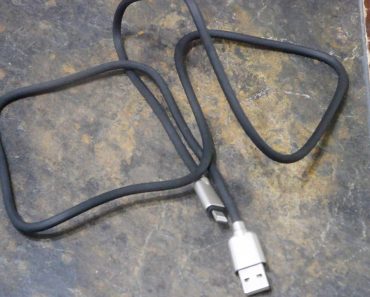
My family is hard on charging cables, we go through a lot of them. I also get a lot of them to review. Frankly I like the multiple function charging cables the best. However, they aren’t all that sturdy and sometimes you just need a good old fashioned strong cable. This is especially true with the cables I use at the house.
Speed of charging is also an issue in out highly connected lifestyle so I wanted to try out this new iPhone fast charging cable.
We have an outlet on either side of our living room couch that have built in USB ports, and they keep cables plugged in 24/7/365. These cables take a lot of abuse as they boy keeps tugging on them. They also get tangled up a lot.
This iPhone cable is both strong and Fast
The connections are zinc and are said to last 5 times as long as typical chargers. I also like how thick the cords are. They are pure copper the company claims they charge phones 30% faster because they are very efficent in transferring power.
The cords are also rubberized which makes them tougher and less prone to tangling.
In total, I am pleased with these cables. I haven’t had them long enough to see just how tough they are, but I have high hopes.
I needed to move my lawn mower from under the carport and the last time I let it sit uncovered water did a number on the carburetor.
This lawn mower cover comes either in green or beige.
This cover is much heavier than I expected. It is a very think rubberized nylon. Amazon says it is a high quality sturdy oxford fabric with a pvc coating and waterproof tape on the seams. They say it offers 100% waterproof protection. I am normally skeptical, but in this case that seems fair.
The seams are well stitched and it has an elastic cord around the base. This is not a tarp, but a fitted cover.
The makers say it is a universal fit for a lawn & Garden tractor with a deck up to 54″. If you want to check to see if it fits your tractor it is 72″ Long x 44″ Wide x 46″ High. It easily covers my old Murray rider. Actually, before I spent money on new parts, the cover probably is worth more than my old mower.
This well made cover also has a ventilation flap that is designed to keep the moisture easily out for long term protection of your lawn tractor in your garden or back yard. I like how it also has two tie down straps fasten the cover to your tractor. That means I don’t need to worry about a strong wind blowing my cover off.
My only issue with the cover is the price. It is $45.99 with prime shipping and that is a lot for my budget. However, to be fair this is great quality and they say it has a life time warranty



 This is not the first laser boresighter I have used on this website. I like using these tools, but if you don’t have one you can always use the



 My family is hard on charging cables, we go through a lot of them. I also get a lot of them to review. Frankly I like the multiple function charging cables the best. However, they aren’t all that sturdy and sometimes you just need a good old fashioned strong cable. This is especially true with the cables I use at the house.

