

Recovering A Liver Shot Deer

Buy at Amazon

In the event that you’ve shot a deer previously while hunting, you’re most likely comfortable with the general grouping of occasions. Going from shooting the liver to the recovery of the liver can take negligible hours, depending on several points. It’s dependably a probability that we could lose a sight of the injured liver, which will lead to many sleepless nights. This guide will help you in recovering a liver shot deer so you can increase your reputation by becoming a better hunter.

Tracking Stages

Ideally, for your sake, you are going through this article before you make the shot. Guaranteeing that you know and take after each step of the blood trail tracking is critical. All things considered, this post will make you step by step of the deer blood trail tracking strategy from straightforwardly after the shot, to the point where you recover your deer.

Back Off Right Away

A liver shot is regularly the after-effect of a shot that was off its check and back of the vitals. In many cases our aim is off, we tackled a deer in motion, or we were tricked by the deer’s front foot position. At the point when a broadside deer’s front leg is back in its position, the front part of the vitals is secured. This leaves a little part of lungs uncovered and a shot that took a gander at the season of effect really may have hit back of the lungs and hit the liver. Whenever possible, sit tight for a deer to advance forward with their front foot, uncovering the vitals, before taking your shot.

The liver shot is a deadly shot yet requires an any longer wait time than a lung or heart shot. Blood trailing deer after a liver shot is likely the trickiest of all things considered. Numerous deer are pushed because of untimely recovery tries with a liver shot deer.

A liver shot deer may take off at any pace, with its tail up or down, yet will, for the most part, go to sleep after a short separation. If not disturbed, the deer will typically pass on at this area. The blood from a liver shot is to a greater extent a darker red/maroon and has a watery consistency. We recommend holding up 5-6 hours, if the climate allows, before blood trailing a liver shot deer.

My Experience: My experience was an exemplary instance of a liver hit—due to where I saw the arrow hit on affect, the deer’s response, and the dull red blood I found on the ground and arrow. In the wake of giving the deer a half hour, I wrongly went after it. I kicked him up around 100 yards from where I shot him. It was by then I chose to withdraw the forested areas for the night and return the following day. If at any time in question, give the animal time.

Search for Evidence

Subsequent to replaying these details in your brain or checking the hunting cameras, move down and explore to the point of interest where you trust you shot the deer. This is the place numerous seekers turn out badly with tracking deer. Numerous seekers mistakenly simply take up the trail instantly. Regardless of whether there is clear blood, this activity can destroy your recovery effort rapidly in the wrong circumstance. You’ll clearly be searching for blood, yet additionally focus on hair, irritated leaves, and broken branches. Loads of white hair implies either your shot was low on the stomach or it left the deer low.

Another Important Point is to look at the arrow. Chasing arrows can reveal to you a ton as well. Inspect the blood on it and give it a sniff. You may even have a marker area or white wrap that can obviously demonstrate the blood. We’ll take a gander at the blood classifications beneath for various shots, however in the event that it smells spoiled, it’s imaginable you influenced a paunch to hit.

Stay Hydrated And Get Some Rest

Try not to punish your rest and how you feel previously and between the duration of the track. Bring water and bites. This was particularly valid for me since it was September temperatures. In the event that you end up exhausted, your engine aptitudes and faculties endure, and you may surrender the trail too early. Additionally, you have to keep up high resolve, and that begins with feeling refreshed and supported.

Blood Trailing Deer

While a liver shot is constantly deadly, it will take more time for a deer to die. In the event that you locate the thicker, dull red blood, hold up no less than four hours if conceivable before you begin tracking. Liver shot deer will more often than not make camp inside 200 yards to rest. On the off chance that unpressured, they will more often than not seep out and terminate in these first beds. In any case, if you surge in, you may jump the slept with deer. Since they may just deliver droplets for a blood trail, each further inch you push them influences your tracking work significantly harder.

 Author BIO:

Sayfullah Khan

Sayfullah Khan is the founder of Beasts Insider, a multi-niche blog dedicated to provide honest product and blog reviews and information. He started this blog to provide unbiased product reviews (mostly in the form of Top 10). Check out his latest article on deer hunting for beginners.

6 Things You Should Know About Inflatable Kayaks

Buy at Amazon

If you are considering buying an inflatable kayak there are some very important things to consider before purchasing one. This is a big investment, and you can sink a lot of money into a kayak, only to find that you didn’t get what you wanted or that it suffered damage because you didn’t know how to use it.

No worries. We have some great tips on things that you should know about inflatable kayaks so that you can get the most out of your purchase and also get the most out of your adventures while using it.

Stay away from sharp rocks

This is one of the most important things that you should know about inflatable kayaks. No matter how durable it is built and no matter how tough the manufacturer claims that it is, never bump into sharp rocks or other obstacles in the water. It doesn’t matter how well it was made, chances are you are going to puncture your kayak and end your good time. You would be surprised at how many people get careless because they believe that their kayak can handle everything. It can’t. Just stay away from sharp rocks and other things that can pierce your kayak.

Make sure you actually know how to use a kayak

You might be surprised at how many people buy a kayak and have no experience using one. And this leads to all sorts of problems. We already covered running into sharp rocks, but there are other things that can go wrong if you have no experience. You might find yourself unable to keep control of your kayak in rough waters, or you may even end up in the water yourself because you didn’t know how to get into it properly. Get familiar with a kayak before you invest a lot of money into one.

Know what conditions you will be using it in

The water conditions that you will be using your kayak in will determine what kind you need to buy. Do you want to kayak solo or paddle with another person? Do you plan to use it in calm waters or rapids? Will it face extreme heat from the sun or moderate? Basically, determine how you will use it so that you can buy the one that is best for your situation.

Even inflatables require storage space

Inflatable kayaks are great because they store compactly. However, depending on the size of the inflatable kayak, it can still take up a considerable amount of space. They don’t all fit into a suitcase-sized package. be aware of what size it folds down to when not inflated.  If you want something that is easy to transport.

You will sacrifice speed when buying an inflatable kayak

You should be aware that an inflatable kayak is not as fast as a hard shell kayak. Due to their design, they don’t sit as low in the water, so they don’t cut through the water as naturally. However, what you lose in speed, you make up for in convenience and stability.

Inflatables are not as narrow as hard shell kayaks. So just be aware that they can’t get into tight spaces the way a hard shell can. But again, you are getting extra stability, so it’s a trade-off.

These are all things to be aware of when it comes to inflatable kayaks. Just keeping these things in mind will help you to get a great kayak and enjoy it for a long time. And now that you have these tips, maybe it’s time to buy one. Gadget Review’s buying guide has more info.

Canoeing and kayaking has even been shown to be a great way to stay fit, so why not give it a try?

The Hunting Generation Is Fading

Buy at Amazon

The popularity of hunting as a sport has dropped sharply in recent years. Older generations that grew up as hunters are retiring from the sport or giving up altogether as forests disappear. The younger generation doesn’t seem to be inclined to take up the pastime. While this may please some animal lovers on the face of it, the drop-off could have serious consequences.
Why Hunters Are Disappearing

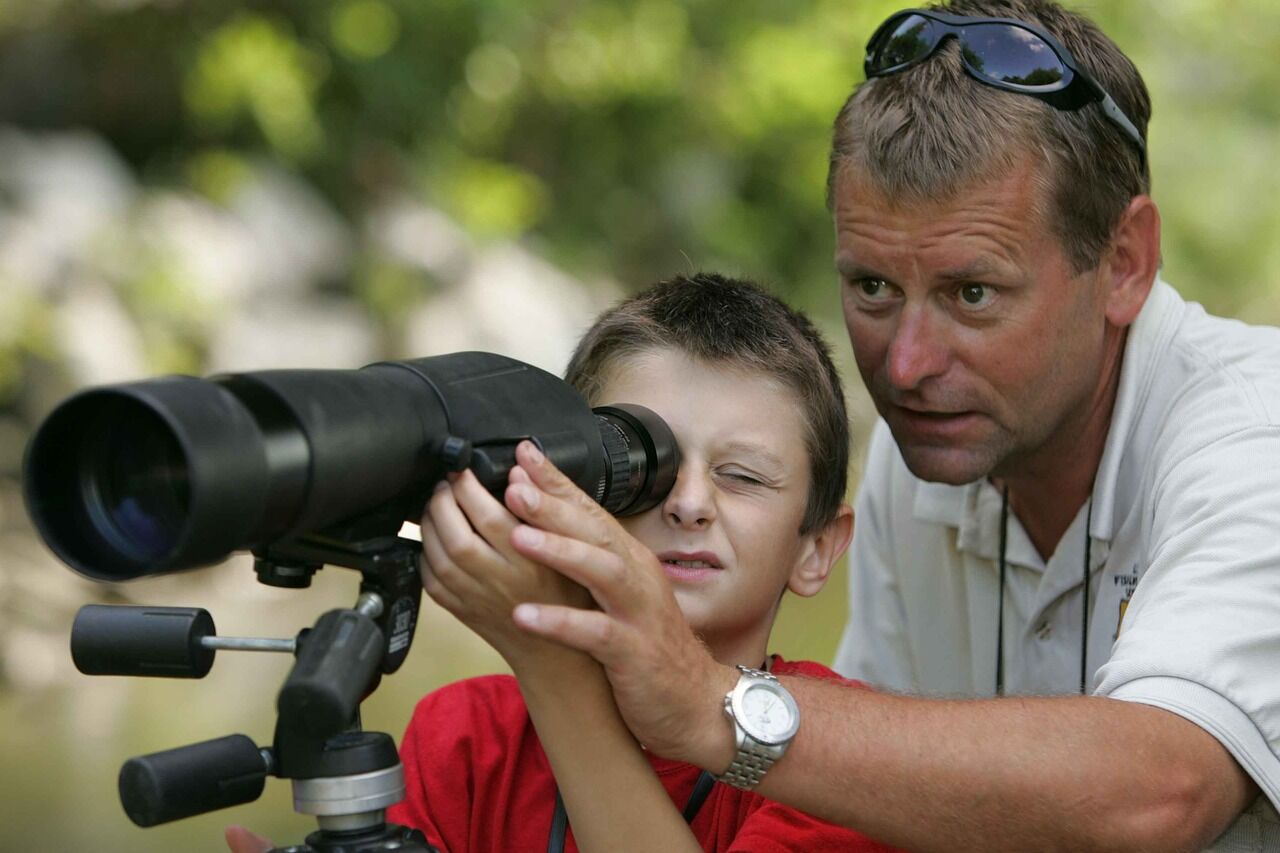
The chief reason may be suburban sprawl. As housing developments and shopping malls spring up everywhere to satisfy growing populations, the woodlands are vanishing. Technology is another reason. Today, our youth are less inclined to spend their time outdoors. Instead, they’re glued to computer screens and smartphones, playing games or posting on Facebook. They will find it cheaper and easier to stay home and play a hunting video game than actually get out into the woods.

Benefits of Hunting

Hunting has long been a form of population control as native species spread beyond their dwindling habitat. Exploding deer populations are already a threat to crops and landscaping in many areas, not to mention vehicle traffic and the spread of illnesses like Lyme disease. Also, the sales of guns and hunting equipment generates billions of dollars in the economy, and that means jobs. These sales includes taxes and license fees that are earmarked for conservation efforts. Declining sales, ironically, are reducing the ability of forestry departments, conservationists, and wildlife officials to do their jobs.

An American Tradition

Hunters see their sport as a wholesome tradition harking back to the days of the first colonists and settlers taming the vast American wilderness. We are by nature meat-eaters. But to a hunter, the sport is not so much about killing and taking a trophy as it is a test of knowledge and skills. It’s also a great way to get away from the stresses of society and enjoy nature in a very fundamental way. .

Purchasing Firearms

Hunters must also master their basic equipment, which generally means firearms. Safe and responsible gun ownership is an important part of the hunting tradition. Hunters select and purchase guns legally and for a specific purpose from a place like First Southern Service. While gun control is a hot topic again, many gun, nature, and hunting organizations are reaching out to younger people across social media and other channels to stir up interest in the sport. Of course, your local hunting or gun shop can also answer any questions you have.

The fall-off in hunting has many related industries and organizations concerned. If you feel an interest in hunting, remember that it’s an intrinsic part of our economy, history, and current wildlife management efforts. Reach out to one of these organizations and learn what hunting is really all about.

How to Choose & Use A Spotting Scope for Hunting?

Buy at Amazon

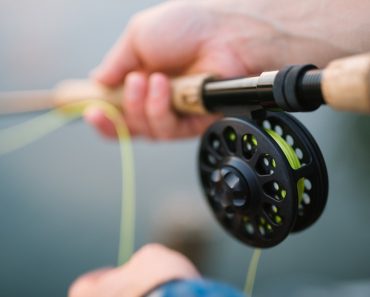
Telescopic optics provide capability to a Hunter that nothing else can. A Spotting scope takes advantage of that technology better than any other piece of equipment we can carry with us into the field.

Anytime you take a spotting scope with you into the field, you bring with you the capability to see for miles around and be able to search out game with pinpoint accuracy far better than you can with any other piece of equipment.

Choosing the right spotting scope to bring these advantages to the table can be difficult at best. Hunting optics are highly technical, can get very expensive, and choosing one largely comes down to a combination of experience and knowledge.

Here are a few factors that you should consider when you are choosing and using a spotting scope for hunting.

Factors to Consider when Shopping for a Spotting Scope

Quality & Cost

Nothing else, when it comes to equipment, can get nearly as expensive as optics. Spotting scopes, in particular, get very expensive very quickly when you start talking about small differences in quality. Most of the midrange priced spotting scopes on the market designed for hunting will be fine for the majority of hunters.

Many hunters opt for nicer models than they need and then tried to justify the cost by telling everyone else that they need the same level of quality. If you like fine optics from European manufacturers, have at it! However, research the level of quality you need and stay within your budget. You’ll appreciate your equipment more knowing that it does exactly what it needs and you didn’t have to sacrifice too hard to get it.

Magnification

Magnification range in spotting scopes are often much larger than on rifle scopes or binoculars. This is great because the amount of magnification that you can have is largely only limited by the size of the spotting scope that you are willing to carry. In fact, some spotting scopes these days that top out near 80x magnification could qualify as telescopes.

Remember that the amount of magnification you need is going to be determined by the type of game you’re hunting and what you are using it for. For example, if you are a Western Hunter looking to judge the trophy quality of bull elk from over a mile, you are going to need high magnification. However, if you are varmint Hunter on the edge of a Prairie dog field looking for small game to pop up out of holes in the ground, you will likely need the same level of magnification as a long-range trophy Hunter.

Size

Almost as important as weight, size should be a large factor in determining the spotting scope that you buy for hunting. Most of the time when you’re using spotting scope for hunting it means you’re going to be carried get it on your back. You don’t want to be porting a ton of bulky equipment into the field regardless of how much it weighs. Opt for slimmer and trimmer spotting scopes with low-profile tripod mounts whenever possible.

Weight

Weight is a large concern for almost all hunters. Unless you constantly hunt with a large group of people that can afford to take heavy equipment field, carrying extra ounces equals pain. Having lightweight equipment is definitely worth the cost when you factor in the enjoyment and increased performance you gain from not being over exerted carrying extra weight.

Spotting scopes recently have embraced carbon fiber, thinner and lighter lens construction as well as smaller footprints in general to save weight. Also remember, the accessories you take with you in the field can weigh you down as well. Look for manufacturers that offer ultra lightweight lens covers, protective cases and especially tripods to save weight in the field.

Features-Wants Vs. Needs

Before you go shopping for a spotting scope, make a list of the features that you have to have an features that you like to have. Nowadays, it’s very common for each manufacturer to have proprietary technologies and patented features on their equipment that can suit individual tastes and requirements.

In many cases, these are useful but often they are very minor differences that only amounts to more money spent in the showroom. Make sure you know exactly what you need before you go shopping so that you don’t end up blowing your budget on equipment you don’t need.

Uniformity

If you are a long-range Hunter, make sure your spotting scope works with your Riflescope and binoculars. This means that if your Riflescope uses a mil-dot reticle or target turrets, your binoculars and spotting scopes should use mil-dot as well. You don’t want to be constantly doing algebraic equations in the field when it comes time to pull the trigger.

Other features like commonality between tripod adapters for multiple pieces of equipment can save you weight in the field. A little planning ahead can save you huge headaches in the field.

Warranty & Insurance

This DLSR Camera Adapter fits on the Spotting Scope Pictured Above, Buy at Amazon

There’s not many piece of equipment that are worth ensuring when it comes to hunting. Optics, especially spotting scopes, are definitely worth buying an extended warranty or taking out an insurance rider for. In many cases, these are offered by the retailer or manufacturer, but make sure you have some sort of protection on your spotting scope before you take it out for a multi-day adventure in the Rockies.
It may seem trivial, but if you drop your spotting scope over ledge and have the objective Bell shatter, you’re going to want to have it replaced regardless of whether or not it ruin that particular hunt. Remember, most manufacturers do not cover wear and tear or accidents on their warranties, however, check before you spend extra money because some do.

Spotting scopes are amazing piece of equipment for hunting. Choosing the right optics for hunting, in general, can be a challenge. Do some reading and find some spotting scope reviews online of models that your incident before you run off to your nearest retailer. Make sure you get a model that you can live with in the field, and get out and use it!

The best spotting scope in the world doesn’t do you any good in its case.

5 Essential Items for New Fishermen

5 Essential Items for New Fishermen
Buy at Amazon

If you’re thinking of taking up fishing as a pastime, then you’re about to take your first step into an activity which requires a great deal of skill, finesse and accuracy. Fishing is also a hobby which can bring you a lot of joy if you’ve got the time and patience to learn. As you set out, the various techniques and pieces of equipment out there may cause you some confusion.
Below is our “idiot’s” guide to 5 Essential Items for New Fishermen that you will need to invest in if you’re thinking of taking the plunge (forgive the pun) and devoting your idle hours to the pursuit of fishing.

Rod and Reel set

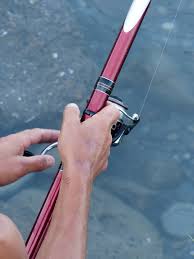
This is where you need to start. A good rod and reel are essential to helping you build your confidence as you start. Your rod and reel will be your trustiest friend, and you will need to be comfortable with whatever you pick. A rod and reel combo set is the best option for beginners, as it allows you to grasp the basics of fishing and begin to get a handle on your technique.

The other great advantage of rod and reel sets is that they are relatively inexpensive, meaning that if you decide fishing isn’t for you, you’re not going mad with your money.

What to look for in your first reel

  • The ideal reel needs to be about thirty centimetres longer than your height.
  • The rod needs to responsive; it’s essential you can feel the fish bite and are able to pull them out of the water.
  • Spincasting reels are the best option for absolute beginners, as the line can be cast automatically, mounted on top of the fishing rod.
  • Baitcasting reels are manually controlled, and offer greater distance, but they are perhaps more suitable for someone whose technique is more advanced.
  • It needs to have the necessary weight and lifting power that you are able to practice catching different types of fish.

Choosing the right setup is important. If interested, Gear Lobo has a good review of the Ugly Stik GX2

Fishing line

The experts say that a monofilament is your best bet for a beginner. Durability is key for fishing line; they are classified in terms of their breaking strength, which is the weight they will support. Obviously, the breaking strength of the line needs to be matched with the size and weight of the fish you are trying to catch, so you need to bear this in mind when purchasing; if you’re planning on going for bigger fishing then you will need a rod with a greater breaking strength.
Fishing hooks

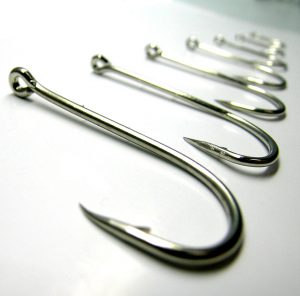
Again, as you grow more accustomed to fishing, you will want to practice with different types of hook. It’s important to understand the size classifications of different types of hook; the higher the number, the smaller the hook. Any size classification beginning with a 1 or 2 is best for a beginner, as it’s likely you’ll be starting on smaller fish, and you will want to learn precision catching.
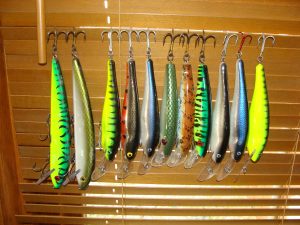
*I learned that smaller hooks catch more fish, I also learned a neat trick to keep your hooks organized.

Baits and lures

Lures and baits are both integral to learning your fish-catching technique. Lures are like decoys which, you guessed it, enable you to “lure” your fish to the bait. Fishing spoons are a popular form of lure, as they mimic the shape and behaviour of prey. Meanwhile worms and insects make the most effective form of fishing bait. You will need to match the size of the bait to the size of the fish.
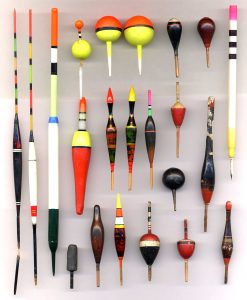
The types of fishing bait you use will most likely depend on what kind of water you are fishing in, and the kind of fish you are looking to catch. Weather and water conditions can of course, have an effect on the feeding patterns of the fish, which in turn will affect the kind of bait you use.

Floats and sinkers

Floats are used to keep bait close to the surface, allowing you to lure in fish feeding close to the surface. Sinkers provide casting weight, weighing down your bait and line so that you are successfully fishing at the level where fish are likely to be feeding.

This list of supplies is not exhaustive, but these are arguably the essential pieces of equipment for getting you comfortable with the strategies and techniques of fishing. The most important thing you need as you start out is a willingness to have fun, and the patience that comes with being a novice.

Basstastic offers fishing equipment, clothing and accessories for both beginner and professional anglers and fishermen.