
The Amazing History of Early Weapons

Book Review: The Amazing History of Early Weapons
Buy at Amazon

The Amazing History of Early Weapons is 120 pages of illustrated articles reprinted from American Machinist Magazine, 1918. 1. Cannon making in past centuries. 2. Musket manufacture in past centuries. 3. Early attempts at submarine building. 4. Some types of modern (1918) hand grenades. 5. Early history of the marine torpedo. 6. Ancient helmet making. 7. The development of gun manufacture. 8. The forerunner of the tank. 9. Fighting with fire in ancient times. 10. Early attempts at rapid-firing guns. 11. Making boring bars for big guns. 12. Intrenchments and the wire barrier.

This book is reprint from an old magazine, it gives good information, but it is not a step by step assembly guide.  I have used this book to build things, but you have to be able to extrapolate from what they are saying.

This book came from the now defunct Lindsey books, which was a priceless tool for preppers, DIYers, and the self reliant.  I was very sad when Lindsey decided that the world was now overrun with the stupid and he didn’t want to deal with the public anymore.

I can’t say that the History of Early Weapons is the best of his books, but I did find it pretty interesting as well as a book full of ideas.  I believe that the handy and smart modern man, with desire and the willingness to work hard can replicate any of the technology of the 1800’s and earlier.

This means that if you want it, and are willing to do the work any of the subjects in this book can be replicated.

Which is why, if you dig down to the root, is the reason I took up metal casting.  One day I hope to build my own cannon.

Ammo Up Review


Ammo Up
Buy at Amazon

I got the chance to review the new Ammo Up machine, and since I hate picking up brass I jumped on the chance.

This device is similar in desired use as the brass wizard I have had for years, but the operation is completely different.

In this machine, you simply press the ammo-up over the spent ammunition casing, lodging it in the plastic bristles and then pick the case up.

What sets this machine apart is how much easier it is to release the brass than it is with the brass wizard.  The ammo up has a pull lever that drops the spent casings out.  I love that.

I find that like brass wizard this thing works well, but how well depends on the type of terrain the rounds fall in.

This worked best on the cement slab of a covered range, and worst in the gravel.

To me the ammo up worked better than the brass wizard on grass, but others have said the opposite.

Nether device works well on gravel.

What works best for me is having students police up the brass at the range, but when I am shooting solo I find that I like this device infinately more than bending down to pick up my own spent shell casings.

PVC Projects for the Outdoorsman

Buy at Amazon

In PVC Projects for the Outdoorsman you will learn how to make inexpensive and practical gear such as snowshoes, an equipment raft, shelters–including a teepee and a portable ground blind–a boot dryer and even a blowgun in your home workshop out of durable PVC pipe.

Photos and easy-to-follow instructions show you how to construct more than 30 projects.

I haven’t done all the projects in the book, but it has given me a lot to think about as well as fertilize my mind to keep it actively looking for other ways to use common materials.

This book was so popular that it spawned a sequel More PVC Projects, I have that one also.

The idea of using PVC to make things is pretty cool, at least in my own opinion.  It is workable with few tools, is cheap, and you can buy it in any town in the nation.

PVC Projects for the Outdoorsman is a good book to have around the house as it shows how to start MacGyvering solutions out of common materials.

I use it as a source of ideas, and through the ideas given I have used it to make garden hoop houses, tarp coverings for my rabbits, and a rabbit tractor, none of which are in the book proper, but the ideas stemmed from the book.

Technician No-Code Plus

Book Review: Technician No-Code Plus
Buy at Amazon

Technician No-Code Plus is the first book I bought when I decided to get a ham license.  Actually, this and the test bank is all I used to learn enough to pass the test.
It is very basic, but gives you all the information you need to get a FCC Technician’s License for the Amateur bands.

There is some good practical knowledge to be found in this book, and for the price – I recommend it as a great starting place.

I find that Ham radio is essential to preparedness, this is because Amateur radio works when all other communication methods fail.

Smart emergency managers work with ham operators so that the Amateur bands can be seamlessly integrated into disaster response efforts.

I also find that due to the nature of the hobby, ham technicians are very willing to take the time to work with inexperienced individuals wanting to learn how to use the radios, unfortunately it is my experience that they like ham for ham’s sake, and are not as willing to share with those that are getting licenses for emergency preparedness reasons.

I would recommend NOT telling that your primary interest is being ABLE to communicate, but rather stick to discussion of your desire to learn how TO communicate.

Review on The Beginners Guide to Preserving Food at Home

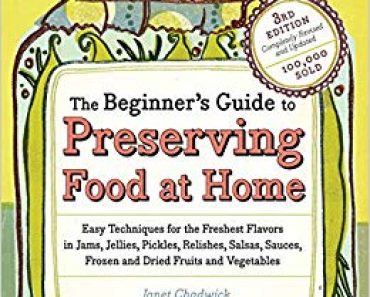
The Beginners Guide to Preserving Food at Home

Book Review: The Beginners Guide to Preserving Food at Home
Buy at Amazon

A wonderful thing is happening in home kitchens. People are rediscovering the joys of locally produced foods and reducing the amount of the grocery budget that’s spent on packaged items, out-of-season produce, and heavily processed foods. But fresh, seasonal fruits and vegetables don’t stay fresh and delicious forever – they must be eaten now . . . or preserved for later.

For all the vegetable gardeners facing baskets overflowing with bright tomatoes, and for all the dedicated farmers’ market fans and CSA members, The Beginner’s Guide to Preserving Food at Home has the simple solutions that turn overwhelming bounty into neatly canned tomatoes, jars of jams and jellies, and crispy-tart relishes and pickles.

Organized in a friendly, food-by-food format, readers will find freezing, drying, canning, and storing instructions for each vegetable, fruit, and herb. In many cases, several ways to freeze or can a food are described, and there are often other preserving suggestions as well, such as making juice or fruit leather.

In the book The Beginners Guide to Preserving Food at Home everything is written with busy people in mind: these are the quickest, most efficient methods for preserving summer’s bounty. Up-to-date information and clear, step-by-step instructions show even absolute beginners the way to a fully stocked pantry.