I decided to try my hand at DIY publishing on the kindle.
The Ultimate Guide to Pepper Spray Now on Kindle has been in my head for a few years. I never tried to write it as a traditional book because a 30,000 word requirement just adds words for the sake of words. I didn’t want to write a book of fluff.
I wanted a book that gives easily understood, accurate, and useful knowledge concerning a less than lethal option.
Not everyone like guns, not everyone can carry guns.
As I wrote this I though of teachers like my wife, who would not ever wish to harm a fly, but have several children under her care.
In this book I took all my experience as a chemical agent instructor having been sprayed myself multiple times, and seeing, or spraying others hundreds of times. I have helped untold numbers of students decontaminate themselves after being sprayed in training.
I know what works and what is bad information. I share it and more in the Ultimate Guide to Pepper Spray .
If you want to know the best way to tell if you have a strong pepper spray so you don’t get misled by marketing hype, if you need to know the best spray patterns to get for your use, or see some options for carrying spray while jogging or walking around, it is covered inside this book
I am offering this exclusively through Amazon. The Ultimate Guide to Pepper Spray Now on Kindle as an eBook but it is also available as an paper copy. As an additional value, if you purchase the paperback, you get the eBook free.
Because I want to offer great information that is useful to you, I have posted the Amazon preview link to the right so that you know exactly what you are getting when you buy this ebook.
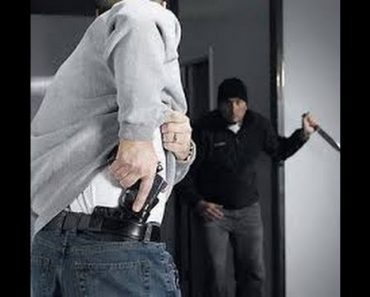
Should you shoot to wound? I talk a lot about lethal force, and one concept comes up almost universally. I call this idea the leg shot syndrome. The leg shot syndrome is expressed by the statement “I wouldn’t aim to kill; I would shoot the robber in the leg”. I believe I know where this thought comes from.
As propponents of self-defense, it is very important that we answer the question “Should You Shoot to Wound”.
It comes from the fact that everyone I give firearms classes to comprise the “good guys”. Good guys don’t go around killing, robbing, and raping people. They believe that everyone has redeeming qualities. Good guys don’t want to kill people, they didn’t start the encounter, and if they had their way, the bad guy would just leave. Now before I get tons of hate mail, let me say that I understand the reason people think this, and I wish everyone in the world felt that way. If there were no bad guys, there would be no crime. I could then put more energy into my primary job of preparing for natural disasters instead of diverting energy to preparing for criminal disasters.
While understanding and admiring this idea, I want to emphasize that this is not a good way to apply this concept. There are many reasons why this philosophy is not sound in the lethal force arena. Some of these reasons are legal, some tactical, and some, yes, are even moral.
I will jump into what I hear as the most widely use reason why the leg shot syndrome should not be used, legal. A handgun is a lethal weapon. Unlike a baseball bat, a butcher knife, or a policeman’s baton, there is no less lethal way to use a handgun against another human. The law does not distinguish the difference between shooting a person in the head, and shooting a person in the chest. If there is not legally defensible motive and the person dies it is still murder. A bullet cannot be recalled once it leaves the barrel, and what it does upon entering a person cannot be decided by the person who fired the bullet. There is a major artery in the human leg, which if severed, can kill a person as quickly as shooting them in the chest.
Tactically manipulating a firearm under lethal force pressure is extremely hard. Quite a few books, and statistics from a vast amount historical data show that only about 1/3 of the rounds fired impact on the target. This doesn’t seem to be that bad, until you look at other statistics that show approximately 90% of gun fights happen under 7 yards and comprise less than 3 shots total.
How realistic is it then that when most people can would be lucky to hit their attacker, you are going to hit one of the smallest areas, and an area that is most likely to be moving. Tennessee (and every other state I have found that has a defined handgun training curriculum) specifies shooting center-mass with the intent to stop. This involves two concepts. The first being center-mass, this means aiming your projectile to impact inside the largest target area (the chest), since this is the largest area you have the greatest ability to actually hit it. Also the chest area has the largest ability to stop your attacker due to it being the location of most the bodies organs. Intent to stop, is neither aiming to kill, nor shooting to wound, either of these are irrelevant, your legal self defense ability is centered upon the attacker being able to kill you, and trying to kill you.
If the mere presence of your legally owned firearm cause the attacker to stop, it has done its job, if one well placed round to center mass persuades the criminal to stop, that’s okay, however if it takes 3 ” boxes of bullets to stop a drug crazed, gang-banging, neo-nazi terrorist from killing you, hey so be it. This intent to stop is the half of my moral argument.
The other reason comes from plain street sense. I have a few years working in corrections. These years are split between entry level corrections working on the recreation yards and cages listening to inmates talk about themselves and their crimes, to working as a supervisor in maximum security units and applying inmate psychological knowledge to keeping the prison running smoothly. Criminals do what they do because it works for them. If a mugger or a rapist tries to talk you into leaving with him, it’s because it has always worked for him before.
Believe me, a violent criminal hasn’t decided to start being a violent criminal just because your there, a criminal starts small and works up gradually becoming more violent. If a criminal gets away with hurting you, he will do it to someone else. I am not saying that vigilante justice is okay, I’m not. I am not advocating deadly force as a punishment for a criminal either. What I am saying is that you are a reasonable person, with an inalienable right to life and liberty, minding your own business, living a peaceful life. You have a right do what you need to do to be safe, to go home to your family, this criminal attacked you, tried to hurt you for no reason other than his personal gain, your not trying to kill him, only making him stop trying to kill you. This is not wrong. This is right, your family needs you; make sure you do what needs to be done to be there for them.
I hope you now know the reasons behind the question should you shoot to wound, as well as understand your moral and legal obligations.
Experienced martial artist and veteran correction officer Sgt. Rory Miller distills what he has learned from jailhouse brawls, tactical operations and ambushes to explore the differences between martial arts and the subject martial arts were designed to deal with: Violence.
In Meditations on Violence Sgt. Miller introduces the myths, metaphors and expectations that most martial artists have about what they will ultimately learn in their dojo. This is then compared with the complexity of the reality of violence. Complexity is one of the recurring themes throughout this work.
Section Two examines how to think critically about violence, how to evaluate sources of knowledge and clearly explains the concepts of strategy and tactics.
Sections Three and Four focus on the dynamics of violence itself and the predators who perpetuate it. Drawing on hundreds of encounters and thousands of hours spent with criminals Sgt. Miller explains the types of violence; how, where, when and why it develops; the effects of adrenaline; how criminals think, and even the effects of drugs and altered states of consciousness in a fight.
Section Five centers on training for violence, and adapting your present training methods to that reality. It discusses the pros and cons of modern and ancient martial arts training and gives a unique insight into early Japanese kata as a military training method.
Section Six is all about how to make self-defense work. Miller examines how to look at defense in a broader context, and how to overcome some of your own subconscious resistance to meeting violence with violence.
The last section deals with the aftermath?the cost of surviving sudden violence or violent environments, how it can change you for good or bad. It gives advice for supervisors and even for instructors on how to help a student/survivor. You’ll even learn a bit about enlightenment.
Finalist – 2008 Book of the Year Award by Foreword Magazine
Finalist – 2008 USA Best Book Award
A Comparison of Martial Arts Training & Real-World Violence
Though we do believe that proper martial arts training is the best way to learn an arsenal of effective self-defense moves, there are some basic moves that you can easily learn without having to spend years of training.
On this post, the team at BookMartialArts.com is sharing 5 self-defense moves that anyone can learn and use to defend themselves during a violent physical attack.
Please note that we highly recommend for you to seek the assistance of an experienced martial artist and/or a professional to demonstrate how you can safely and properly execute these self-defense moves to avoid unwanted harm or injury to yourself or others.
The Wrist Lock
BJJ No Gi Wrist Lock Variations Tutorial. Video credit: Stuart Tomlinson YouTube channel
This straight-forward yet effective technique comes from Brazilian Jiu-Jitsu (BJJ) and it is a move that anyone regardless of size, age or fitness ability can do. The wrist lock variations comes in handy when an attacker gets hold on your wrist. To execute the simplest form of this move, rather than pulling back, you will need to squat down. Once in this stance, proceed by leaning forward and bending your elbow towards the attacker’s forearm until you free yourself of his grip.
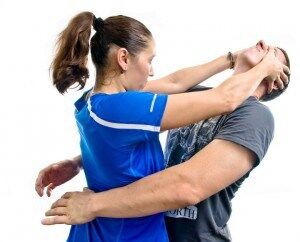
The Eye Gouge
Image credit: Tipsforsurvivalist.com
The thought of gouging someone’s eyes is enough to make most people shudder. However, it is definitely an effective method to free yourself when an attacker gets a hold of you.
There are different ways to execute an eye gouge, however, the simplest way is to aim both of your index and middle fingers towards the attacker’s eyes and poke them hard. You can also opt to use your thumbs for maximum impact.
With the thumb eye gouge, you would need to place your hands on the side of the attacker’s face and press your thumbs as hard as you can into the eyes.
The Stomp Kick
How to Do a Toe Stomp. Video credit: Howcast YouTube channel
Our legs are generally stronger than our arms so kicks may be one of the best ways to easily get away from an attacker. A toe stomp kick is a move that is easiest and most effective to do so.
Start by bringing your knee up and drive your heel down as hard towards your attacker’s instep as fast and as hard as you can. If you kick hard enough, you may just break some bones and severely injure his foot enabling you not only to escape from him but also prevents him from running after you. Ladies, this technique is particularly useful when you are using stilletos or high heels as the heels of your shoe can act as a ‘weapon’ and likely to help in severely injuring the assailant.
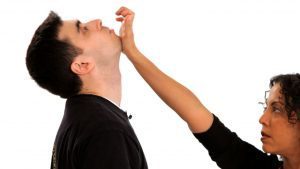
The Palm Strike
Image credit: Howcast.com
Instead of the usual punch done with a clenched fist, this technique uses the ‘meaty’ portion of the bottom of your hand – located by your wrist.
This move will do enough harm and confuse your attacker, giving you enough time to flee from him. Plus, hitting with the heel of your palm is less painful (for you) than throwing a punch!
Though the palm strike is particularly effective when aimed straight up towards the attacker’s neck, it can be as effective when used to target the opponent’s head or shoulder.
The Groin Kick
Groin Kick Techniques for Krav Maga. Video credit: Expert Village YouTube Channel
This move is one that is taken out from Krav Maga’s playbook. Also known as the “Art of Staying Alive”, Krav Maga moves are designed with effectiveness and efficiency in mind.
The groin kick, however ‘crass’ it may seem, gets the job done quickly. To carry it out properly, you would need to aim for and kick your attacker’s groin as fast and as hard as you can.
Start by facing your attacker with the leg you’ll be kicking with behind you. Then, proceed to kick out and upwards between the attackers legs with your shin for maximum impact.
I hope these Self-Defense Moves that Anyone Can Learn help you stay safe.
If you want more I linked to a comprehensive article on different types of Martial Arts Training.
By: Lystia Putranto
Lystia is a contributing writer for BookMartialArts.com, the world’s leading martial arts theme travel website. She’s fascinated by all types of martial arts and can’t get enough of martial arts moves both on screen & off.


 Experienced martial artist and veteran correction officer Sgt. Rory Miller distills what he has learned from jailhouse brawls, tactical operations and ambushes to explore the differences between martial arts and the subject martial arts were designed to deal with: Violence.

 Though we do believe that proper martial arts training is the best way to learn an arsenal of effective self-defense moves, there are some basic moves that you can easily learn without having to spend years of training.