Tag: shooting

  • Training Survival: Building Shooting Muscle

    Training Survival: Building Shooting Muscle

    Training Survival: Building Shooting Muscle
    Buy at Amazon

    Since you carry a gun for self-defense or to save the life of another, then you are concerned with combative firearms skills rather than shooting merely for the experience of shooting.  To reach this goal, you engage in training, mostly in the form of practice on a range.  How close you get to your goal will depend on the effectiveness of your training.  Building shooting muscle is a big part of proper training regimen.

    Since you carry a gun for self-defense or to save the life of another, then you are concerned with combative firearms skills rather than shooting merely for the experience of shooting.  To reach this goal, you engage in training, mostly in the form of practice on a range.  How close you get to your goal will depend on the effectiveness of your training.

    Let’s use weight lifting and body building as an analogy.  If you want to get bigger and stronger, we know that you have to concentrate on working the large muscle groups of the legs, back, chest and shoulders.  You do this by training mostly with the foundational exercises for these muscles: squats, dead lifts, bench presses, presses, rows, pull-downs and so on.  There’s a total of maybe a dozen core exercises on which you spend most of your time.  Yet there are hundreds of lifts you could do, and most of these work the smaller muscles.  They are useful, but if your goal is size and strength, you use them sparingly, since you have only a limited amount of time and energy.  Mostly these ancillary exercises are used to refine your shape and to add variety in your core routine to avoid boredom.

    But if you go into any gym, you’ll see people spending their precious training time on these secondary exercises.  Either they don’t know any better, or they think they have invented a “better” way, or they read in a magazine somewhere that so-and-so does this exercise, or they’re bored with the core exercises.

    Now, go to any range and watch people there.  You’ll see a great deal of shooting for tiny groups, with eyes focused on the sights of the pistol — regardless of the range.  You’ll see people shooting at ten to thirty yards, rather than at zero to seven yards.  You’ll see people standing still as they shoot.  And so on.

    Now, it is certainly a better marksman and better shooter who can shoot tiny groups, particularly at long ranges.  But in the light of our goals, these kinds of skills are secondary.  They are far less likely to be needed for our job than other, more foundational, skills. How do we know this?  Here’s three sources.

    The first is the consistent statistics from law enforcement shootings in which officers were killed.  These FBI-compiled numbers have been pretty much the same for many years: 50% of LEOs killed are killed at five feet or less, and 75% killed are killed at ten feet or less.   The second source is the Police Marksman Association survey done in 1992 showing the average police gunfight was won at about 20 feet seven yards (but note that this conclusion was from a pretty small sample.)   Finally, there is the data from NYPD’s SOP-9 that indicates that from 1994-2000, 69% of their shootings (of all types) were at two yards or less, and 88% were at seven yards of less.  These numbers are pretty consistent form year to year.

    So what do these statistics mean in terms of training?   That the bench press and squats of firearms survival training are the techniques to handle threats at seven yards and in.  We detail the techniques relevant to these distances below, but first, a caveat.

    We do most emphatically not mean to say that training at long handgun distances (15 to 50 yards) is not useful or even not important.  Police officers certainly have to engage in long-range shooting on the job.  We are just noting that these long-range skills are less likely to have to be used than close-range skills — that’s just the facts — and thus we suggest that they constitute your ancillary — not core — training.  Longer range skills and super-tight marksmanship skills are the equivalent of weight exercises to develop the smaller muscle groups.  They are  less likely to be used, but they can 1) be useful in and of themselves, 2) they help to keep the training interesting, and 3) they round you out.

    Contact distance to 2-3 yards  At this distance, if you do not already have your gun out, and you are facing a deadly force attack, you simply will not have time to draw your weapon.  The physics of the situation dictate that you will have to at least initially deal with this attack with empty hands techniques.  This reality, of course, means that the “equalizing” factor of the firearm — one of its chief advantages — is negated.  It also means that life is unfair, as the small, the weak, the injured and the older are at a disadvantage to their undoubtedly younger, more fit attacker.  Life is, in fact, not fair. Sorry.

    Your only choice here, if you want to honestly deal with your most likely self-defense scenario, is to pick up some vicious empty hand techniques.  These, of course, work better if you are in shape, whatever your age.  Such techniques are called “combatives” these days, as opposed to “martial arts”.  The integration of combatives with the use of the firearm generally goes by the term “extreme close quarters shooting”, and the leading edge material in this area today comes from a man known as “SouthNarc”, for the apparent reason.  His DVD on the subject, “Fighting Handgun Volume I” is available from Shivworks, www.shivworks.com, and is highly recommended.

    3 yards to 7 yards  At this distance, if you are trying to hit an exposed person, the proven method of Applegate-style target focused shooting (as opposed to many other methods of “point shooting”) is the most likely technique to be useful.  This is for the simple reason that under a lot of stress (some combination of startle and fear), you are hard-wired to look at the threat, not anything less important from an evolutionary viewpoint, like your sights.  (Of course, if you aren’t much startled, or not in much fear, you may well be able to focus on your sights.)  Here the gun is held very firmly, the gun raised to intersect the eye/target line, and the trigger pulled.  The technique works both one-handed and two-handed, and most people find that that the tighter they hold the gun, the better results they get (relaxed, “firm but not too tight” holds work well, by contrast, for precision and non-stressful shooting.)  Since most shooters have been trained to look for their front sight, practicing target-focused shooting takes some mental concentration.  Interestingly, when I am having a not-good day on the range with semi-sighted fire at these distances, if I force myself to target-focus, I can often improve results.  If you are in a law enforcement or military unit, Lou Chiodo of Gunfighters Ltd (www.gunfightersltd.com) is a great source for instruction in this method of shooting.

    7-10 yards and out  At these distances, traditional sighted shooting is appropriate.  And we strongly recommend that you practice it, and not only because longer range shooting may be necessary.  When we cite the distances above, we are assuming that you need to hit a man-sized attacker.  Hits anywhere on the torso are acceptable, with most instructors insisting on hits within a roughly 8½ x 11 inch  area (the size of a standard piece of paper) as the goal.  If you have only a part of your attacker available as a target, then the precision demanded of you increases, and thus the effective distance increases.  A half a man target area available at 5 yards is about the same difficulty as a whole man at 10 yards, and so on.

  • How to Shoot a Slingshot without Losing Accuracy?

    How to Shoot a Slingshot without Losing Accuracy?

    Slingshot
    Buy at Amazon

    One of the best ways to improve hunting skills is to use a slingshot. But how to shoot a slingshot is something that not many of us know. But that’s okay because the learning process is pretty basic and easy. And most importantly, it’s essential that you learn how to use the tool properly if you want to avoid casualties or damages.

    A slingshot is a weapon that needs to be handled with care and responsibility. So please continue reading if you want to understand the correct away how to shoot a sling shot safely.

    We’ve listed a detailed guide on this particular topic so that you can enhance your hunting skills. The article also includes some valuable tips on how to use the tool properly. So let’s begin!

    Here’s a clear idea of what awaits below:

    • What you need in order to learn how to shoot.
    • Ammunition loading.
    • The correct way of aiming your shot.
    • And finally, getting ready to fire.

    Gather everything you need

    When learning how to shoot a weapon like a slingshot, there are a few things you need to gather beforehand. This helps in saving ample of time and directing your complete focus on the process of learning instead of struggling with finding materials.

    What you will need:

    • Ammunition
    • Slingshot

    We would advise you to use dense and round objects. For ammo, feel free to select from fishing sinkers, small rocks, glass balls, and marbles. Ball bearings and marbles are considered to be the best since they come in striking colors. And this makes the process of tracing and evaluating your shots easier.

    The method

    1. Ammunition loading

    Once you gather all the required materials, it’s time to begin loading the ammo. Hold the bottom of the slingshot with either the right or left hand, whichever feels more comfortable. Use the opposite hand to place your ammo in the center of slingshot’s pouch.

    Please make sure that the ammo doesn’t swing away as this tends to mess with precision and accuracy.

    Use the fingers, preferably the index finger and thumb, to hold the ammo in place. At this point, the strap and thumb need to be in a parallel position.

    1. The correct way of aiming your shot

     Hold the slingshot properly

    To shoot in a more comfortable position, you need to use the principal arm. This also helps in producing a better and more accurate shot. The secondary arm is to pull back the ammo. Such a posture provides the principal arm with the much-needed strength to hold the slingshot in a steady position while releasing.

    Now grip your slingshot in a perpendicular or flat manner. This you can do by holding up the weapon and raising the arm. Some shooters prefer to allow the forks of the slingshot to point upward while some like to angle the tool slightly along the side.

    Since slingshots come in different lengths and widths, you might have to tweak the way you hold it based on the size and form.

    • Watch your stance

    The way you stand determines how comfortable and confident you are with your aim. Place the right foot forward while drawing back the left one. At this stage, the left foot needs to point slightly outward. This applies to right-handed shooters. Left-handed hunters can do the exact opposite. Once the feet are positioned properly, bend your knees a little bit.

    Such a stance enables you to create a solid foundation by keeping the feet pointed in the forward direction while also maintaining a shoulder-width stance. Failing to do so might keep you from striking that perfect balance in order to aim accurately.

    • Place the slingshot sideways

    The shoulder of the principal arm needs to front the target. So you can do this by raising the slingshot perpendicularly while also making sure that it marginally slants away from your body. This gives you plenty of space to free the arm to yank back the band.

    • Breathing is important at this point

    Before releasing the thing, it’s important to take a deep breath. This prevents the possibility of any bodily movements, which improves your aiming capacity.

    1. Getting ready to fire

    This part is crucial when it comes to learning how to shoot a slingshot. Take your time to aim to the target. There’s no need to rush, you can do it slowly too. Your head needs to be positioned in such a manner so as to marginally enable you to check the target. And this way you will also stay clear from those bullets.

    It’s best to use the dominant eye only, so closing the second eye is not such a bad idea. But if you wish to train with both eyes open, then that’s okay as well. Because such a practice goes a long way in improving your skills and performance level.

    Once you’re ready with the correct posture, it’s time to take the shot.

    1. Fire the shot
    • Pull the slingshot band

    Make sure that the band is completely stretched and that all triangles are clearly visible. They also need to be shaped by your slingshots’ splits.

    • Discharging the band

    It’s time to flick the wrist forward to shoot your ammo and strike the target. Keep your thumb away from the projectile at this point. Failing to do so might lead to a painful injury.

    Congrats, now you know how to shoot a slingshot!

    If you’ve gone through each and every step discussed in the article above, then you’ve gained a little more confidence as a shooter. We’ve made it a point to make this guide of how to shoot a slingshot as simple as possible. So the instructions are easy to understand.

    You need to keep in mind that practice is key. You have to keep going at it if you want to improve your skills. The goal is to make not only shooting but also aiming a more comfortable experience.

    So please continue learning while also helping us improve by providing your feedback at the bottom. Feel free to leave all your comments in the section below. We hope you enjoyed reading the article!

    About the author:

    Tony Lohman (the founder of OutdoorHole) has been writing about outdoor sports and activities for many years now. As an outdoor enthusiast himself, he knows what kind of gear to use and how to use it. And that is what he shares with fellow adventurers on this platform. His valuable guides and tips are useful for beginners seeking to find the reliable answers.

    Sources:

    1. http://deerhuntingfield.com/how-to-shoot-a-slingshot/
    2. http://melchiormenzel.de/info_shoot.html
    3. http://www.buzzle.com/articles/slingshot-shooting-tips-how-to-shoot-a-slingshot.html
  • The Whys and Hows of Contact Shooting

    The Whys and Hows of Contact Shooting

    The Whys and Hows of Contact Shooting
    Buy at Amazon

    Contact shooting is just what it sounds like. Putting the muzzle of the weapon in contact with the target and shooting it. This is done when you absolutely cannot afford to miss. An example of this would be your spouse or child being attacked and they are wrestling on the ground. Traditional aiming would be unsafe as there is too much movement and the good guy is too close to the bad guy.

    The technique shown in the video is for locked breech guns that won’t fire when they are out of battery. Out of battery means the slide is depressed enough so that the gun is no longer locked.

    This is particularly useful with Glocks, but it is applicable to many other makes and models.

    Please take note that the gun not firing out of battery does not apply to all guns. I have owned semi-automatic pistols that would fire when the slide was depressed. Also, in class demonstrations with unloaded guns I have had the slide depresses, but not depressed enough so that the striker will fall.

    Therefore:

    Do not demonstrate the technique shown on the video with a loaded gun, mistakes can allow the gun to fire out of battery.

    I have done this demonstration many times, and have guided students to do it hundreds of times. It is “scary” as many students are afraid the slide will come back and break their thumb.

    This will not happen if pressure is placed on the back of the slide. This keeps the barrel locked and prevents the slide from moving under recoil. Do not let the slide move….

    If you do not press the slide closed, and movement to the rear is started, it can hurt your thumb.

    This is not a technique that needs a lot of practice, as it is a close proximity shot under extreme circumstances. Very few people will ever use this technique, but having it the tool box can be a lifesaver.

  • Shooting a Beer Can Mortar into a Mobile Home

    Shooting a Beer Can Mortar into a Mobile Home


    Blackpowder Can Mortar
    Buy a Cannon, Click on the Picture

    Of all the toys I have have had, nothing is as fun as my Beer Can Mortar.  I love making up rounds and then experimenting with how different powders impact my range.
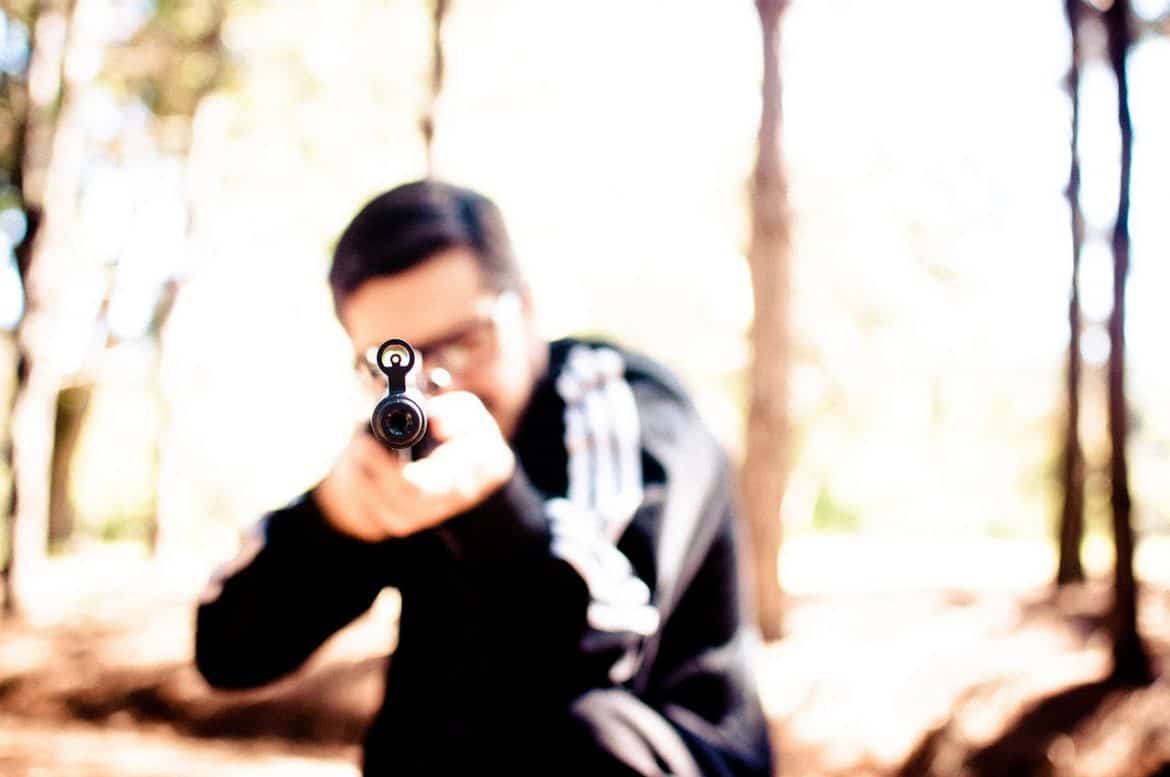
    Since I was tearing down the trailer anyway, I decided to have a little fun.  I wanted to see if I could shoot my cannon into the wall of the trailer.

    I did not know what to expect, and I was a little nervous.

    Luckily, there was nothing to be nervous about.  The loose fit of the mortar, and the small amount of powder I used kept the can mortar round from doing too much damage.

    Actually, the mortar is not designed to be a direct fire weapon.  Rather it lobs the rounds up and over to land down on the target.  The round probably would have done more damage if I shot it froma farther distance and let the cement filled soda can fall down from the sky.

    In the end, it did not matter how much damage the round did, as I was only trying to have a little fun showing off my can cannon.

    Once again, I think everyone should own a beer can mortar.

  • Advanced Carbine Tactics DVD

    Advanced Carbine Tactics DVD

    Book Review: Advanced Carbine Tactics DVD
    Buy at Amazon

    Its exceptional accuracy, controllability, and wide array of accessories make the carbine an essential tool for modern warriors.

    In this exclusive video from Paladin Press, WARTAC founder Rich Nance and WARTAC instructor Aaron Peachman teach combat techniques and tactics designed to help you deploy the carbine under real-world conditions.

    In Advanced Carbine Tactics they first they reveal the mindset needed to master the fundamentals of marksmanship, proper weapon handling and shooting positions, malfunction clearing and reloads, and shooting in low-light situations.

    Then step-by-step instruction in one- and two-man room entry and the use of cover provide you with the advanced tools needed to maximize the carbine’s advantages in a firefight.

    Ultimately, the will to win and expert training in sound combat tactics are what help you prevail in any violent encounter. This video delivers both.

    Rich Nance is a black belt martial artist, with over 25 years of experience. Nance has been a police officer for 13 years and a SWAT team member for six years. He is a firearms instructor, patrol rifle instructor, less-lethal munitions instructor and his department’s lead defensive tactics instructor. In 2004 Nance and David Hallford founded WARTAC CQC , a company specializing in tactical training for law enforcement and military personnel. Aaron Peachman has 20 years of experience in the martial arts. He has been a police officer for four years and is a member of his department’s SWAT team. Aaron is an instructor for WARTAC CQC.