Tag: survival

  • How to Use a Survival Still Over a Campfire

    How to Use a Survival Still Over a Campfire


    Gear Review: Using Survival Still on a Campfire
    Buy at Amazon

    The other day we showed how to use shelf brackets to hold pots over a campfire, today we will use this technique to try to distill water over a campfire.

    This is probably the most important test of the survival still, because if you ever have to actually rely on the still, you may not have any other cooking method other than the trusty campfire.

    Once again, if you rub bar soap on the outside of the bottom pot BEFORE you put it on the fire, the soot will clean up much easier.

    While a lot of people think the survival still is too expensive, I think it is a pretty neat product.

    I find that using a survival still over a campfire is a pretty easy way to distill water.

    (Edit) Now the Survival Still ships with a stainless steel water line.  If you have the old silicon one, contact them and they will ship you a new one free.  I got one in and it does work well, it is flared, so I find it picks up the water inside the still better, but being steel it is not flexible and I found it harder to fit on my stove with the pots I have – I had to use a bowl instead of dripping into the mason jar I normally use.

  • The Internet Guide to Survival and Self-Reliance

    The Internet Guide to Survival and Self-Reliance

    Book Review: The Internet Guide to Survival and Self-Reliance
    Buy at Amazon

    You could search the internet for weeks and not find half of the expert survival sites in this unique guide.   The Internet Guide to Survival and Self-Reliance comes with its own Web site to put all this information just a click away.

    The book, The Internet Guide to Survival and Self-Reliance teaches you how to supply your own food, power and shelter; save loads of money; and spark your imagination with creative and resourceful new ways to live a self-reliant life.

    While some of the links in the book are not longer active, this is a great concept, and the website address for the book’s site is very useful.

    I wish I had thought of this and acted on it first – its that good of an idea.

    While it is an older book on the internet, I think it is worth a read.

    However, while I would buy this book again, I would try to find it at a used book store or otherwise at a discount.  I got mine from the “scruffy” sale at Paladin Press, where they sell damaged books at a discount.  Actually I get most of my more “Action” orientated books this way.

    I guess the best thing I can say is that I wish I had done this first.  Its a great idea for a book.

  • How to Extract Clean, Drinkable Water From Plant Leaves

    How to Extract Clean, Drinkable Water From Plant Leaves


    Survival with Water Condensed from Leaves
    Buy at Amazon

    As a child I used to read about solar stills made by digging a hole in the desert and covering it with clear plastic, I was an adult by the time I actually visited a desert environment, but I was very disappointed with the results.
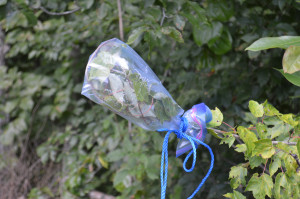
    However, by placing a plastic bag over the leaves of a living plant, you can extract clean, drinkable water from plant leaves. This survival tip is very easy to do.

    I was able to collect much more water condensed from leaves than I could from the typical solar still dug into the ground.  Additionally, this method too far less work and effort.

    Condense Drinkable Water From Plant Leaves

    Material:

    • Several Large clear plastic bags
    • String or cord
    • Live, non-poisonous vegetation with green deciduous leaves

    Procedure:

    1. Tie a clear plastic bag on the end of a plant or small tree branch. The bag should be sealed very tightly over the branch so water cannot escape.
    2. Water vapor will collect and condense in the bag.
    3. Wait until evening for maximum condensation before removing the bag.
    4. Switch the bag to another branch and repeat.

    Yield:

     Water Condensed from LeavesYou can expect an average of one cup of water per bag per day – which means you will need 16 of these devices per person to collect the minimum recommended one gallon per person per day or water.

    Gathering water condensed from leaves is much easier than other condensation methods, but as with any method it takes a lot of stills to get enough water.

  • Survival Punk Paleo Food Bar

    Survival Punk Paleo Food Bar


    Kitchen DIY: Survival Punk Paleo Food Bar
    Click the Picture to Purchase

    One of the friends I have made while creating this site is James Burnette of Survival Punk.

    While we share a strong DIY ethic, we do have a lot of differences.

    Most notably in the areas of fitness and nutrition…  However, while out working on the land James offered me some of a Paleo Food Bar he developed.

    Jame’s Paleo food bar is a mixture of 4 ingredients – Lemon, dates, coconut oil, and shredded coconut.

    While I much would have preferred a burger, I can see where a paleo ration bar has a use in preparedness or survival.  While, I don’t like coconut, it tasted pretty good.

    Watch the embedded video to hear James talk about his bar and why he created it the way he did.

    My wife has experimented a little with paleo diets as she has worked to get healthy. I still am not convinced any diet is better than just eating a balanced diet and working hard physically.

    However, since I still eat mayo, cheese, sweet tea and beef as my four food groups you should not consider me an expert.

    *Update:

    I dropped sweet tea as a food group.  I now drink water.  That helped my diabetes.  I am also working on my cholesterol so mostly I eat Cheerios and grumble.

  • Knots: Figure Eight

    Knots: Figure Eight

    Knots: Figure Eight
    Buy at Amazon

    If you are involved in either sailing or rock climbing, it is likely you know the importance of the Figure Eight knot. It is used to stop ropes from running out of retaining devices.

    Like the overhand knot, it will jam under strain, but unlike the Overhand, which often causes the rope to have to be cut, the figure of eight is usually more easily undone than the overhand knot.


    Tying the Figure 8

    • Pass the tail over itself to form a loop.
    • Continue under and around the standing end.
    • Complete the knot by passing the tail down through the loop

    Can also double the rope up and make a figure 8 on a bite to be used for anchoring rope.

    When my dad taught me about mountaineering and repelling this was one of the first knots he had me memorize.

    He told me that proper knots are more than just pretty.  They were a sign of professionalism and knowledge.  He said that proper knots did the job they were designed to do, and as a rule (with the double fisherman as an exception) were easier to untie than improper knots.

    To this day, I cannot tie a load down without thinking of him.