As a child I used to read about solar stills made by digging a hole in the desert and covering it with clear plastic, I was an adult by the time I actually visited a desert environment, but I was very disappointed with the results.
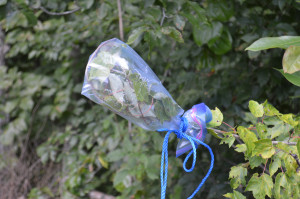
However, by placing a plastic bag over the leaves of a living plant, you can extract clean, drinkable water from plant leaves. This survival tip is very easy to do.
I was able to collect much more water condensed from leaves than I could from the typical solar still dug into the ground. Additionally, this method too far less work and effort.
Condense Drinkable Water From Plant Leaves
Material:
Several Large clear plastic bags
String or cord
Live, non-poisonous vegetation with green deciduous leaves
Procedure:
Tie a clear plastic bag on the end of a plant or small tree branch. The bag should be sealed very tightly over the branch so water cannot escape.
Water vapor will collect and condense in the bag.
Wait until evening for maximum condensation before removing the bag.
Switch the bag to another branch and repeat.
Yield:
You can expect an average of one cup of water per bag per day – which means you will need 16 of these devices per person to collect the minimum recommended one gallon per person per day or water.
Gathering water condensed from leaves is much easier than other condensation methods, but as with any method it takes a lot of stills to get enough water.
Today we are going to test and discuss my water line installation. I rented a trencher to put in a new water line and while I was at work my buddy installed a water hydrant like the one pictured here.
He also put in an underground connection for the tiny house. Additionally Smitty put in a stub so that later we can branch off and run water to a future goat barn.
To ensure we have no leaks before we fill the hole back in Smitty put in a temporary stand pipe and attached an air gauge.
We attached an air line and pressurized the system to 80 psi for about 4 hours. If the pressure stays in the system there are no leaks.
If the pressure drops then you know you have a leak.
To find the leak add three drops of dish soap into a bottle of water. Simply spray the water around the couplings and air the system back up. Leaks will blow bubbles with the solution.
You can then fix your water line installation problem.
We also put the water line to the tiny house in a bucket buried in the ground and added a shutoff. This is useful because if the plumbing in the house needed to be worked on, you can shut it off from the outside so that you don’t have water leaking all in the building.
I spend a lot of time looking at appropriate technologies coming from missionaries and other groups that work in third world countries.
I figure – if it works in areas lacking infrastructure then it will work if we ever lose our infrastructure.
This idea came from a couple of YouTube videos I saw of people making water bottle skylights out of 20oz soda bottles.
This is also called a solar bottle bulb. Either way, the concept is pretty simple I have used this in domes and animal houses several times.
Most specifically I got it from the video at the bottom of this page.
I modified it slightly and was quite pleased that two of them gave enough light in my cement dome that I can see what I am doing.
Actually, if I am in the general area of one of the lights I can actually read by the light.
This technique was used on my Dome of Doom on Doomsday Preppers and it works very well. I have a series on how I made my cement EMT dome.
Parts:
1 clear soda bottle
Water
Bleach
Plastic roof flashing
2 eyebolts
Wire
Duct tape
Mylar space blanket
Procedure:
Drill two small holes on opposite sides of the plastic flashing, and thread the eyebolts in the holes
Fill the bottle with water, leaving enough space that you can add about a ¼ cup of bleach to keep anything from growing in the water.
Cut the mylar blanket into a strip approximately 1/3 the height of the bottle.
Center the mylar strip in the middle of the bottle and wrap it tightly – you need to leave unwrapped bottle at the top of the bottle to gather light, and at the bottom to release it. – Basically you are making a reflective tube to channel the light.
Insert the bottle into the flashing, leaving about 1/3 of the bottle sticking outside the top of the flashing.
Wrap wire around one eye bolt, pull the wire tight over the bottom of the bottle, and then secure it to the other eye bolt – this keeps the bottle from dropping out of the flashing.
Insert the entire assembly on your roof and calk as needed to prevent leaks.
Note:
Over time UV light will degrade the plastic – but since soda bottles are everywhere, it is a simple process to rebuild as needed.
This method Sterilizing Water in a Pressure Cooker is much like pressure canning. Except instead of sterilizing food, we will be sterilizing drinking water in glass canning jars. Unlike filtering or distillation, this will not do anything for contaminate – just organisms.
To truly sterilize something, it must be free of all microbes AND spores.
Boiling does NOT kill all bacteria. Some bacteria are actually resistant to the temperature of boiling water at 212° F. (100 ° C.). Many bacteria formed spores can withstand boiling.
To kill all the bacteria, you need to raise the temperature to about 250° F. (121° C.). Sterilizing with steam heat is the most common method to obtain this level of sterility.
It is also the most effective, since spores can resist dry heat, but 30 minutes of exposure to steam at 250° F. 121°C will kill almost anything.
Fill the canning jars with water, leaving 1 inch head space before closing the lid, and only tightening the bands just finger tight.
Add the water filled jars to the pot.
For Canners or Cookers with A Weighted Pressure Regulator
Lock the lid in place, but do NOT place the weight on the vent pipe.
Turn the heat to high
As soon the water at the bottom of the pot begins boiling the steam will displace the air inside the unit.
Let the steam escape from the cooker or canner in order to expel the air.
Wait until a good jet of steam is venting from the vent pipe before replacing the pressure regulator weight on the vent pipe.
Once the pressure setting reaches 15psi, turn down the heat and start a 30 minute timer.
Make sure the pressure setting remains constant, if pressure drops, get back up to 15 psi and restart timer.
After 30 minutes, turn off the heat and allow the pot to cool naturally until the pressure slowly drops.
The jars of sterile water should now be removed immediately.
As long as the sterilized liquid remains sealed the jars should be free of microbes until it is opened again.
It occurs to me that if you are having to sterilize water in a pressure cooker, the chances are good you kitchen stove isn’t working so I have included below instructions in using a pressure cooker on a wood fire.
If your pressure cooker is stainless steel and does not have any sort applied coating or non-stick finish, it can be heated outside over a wood or charcoal fire.
Start by digging a shallow depression in the dirt and build a fire in it.
Build up a large enough fire to produce a deep bed of coals.
Position the canner in the heart of the coals.
Cooking on a fire is harder than on a stove because it will be necessary to reposition it in order to maintain proper pressure
Moving it in or out of the hottest part of the coals as needed.
The survival still I am reviewing today is a lightweight, portable water purification still that can purify almost any water source from any heat source.
That makes it flexible. Which is a vital, but often overlooked feature of survival products.
As soon as I saw this still I knew I had to have one, so far this has been the ONLY piece of survival equipment I purchased without needing to do any research. Understood the science behind the product, and the second I was introduced to the product I knew it was a keeper.
As a matter of fact, my first question was, how many do I need to buy to become a dealer? The only other question I asked concerned the makeup of the drip tube (the only non stainless steel part in the product). By the way, the tube is medical grade silicon so it won’t degrade or release dangerous chemicals if it is accidentally exposed to solvents.
I am a true believer in this product, and as time passes I will show videos where we distill various contaminates, and using a variety of heat sources so you can see the versatility.
The Survival Still is a non-electric appliance that uses the science of distillation to purify water by boiling the water and collecting the pure steam leaving any contaminates behind.
Because of the process, distillation allows you to have consistently pure water from virtually any water source, without the use of filters. There are no moving parts, no filters to clog or replace, and no complicated steps to remember.
The survival still lets you purify water from your swimming pool, a stream or even the ocean, for as long as is needed. When the disaster (or camping trip) is over, simply wash out the bottom pot and pack away.
Extremely effective against all types of contaminants.
Kills and removes bacteria, viruses and parasites.
Is a permanent solution for purifying sea water.
Does not need filters, maintenance, infrastructure or a supply chain.
Distillation is recommended by FEMA and the Red Cross!
The power of distillation
As we said earlier, the Survival Still uses the process of distillation. This process scaled down from nature’s process to purify water.
Nature purifies water through the three-step process of
Evaporation
Condensation
Precipitation.
When water evaporates it cannot hold onto the particulates such as dirt, debris, or heavy metals so these contaminants stay behind while the vapor is pure.
The pure vapor then rises and condenses into clouds. The clouds move inland and release the water as rain. Rain is very pure water and is the source of all fresh water on the planet.
In the same way, distillation produces high-purity water without the need for filters.
How it works
The Survival Still is designed to be used with standard cooking pots that you already have.
To use the Survival Still simply fill a standard soup pot with about a gallon of water and put it on a heat source such as a propane grill, stove top, or campfire.
Bringing the water to a boil kills any bacteria and parasites.
Contaminants are left in the lower pot, while the pure steam rises and is captured by the Survival Still.
The Survival Still rests on top of the bottom pot.
A second pot of water sits on top of the Survival Still, for the purpose of cooling the steam back into liquid water.
Droplets of pure distilled water then drip down and they flow into a storage container.
Once again, the Survival Still® is a wonderful addition to your preparedness plan, it is rugged enough, effective enough, simple enough, and effective enough to be one of your primary water purification methods, and unlike filters there is nothing to replace or clog.
As an added benefit, the action of condensing the pure steam heats the water in the top pot so that as you purify your drinking water on your campfire you are heating water for hygiene needs – so you are getting multiple benefits from the same device.
How does the Survival Still® compare to filters?
Survival Still®
All Filters
Meets Red Cross Recommendations
Yes
No
Converts Ocean Water into Drinkable Water
Yes
No
Fail Safe Protection (air gap that separates contaminated water from purified water)


 You can expect an average of one cup of water per bag per day – which means you will need 16 of these devices per person to collect the minimum recommended one gallon per person per day or water.


 I spend a lot of time looking at appropriate technologies coming from missionaries and other groups that work in third world countries.

 This method Sterilizing Water in a Pressure Cooker is much like
