Category: How To (How I Did)

You could call this a How To – but people often tell me I did it wrong – now to be fair you can’t really tell me I can’t do it that way, when the video shows I actually DID do it that way – so to cool down the hateraide – lets just call this HOW I DID

  • How to Build a 12 Volt Chlorine Generator for Water Purification

    How to Build a 12 Volt Chlorine Generator for Water Purification


    DIY Chlorine Generator for Water Purification
    Buy at Amazon

    The way I approach prepping is that I have a list of tiers of preparedness, and I try follow a consistent approach of not jumping tiers for specific sections until all sections on a tier are filled (This is flexible based upon situational factors).

    In my Defense tier, I would really like to have .45 Camp Carbine with an integral suppressor and mounted thermal imaging. If I spent my resources on that and only had a CB radio and a 72 hour kit as my only other preps, then I would not be spending my resources wisely.

    It is most cost effective to buy a year supply of food using the LDS list before you spend twice as much on a 3 month supply of freeze dried food.

    Water Purification is Important

    That being said, you might have noticed I am on a water purification kick. Some of that is that I have noticed the amount of water I have been using on livestock and gardening.  Some is that I realize its impossible to store water for an extended period due to space and weight issues.  The third reason is that I ended a preparedness tier with my Calcium hypochlorite prep.  One small purchase game me the ability to disinfect approx 50k gallons of water.  It is easiest to start the next tier on water since that’s what I have been researching lately.

    What is a Chlorine Generator

    Today’s project is a device used to create a practically inexhaustible supply water purification chemicals.  Basically, it make the same disinfecting solution as the calcium hypochlorite makes. You might ask why I went through the trouble of buying the HTH pool shock if I had planned all along to make a device that does the same thing.  Especially considering the storage considerations of the corrosive chemical. Well, the pool shock is does not need an energy input to work. I cannot break it.  Additionally, I bought a lifetime supply for under $25.00.

    The DIY Chlorine Generator for Water Purification is also called a Chlorine Producing Unit (CPU) I am about to show you works very well, but it requires 12 volt electric input, uses expensive and technologically advanced electrodes and cost a little over twice as much to make.

    I have found that American missionaries that work in the third world are an excellent supply of information in what some call “appropriate technology” This is people centered, small scale, labor intensive, energy efficient, environmentally sound devices and processed. It’s a lot like “Macgyverisms” from my favorite 80’s TV show. He had advanced knowledge and primitive supplies and was able to cobble together 1900’s level tech with modern scientific principles.

    One famous example of this is the CD3WD which is a collection of appropriate tech, Travis Hughley and barrelponics (which I AM going to build one day) and Safe Water International Ministries the developers of the CPU that is the focus of today’s article.

    SWIM has developed the CPU to provide a chlorinating solution for water disinfection in third world countries. I would highly recommend you check out their website and consider donating to their mission as they are doing wonderful work.

    Comes in a Complete Kit Also

    If you want a CPU, but don’t have a DIY gene or interest in building one yourself, SWIM sells complete CPU tool box kit which includes an instruction card, a chlorine test kit, 2 mixing bottles, a salt measuring cup, and a couple of solution droppers. All you need to provide is 12 volts of electricity, salt, and water. A donation of $150 to their ministry would support this kit.

    I wanted to turn this into a project so I gave a $50 donation and received the anode and cathode from them. They will email you the plans for free if you contact them on the website, and they have a technology link online with the instruction manual and a basic lesson plan for teaching this to others. I will warn you, the cathode and anodes are the main expense in the CPU, and you may have a hard time finding a supplier. One is a titanium mesh; the other is a mixed metal oxide (ruthenium).

    However, I must tell you that their primary mission is to provide these units for missionary work in third world countries, so if demand causes a supply backlog, I would imagine they would fill that need first.

    Basically what happens is when you bridge the electrodes with a salt water solution and apply an electrical charge to them you start a chemical reaction called electrolysis. In this particular process the water bubbles and produces a caustic chlorine solution roughly half as strong as laundry bleach. After the 9/11 attacks many municipal water treatment plants converted to this process so that they could remove their one ton chlorine gas tanks from their sites to mitigate their attractiveness as a terrorist target.

    Per the SWIM for Him website the directions for use are:

    1. Mix salt & water solution ( approx. ¼ cup salt to 16 oz water)
    2. Connect wires to 12 volt source (negative, or black, to negative; positive, or red, to positive)
    3. Pour the saltwater solution through the CPU into another bottle (observe the bubbling process)
    4. Carefully repeat the pour-through process 5 times.
      1. This is different from a chlorate cell as that the water free flows through the unit which does not allow chlorates or perchlorates to form. This process operates at a different voltage and a much lower temperature.
    5. Unhook the battery wires.
    6. Rinse the CPU by pouring clean water through it.
    7. Add 10 drops of the solution for each gallon of drinking water.
    8. Wait one hour before drinking.

    It works with Solar Also

    Additionally, if you are using solar power to charge your battery, you will want to recharge it for 3-5 hours after this process to ensure it is fully charged.

    You will also need a test kit to ensure you use enough chlorine solution to properly sanitize your water supply.

    This was a very simple project and I built the device in under an hour, I have to wait about 24 hours for the sealant to set, and then another 30 minutes in finishing touches. Please watch the video below to see all the steps.


  • How to Build a Parabolic Solar Heater

    How to Build a Parabolic Solar Heater


    Build a Parabolic Solar Heater With an Old TV Dish
    Buy at Amazon

    My last tenants got direct TV without asking me, that’s not so bad, but they set this big metal post in concrete right at the edge of my house. I don’t like it, but I really did not want to grub out this post. Rather than rip it out, I re-purposed it to make a parabolic solar heater
    I am a fan of solar energy, especially when its limitations are accounted for. Through research, I have decided that the heating aspects of solar is easier to utilize than converting it to electricity.  Its also much cheaper.

    A man that has done quite a bit of work in this area is Dan Rojas of Green Power Science.  He has done quite a few projects that I admire and plan on emulating.  He also sells some supplies for these projects and that where I bought the solar film I used in this project

    Re-purposing a Direct TV Dish

    What I did was dismantle the Direct TV dish and sand it smooth, I then painted it with black paint (and should have sanded that smooth also).

    I cut strips of the mirror film and attached them to the dish.  Its easiest to just cut straight strips and overlap them slightly.  Early cartographers learned that it is impossible to draw a round earth accurately on a flat sheet of paper, its the same with the film and a parabolic dish.  You cannot just slap the film to the dish, it will bubble up and refuse to form to the shape.  Some try to calculate the curve and cut out “pie” slices, but this works best in theory, the math works, but it does not translate well to the real world.  Strips that are allowed to slightly overlap each other works the easiest.

    You will find its impossible to separate the thin strip of film from its backing by hand.  Mr. Rojas suggested to use slap a piece of tape to both sides of the film (at the end of the strip, and don’t let your tape strips touch).  When you do this the film and the backer adhere to the tape so when you pull the tape in opposite directions the film will peel away.

    Its a lot like Window Tint

    Very carefully install the film on your dish, if you have ever installed window tint, its the exact same process.  I started in the center and worked outward, as this was easiest for me.  I imagine it does not make a big difference.  Just try not to overlap the strips too much, don’t allow bubbles to form, and don’t get two worried about the holes for the mounting bracket.

    After the strips filled the dish, I took a very sharp razor knife and cut a cross into the area of the mounting bracket holes.  This allows the screws to be inserted back into the dish.  I also trimmed around the edges of the dish.

    For some reason (dust and a bad paint job most likely) the film did not want to stick at the edges.  I had planned on running around the center of the dish with tape for decorative purposes, but I ended up doing it to help hold the film down.

    Reinstall the Dish and Focus the sun on the Jar

    I then reinstalled the dish on the post (don’t just leave it there, the focused sunlight can be dangerous – so don’t leave it unattended for long periods).  Pointed it a the sun, and rigged a empty glass jar at the focal point.

    The sunlight then heats whatever is in the jar.  You can use this to cook.  I have seen this on a large scale to boil water, and even make steam.  In California, Rojas’s dish actually burned a wood board.  I was not patient enough for that, but it did heat the jar uncomfortably hot.  (it was about 4pm in the afternoon, and there are a lot of trees in my neighbor’s yard, so that contributed to the heat difference.)

    I plan on working with this a little more, and seeing how effective this can be to cook.  Who knows, I may even come up with some recipes.


  • How to Build DIY Akro Bin Rail

    How to Build DIY Akro Bin Rail


    Workshop Organizer
    Buy at Amazon

    Here is the link for the instructables.com post that instigated this DIY akro bin rail project.

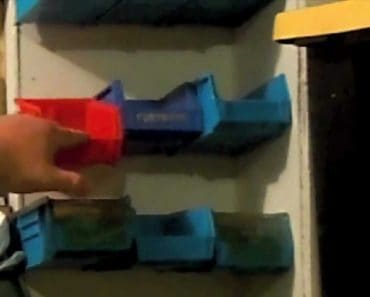
    When I saw this workshop organizer project in my inbox I knew I had to try it.  I had just inherited quite a few acro bins, and when added to the ones I already had, I needed a place to store them.  Add in the fact that my spare parts box was full of nuts bolts and nails, and that it was taking an unreasonably long time to find the right parts when I needed them I had to do something.

    In the instructuctable Mike Begley used aluminum flashing, but I found a piece of plastic molding first, and my ADD made me stop looking so I could get home and nail this thing to the wall.

    I had a weird corner in my shop that left me about a foot of wasted space, so I cut the 8 ft section of molding into 8 sections and stapled them to the wall.

    The lip of each bin clips neatly into the channel of the molding and holds them rather securely.  I do worry about the plastic breaking under extreme weight, but as long as I don’t put undo stress on the strips it should hold.  And if it does break, I get an excuse to buy a chop saw to cut aluminum flashing.

    All in all I am very happy with my DIY Akro Bin Rail.

    * Update

    It has been more that 7 years since I made this Akro Bin wall, and it is still going strong.  I haven’t had a problem with the plastic railing like I imagined I would.  However, to be fair, I don’t really take the bins on an off the wall as I thought I would either.


  • How to Make an Easy Tin Can Stove

    How to Make an Easy Tin Can Stove


    How to Make an Easy Tin Can Stove
    Buy at Amazon

    Today we are going to show you how to make a tin can stove, this type of stove has been around about as long as tin cans have been created, but it reached its peak of popularity during the great depression.  Now its popularity is mostly with frugal backpackers and girl scouts, as a matter of fact, the majority of comments I have gotten were from former scouts telling me how hot this stove can get…

    I first learned about this stove at a vacation bible school camp at the Tennessee Baptist Children’s home in the 80’s, and while this was a fun project, I never thought much about it until I began chronicling my journey to learn how to improvise, adapt, and overcome in a catastrophic disaster situation.

    Personally, I feel that this stove has some pretty severe limitations, its extremely hot, has little in the way of regulating heat, and its heating surface is small.  However, as a way to begin to find new ways of using old things, up-cycling, or making a MacGyverism, this stove is a good way of exercising your mind.

    That being said, here’s How to Make a Tin Can Stove

    Materials:

    • #10 can (empty of course)
    • Multiple tuna cans (also empty)
    • Cardboard (lots of strips as wide as the tuna can is tall, you’ll need a lot more strips than you think.)
    • Paraffin Wax blocks
    • Wick (I did not include this in my video, but it makes lighting the tuna cans a lot easier.)

    Tools:

    • Tin Snips
    • Can opener
    • Double boiler
    • Matches
    • Razor or study scissors for culling cardboard
    • Gloves and other appropriate safety equipment

    Procedure for stove:

    1. Using your can opener, punch air holes around closed end of can.  (a tip from MM in Jackson – don’t punch any air holes in the side you will have toward you, so that smoke doesn’t blow toward you)
    2. Using tin snips cut a rectangle opening at open end of can, large enough to allow a burning tuna can to be pushed into, and pulled out of the stove.

    Optional: use a metal coat hanger to fashion a damper on the stove opening using the scrap metal from cutting your opening

    Procedure for tuna can burner:

    1. Cut cardboard long cardboard strips as wide as your tuna can in tall.
    2. Tightly roll the strips into a small spiral.
      1. A piece of cotton wick inserted into the center of the cardboard helps in lighting the burner later.
      2. If you need to add more strips, overlap the end of the strip coming off the spiral with a new piece of cardboard so that it stays together on the roll.
    3. Insert the spiral into the tuna can.  This works best if the spiral is slightly larger than the can so that you must force it to fit.  The more corrugated cardboard you can force into the can, the less wax you will need, and the fire will burn longer and hotter.
      1. If needed, you can force additional cardboard strips between the can and the spiral of cardboard.  This is not easy, but it makes everything work better later.
    4. Once you have made as many burners as your hands can stand (I can make about 6 before my arthritis makes me stop), melt the wax using a double boiler.
      1. You should never heat wax over a direct source of heat, as it may flame up.  If you do not have a double boiler, use a large pot of water, with a smaller pot nested inside.  The wax is placed in the small pot and is melted by the regulated heat of the water instead of the heat from the stove eye.  This is much safer.
    5. Once the wax is melted, line the tuna cans up side by side and carefully fill them with wax.  It takes a surprising amount of wax to fill the cans, especially if you did not fully pack the cans with cardboard.
    6. Let wax cool.

    Procedure for using stove:

    1. Only use this stove outdoors, it is burns hot and with a lot of smoke.
    2. Place the stove on site that will not burn or be damaged by high heat.
    3. Light the tuna can burner and as soon as it flames place it inside the stove.
    4. It will only take a few seconds for the closed end of the can to reach cooking temperature, so don’t touch it once the burner is inside (I learned this the hard way).
    5. Using a skillet is best, but you can cook things like hamburgers directly on the stove.  It is too hot to cook things like eggs.
    6. Once cooking is complete, you can remove the stove and extinguish the burner.
    7. I flip the burner upside down and smother the flame so I can reuse the can, but you could smother it with dirt.  Don’t douse it with water, or the hot wax may explode with some force and spray you with hot wax.