With all the ice and snow lately a friend of mine sent me this idea for an improvised method to winterize a water spigot. I tried it and it works.
Unfortunately due to the weather I was working a lot of overtime and I could not get this video out until now.
Basically a outdoor winter water spigot cover works by insulating the faucet from the cold outside temperatures.
Today’s video shows a way to do this without buying a cover. I think this is easier, but my wife would probably prefer a store bought solution.
Since trapped air can make an effective insulator, My friend wondered if multiple layers of plastic grocery bags could work.
Since I keep and reuse my grocery bags I simply grabbed a handful and loosely wrapped them in layers over the spigot and then held it in place with some duct tape.
I think this is a good idea to keep in the back of your head just in case. Especially as a way to keep your mind open to work around solutions.
Thanks for the great idea Raging Main…
I know this improvised attempt at winterize a water spigot looks pretty rigged up,. However, we had a really cold winter, including an ice storm that was big enough to rate a Presidential disaster declaration. Through it all my pipes didn’t freeze. Which is not a scientific measure, but it was free, easy, and seems to work so I am happy with it.
I am a bit of a nerd, I like math, and find it useful, unfortunately I am not all that good at it – in school I was labeled gifted/learning disabled which meant I was in advanced courses for some subjects and the special education classroom for math – which translated to “he must be lazy because he should be able to do this” I never really got over this – and I think it has to do with the fact that I was very hard of hearing for most of my life (I had corrective surgery a few years ago and was amazed at how loud everything was) and since math is normally explained verbally I never quite visualized why I needed to know what a cosine was or why I needed to bother – whereas I can SEE why I would need to know English or Science.
For those readers that are not gun guys I will show how you can use math to do things like calculate the distance across a river (which could be used to calculate distance from the squirrely guy trying to dig under your security fence). You can even adapt this to calculate the height of things (like to see if the tree you want to cut is far enough from your house)
We can do this because of the Pythagorean theory which says:
In a right triangle the square drawn on the side opposite the right angle is equal to the squares drawn on the sides that make the right angle.
Buy at Amazon
Translated to a way I can use it – it means that since the angle at “A” is a 90 degree angle, the yellow box opposite it is has the same internal size as the sum of the other two boxes.
This theory is used in all sorts of measurements, but for our use today, surveyors and other outdoor workers use this to measure distance
Let us say we want to measure the distance across a river, if we find a landmark across the river – Which using the picture above to represent the theory we will call that spot “B”.
On our side of the river, and directly across from Landmark “B”, you can mark spot “A”
If you want to want to find the distance between A and B = you will have to find out more information to be able to calculate what you want.
Next, Standing at Point “A” make an exact right turn, and measure off a known distance and mark a point “C” – if your turn was exact – then the angle between “BA” and “AC” is 90 degrees, making a right angle.
Standing at C, measure the angle between “AC” and “CB” – you can do this with a compass. Lets say that the angle is 31 degrees.
Now we know 2 angles and one length.
Using the theory (trust me on this – or I will have to talk more math) – the tangent of 31 degrees is equal to the length of “AB” Divided by the length of “AC”, so if you MULTIPLY 31’s tangent by the distance between “AC” (lets say it is 300 yards) we get the distance across the river.
I am not going to get into tangents here, but you can find an explanation of it here: http://www.virtualnerd.com/algebra-2/trigonometric-functions/right-triangle/right-triangle-examples/tangent-example
For this post we will approximate the tangent of 31 to be .60 so by multiplying .6 by 300 we get 180
Or the distance across the river is 180 yards
If you are paying attention, and visualizing what I am saying, this is the exact same concept (because it is the same theory) as the uphill shooting problems.
Even if this is clear as mud to you today, it is the kind of math that our founders used to create all the infrastructure that made this county great – they country was surveyed, planes were built, and industries founded without computers – solely because men of skill were able to think.
If we ever did have a total grid down – long term catastrophic- TEOTWAWKI – WROL event – this is the kind of thing that would allow us to rebuild
Either you can be the one surveying the river to build the bridge, or you can be the one doing the manual labor to get the bridge built…
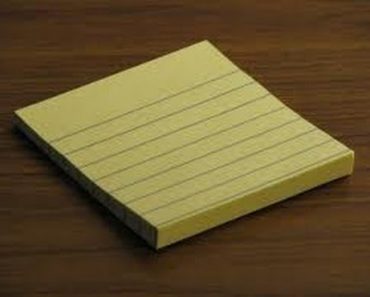
As I said in the video, today’s project is not a “prepper” project. Rather it is something I did to make carrying my business cards easier.
I just wanted to share how to make a DIY card pad with you in the event that it may make your life a little easier as well.
You see, I don’t like carrying business cards. This is because they get wrinkled and bent.
What this project does is connect them into a pad just like a notebook or memo pad. Something that may be of interest is
I have heard of a particular technology guru that buys sheets of two dollar bills from the US Treasury, has them perforated between bills, and then padding compound applied to make tear off pads of money – He likes the wow factor.
To make pads of business cards (or anything else), simply clamp your paper together so that it is stacked neatly and then apply a small amount of padding compound to one of the edges.
The instructions on the bottle say to use a brush, but I find it simple enough to use a finger.
Let dry and add a few more coats. I find three thin coats holds the cards stable, but does not make it extremely hard to remove them as needed.
I have a recipe for homemade padding compound if you want to use this in bulk.
This would be useful to bind printed off copies of information like in my Downloads section. Especially if you wanted a backup to electronic storage.
If your interested in seeing a video like this let me know, otherwise I will keep it in my “neat to know, but not something other people find interesting” pile.



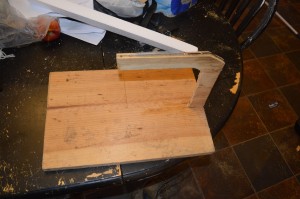


 With all the ice and snow lately a friend of mine sent me this idea for an improvised method to winterize a water spigot. I tried it and it works.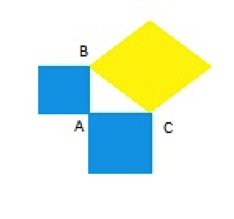

 Translated to a way I can use it – it means that since the angle at “A” is a 90 degree angle, the yellow box opposite it is has the same internal size as the sum of the other two boxes.

 As I said in the video, today’s project is not a “prepper” project. Rather it is something I did to make carrying my business cards easier.