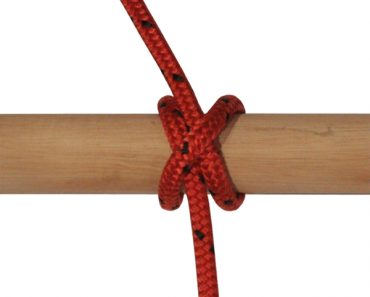
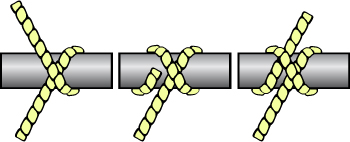
The Square Knot is one of the most well known knots. It is easy to tie and is useful for low strain ties.
While most people call this knot a square knot, in actuality the knot is names the reef knot.
The knot is popular among sailors, climbers, and gift wrappers for its convenience and ease of tying.
It is one of the simplest knots available, yet the square knot proves strong enough for most applications.
Easy to Tie and Untie
What I like best about it is, that if you grab one rope ends that are not under strain, and pull it back toward the knot, a properly tied square knot will untie itself.
Unfortunately, this makes it unreliable for climbing.
Reef Knot
Tying the Reef Knot:
Take two ropes and lay the right-hand rope over the other.
Wrap the right-hand rope under the left-hand rope.
Bring the right-hand rope back over the left-hand rope.
Next, pull the original right-hand rope over the other rope.
Pull the original right-hand rope under the other rope.
Since it can be slipped to tighten or loosen a line, and it also holds well under load, it is a great not for camping.
This makes it useful for lines that may need adjustment.
I learned it in the boy scouts and use it to tie tent and tarps to stakes, because it slides freely, yet jams under load, which makes adjustments easy.
Tying a Tautline Hitch
Make a turn around a post or other object several feet from the free end.
Coil the free end twice around the standing line working back toward the post.
Make one additional coil around the standing line on the outside of the coils just made.
Tighten the knot and slide it on the standing line to adjust tension.
The taut line hitch was the first knot I learned in the Boy Scouts (but I already knew the square knot from my dad). This knot is perfect for guy lines on tarps and tents.
I can think of 8 taut line hitch knots being used semi-permanently at the land – tying down the tarp at my campsite, and trying down a tarp on the back of the shed.
If you are involved in either sailing or rock climbing, it is likely you know the importance of the Figure Eight knot. It is used to stop ropes from running out of retaining devices.
Like the overhand knot, it will jam under strain, but unlike the Overhand, which often causes the rope to have to be cut, the figure of eight is usually more easily undone than the overhand knot.
Tying the Figure 8
Pass the tail over itself to form a loop.
Continue under and around the standing end.
Complete the knot by passing the tail down through the loop
Can also double the rope up and make a figure 8 on a bite to be used for anchoring rope.
When my dad taught me about mountaineering and repelling this was one of the first knots he had me memorize.
He told me that proper knots are more than just pretty. They were a sign of professionalism and knowledge. He said that proper knots did the job they were designed to do, and as a rule (with the double fisherman as an exception) were easier to untie than improper knots.
To this day, I cannot tie a load down without thinking of him.
There are a couple knots that everyone needs to know. The Clove Hitch is one such knot.
A clove hitch is used to tie a rope to a cylindrical object (like a fence post or tree). However, it is unreliable when tied on a square post.
What makes it useful is that if you feed the rope in from either end the knot will loosen. This makes it adjustable.
Basically it is just two half-hitches tied in a row
This knot is used a lot in lashing. I have actually thought about doing some how to lash articles. However, besides doing a tripod lashing article, I just haven’t gotten around to it in the manner I desire.
With this in mind, as the boy gets older I can video teaching him how to do it. That would work, as many of these videos are really for him anyway.
Tying a Clove Hitch
To tie a clove hitch at the end of a rope, pass the end around the pole starting at the right, with the end coming around below.
Next, put the end around in the same direction to cross over the standing end to be above the first loop.
Then, as the end comes around, put it under itself to be over the standing end.
Check that both ends are in the middle, emerging in opposite directions.
Finally, pull to tighten.
When pulled tighter, the rope passing over itself binds it in place.
I had an interesting childhood – my Dad and I were a lot alike, and when I was growing up he jumped with both feet into the world of rope courses – he single-handedly built several small courses in Tennessee which, coupled with his work as a Park Ranger fed my infatuation with survival techniques and self-reliance.
I spent a lot of time as a pre-teen and teenage years tying knots and lighting fires and I want to spend more time getting back to that as I learned a lot, had a lot of fun, and want to refresh my skills with you so I am ready when Tell gets big enough to keep the rope ends out of the dirt long enough for me to teach him.
I am going to start with the bowline, the bowline is one of the four basic maritime knots (along with the figure eight, reef knot, and clove hitch) and is a very simple knot used to form a fixed loop in the “bitter end” of a rope (the working end). It is an essential knot for an outdoorsman to know, especially if you climb or sail.
Like the majority of “good” knots, it is easy to tie and untie. Also like many good knots, if tied improperly it can collapse (capsize).
Anytime you tie a knot in a rope you reduce its strength through bending, the better the knot the less strength you lose, and a properly tied bowline retains about 65% of it’s strength. Because of this the FFA recommends to tie down light aircraft. More importantly, the bowline is commonly used as a rescue knot for conscious individuals that fell into holes or off cliffs. (because of this I will show you how to tie one using a single hand in-case you are injured or want to show off)
Procedure for Tying
Most people learn to tie a bowline using a mnemonic aid.
If you think of the end of the rope as a rabbit, the loop as the rabbit’s hole, and the standing end of the rope above the loop as a tree…
The rabbit comes up through the hole, round the tree from the right, and back down the hole.
It is very important that the loop is formed correctly, with the bitter end on the top of the loop.
If you reverse the loop (shown in the video) you will make an Eskimo bowline, then when the bowline is put under pressure the bowline will slip.
One Handed
If you have the rope secured so you can make it taut, you can tie this knot one handed.
Simply hold the bitter end in your hand.
Lay your palm on the top of the rope (the tendency is to use your wrist which is easier, but will probably trap your hand)
Twist your hand down on the left side of the rope, down, under and back up on the right side of the rope. This makes the loop.
Use your fingers to pass the rabbit around the tree from right to left.
While still holding the end of the rope, pull it and your hand through the loop
Tighten.
With practice you can do this easier than you can tie the rope one handed.
Let me know if you want to see more knot videos, I am probably going to do some anyway, but the detail and amount of will depend on you.

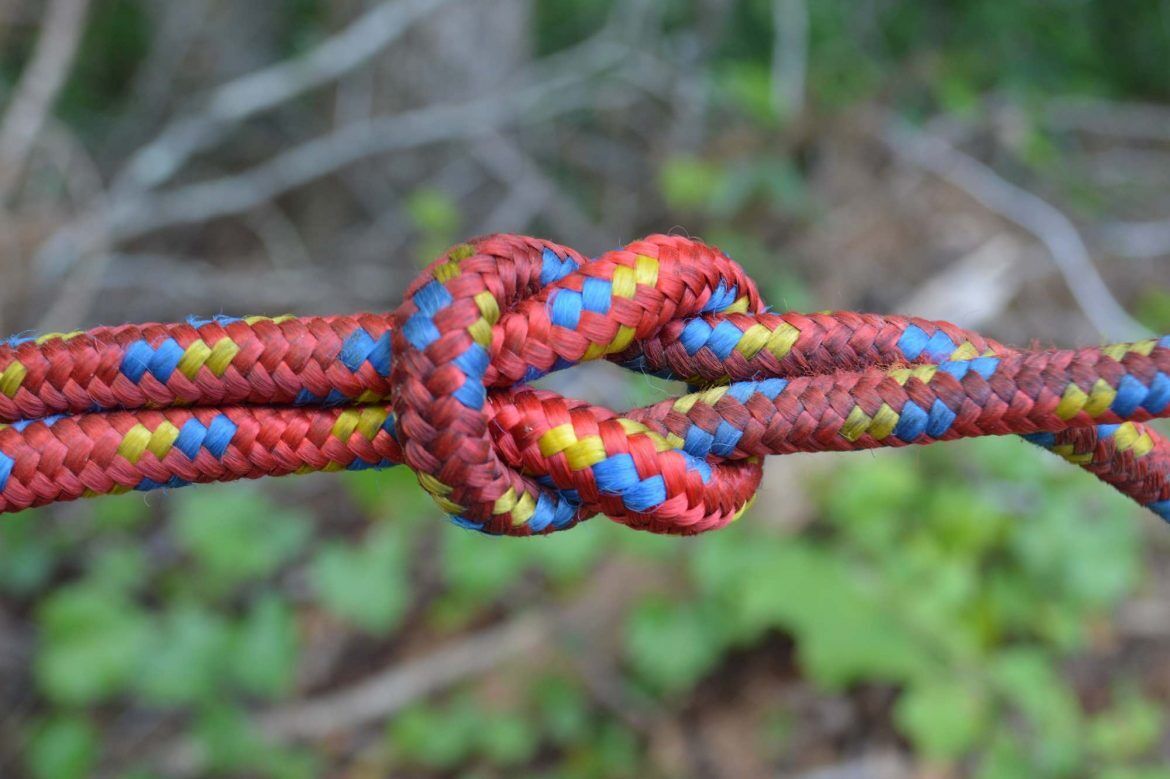


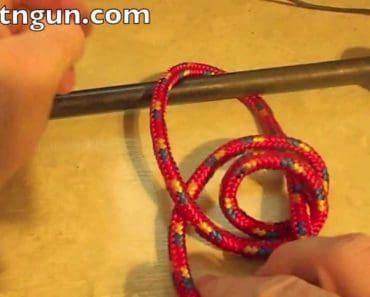
 Today’s knot is the Taut Line Hitch.